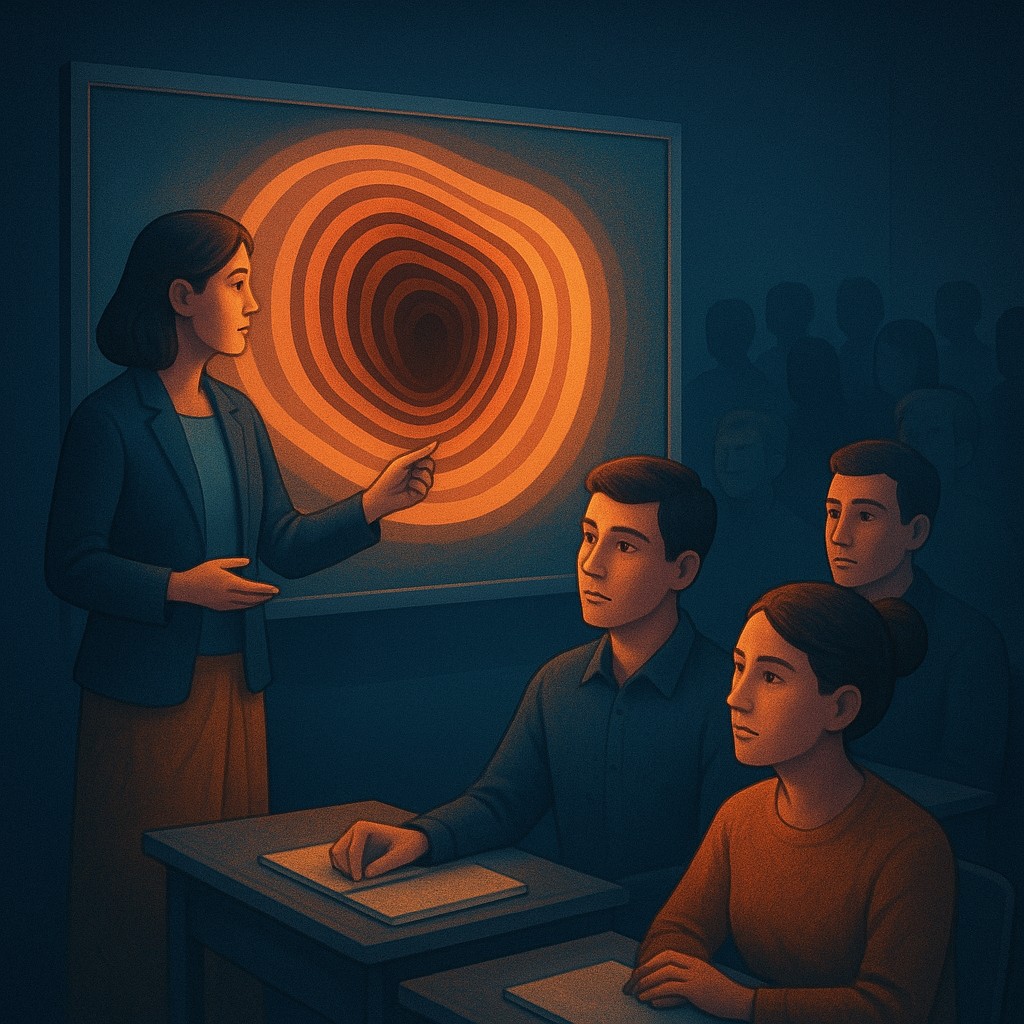
Think about the last time you sat in a meeting or a classroom while a speaker explained a concept that was as clear as mud. You scanned the room, hoping to see a confused expression or a raised hand, but everyone else looked perfectly calm. They were nodding along or taking notes with robotic speed. Fearing you were the only person in the room who didn't "get it," you kept your mouth shut. You might have even given a small, fake nod of your own just to fit in. Meanwhile, three seats away, your colleague was doing the exact same thing, convinced that your confident nod meant they were the only ones struggling.
This psychological hall of mirrors is a phenomenon called pluralistic ignorance. It happens when a group of people privately reject a specific rule or belief, yet go along with it in public because they wrongly assume everyone else truly supports it. It is a strange collective riddle: no one believes it, but everyone thinks that everyone else does. This creates a powerful, invisible drag that can keep outdated policies, harmful traditions, and confusing social standards alive long after they should have ended. By understanding how this engine works, we can learn how to tilt the mirror and reveal the truth hiding in plain sight.
The Mirage of the Majority
At its heart, pluralistic ignorance is a breakdown in how we communicate with others, but not in the way we usually think. It isn't just about people being "sheep" or following the crowd. Instead, it is a specific mental error. We use our own internal feelings (like doubt, discomfort, or confusion) to judge ourselves, but we use other people’s outward behavior to judge them. Because we cannot read minds, we see the calm, composed faces of those around us and assume those faces match how they feel inside. We conclude that since we are the only ones feeling uneasy, we must be the odd one out.
This creates a loop that feeds itself. When you decide to hide your private doubts to avoid embarrassment, you provide the very "proof" that others use to justify their own silence. You are looking to them for a signal, and they are looking at you. If everyone is looking for a signal that doesn't exist, the group stays trapped in a fake agreement. This is different from simple peer pressure, where you know you disagree but feel forced to change your mind. In pluralistic ignorance, you don't necessarily feel forced; you just feel like you are the only one who can see that the emperor has no clothes.
The Mental Trap of Social Comparison
To understand why our brains fall for this, we have to look at how we compare ourselves to others. Humans are wired to look to those around us for cues on how to act, especially in confusing situations. In social psychology, this is often called "informational social influence." If you see a crowd running away from a building, you don't stop to check for smoke; you start running. This is a survival instinct. However, in the case of pluralistic ignorance, this instinct backfires. The situation isn't an actual emergency, but a social performance.
Psychologists Deborah Prentice and Dale Miller famously studied this on college campuses regarding drinking habits. They found that most students privately felt much more uncomfortable with "binge drinking" than they let on. However, because they saw their peers partying, each student assumed they were the "weird" one who couldn't handle the lifestyle. The result was a campus culture where the average student drank more than they actually wanted to, simply because they thought that was what it took to be "normal." The perceived social rule was a ghost, a statistical phantom that lived in everyone's head but belonged to no one.
Distinguishing the Layers of Social Disconnect
It is easy to confuse pluralistic ignorance with other social patterns, such as the "Bystander Effect" or "Groupthink." While they all involve groups making poor decisions, the underlying causes are different. To help clarify where pluralistic ignorance fits into social psychology, here is how it compares to other common group behaviors.
| Phenomenon |
Personal Feeling |
Perceived Group Feeling |
Outcome |
| Pluralistic Ignorance |
Individual rejects the norm. |
Belief that everyone else truly accepts it. |
The norm continues despite a lack of real support. |
| Peer Pressure |
Individual rejects the norm. |
Awareness that others are pushing for it. |
The person gives in to avoid being punished or left out. |
| Groupthink |
Desire for harmony outweighs logic. |
Belief that the group is morally or intellectually right. |
Critical thinking is buried to keep the peace. |
| Bystander Effect |
Confusion or fear in an emergency. |
Assumption that others' inaction means help isn't needed. |
No one acts because no one else is acting. |
As the table shows, the core of pluralistic ignorance is a misunderstanding of what others actually think. In Groupthink, members might actually talk themselves into believing a bad idea is good. In pluralistic ignorance, everyone knows the idea is bad, but they think they are the only ones who know it. This makes it especially dangerous because it creates a "silent majority" that is paralyzed by its own silence.
The High Cost of Staying Quiet
The consequences of this phenomenon go beyond awkward meetings or college parties. Pluralistic ignorance can have devastating real-world effects on public health, business ethics, and environmental policy. For example, in some companies, a "work-horse" culture might exist where everyone stays late at the office every night. Privately, every single employee might value their family time and feel burnt out, but because the bosses and managers stay late, everyone assumes that "this is what it takes to get ahead."
This can lead to a total collapse of well-being. People stop suggesting ways to improve work-life balance because they don't want to seem "lazy" compared to the supposed dedication of their peers. This also appears in social justice movements. History is full of times when most citizens privately disagreed with a discriminatory law or a corrupt government. But because the public conversation was dominated by a loud minority or state propaganda, individuals believed they were alone in their dissent. This "spiral of silence" can keep oppressive systems in power for decades.
Turning the Tide through Transparency
If the problem is a lack of accurate information about what others are thinking, the solution is simple in theory, though hard in practice: transparency. To break the spell of pluralistic ignorance, someone has to be the first to admit they are lost or that they disagree. This is why "psychological safety" is a popular term in modern leadership. If a workplace allows one person to say, "I'm a bit lost, does anyone else feel this way?" it often starts a wave of "Me too!" responses that shatters the fake consensus instantly.
Leaders can use specific tools to get around this mental trap. Anonymous polling is perhaps the best weapon against pluralistic ignorance. When people can share their true feelings without fear of being judged, the gap between what people say and what they actually believe becomes clear. For example, a leader might ask a room, "How many of you think this project deadline is realistic?" and see every hand go up. But if they use an anonymous digital poll, they might find that 80 percent of the room thinks the timeline is a disaster. Seeing those results on a screen gives everyone the "permission" to speak up because they realize they aren't alone.
The Power of the First Brave Voice
Breaking free from pluralistic ignorance requires a mix of self-awareness and courage. We have to learn to trust our own internal compass even when everyone else seems to be heading in a different direction. We must remind ourselves that humans are master performers. Just because someone looks like they have it all figured out doesn't mean they aren't struggling with the same doubts we are. By questioning a "perfect" agreement, we often discover that the walls holding a stale tradition in place are actually made of paper.
When you find yourself in a situation where something feels "off" but everyone else is going along with it, remember how this works. Your silence is the brick that builds the wall of someone else's isolation. By speaking up, you aren't just helping yourself; you are setting the whole group free. It only takes one person to point out that the emperor has no clothes for the rest of the crowd to realize they were all seeing the same thing. In doing so, you turn a group of isolated people into a real community, connected by truth rather than a shared, silent misunderstanding.