Why helium matters more than party balloons and floating dreams
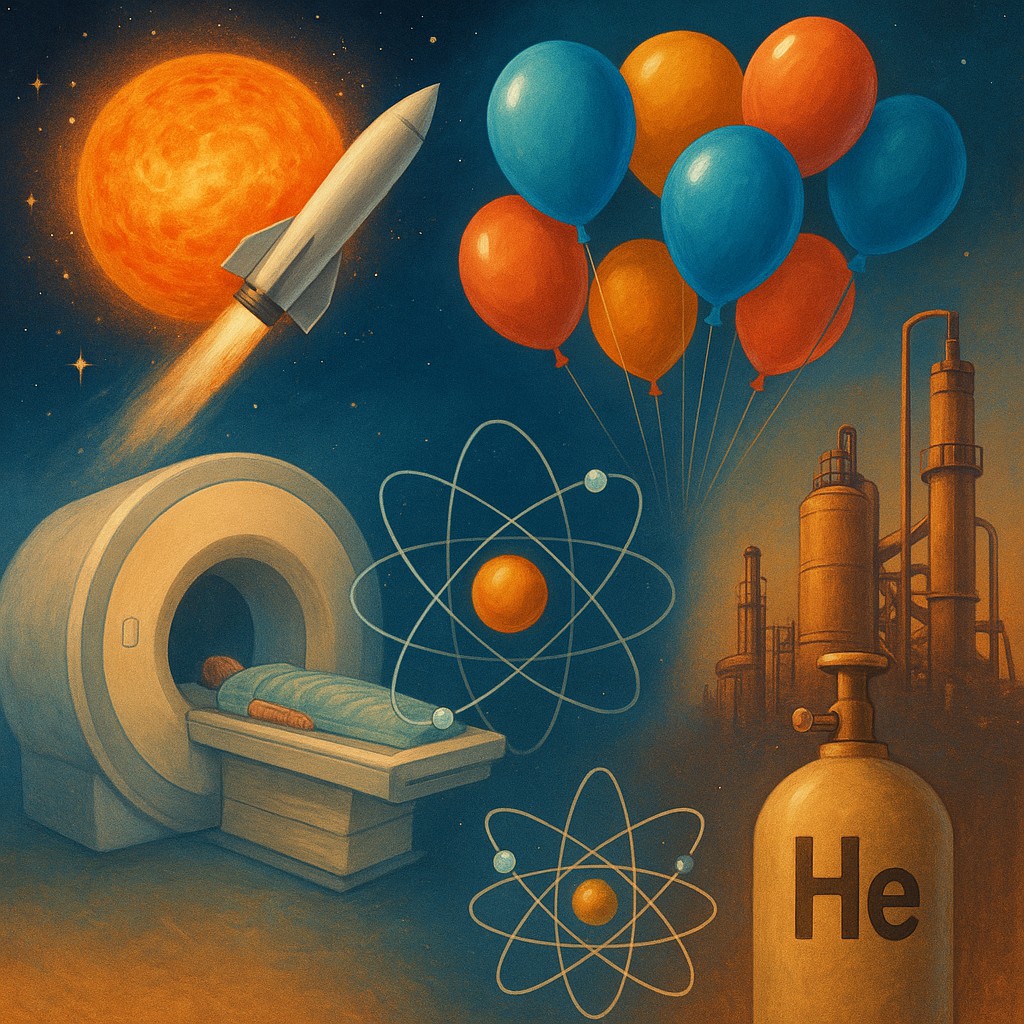
Imagine a tiny, invisible gas that helped the first rockets leave the ground, keeps MRI machines humming, makes party balloons harmlessly float, and is slowly slipping away from our practical reach. That gas is helium, and despite its lighthearted public image, it plays a quiet but critical role in modern technology, medicine, and scientific discovery. Learning about helium is like following a secret thread through geology, physics, industry, and policy, and when you pull on it you find surprising connections that affect everything from cancer diagnosis to the future of quantum computing.
Helium is unusual in many ways. It is the second lightest and second most abundant element in the universe, yet it is quite rare in the Earth’s atmosphere and on our planet overall. This odd distribution leads to interesting questions: where does helium come from, why does it accumulate in some places but not others, and how do people extract and use it without running out? Answering those questions will take us from the atomic heart of stars to the bowels of natural gas fields and into labs where scientists are coaxing out new technologies.
Along the way we will dispel myths, such as the idea that helium is simply an endless, free resource because it floats away into space. We will also see why helium is expensive and strategically important, and what steps industry and researchers are taking to conserve and recycle it. By the end of this Learning Nib you will not only understand the science behind helium, you will be able to explain why a shortage matters and how extraction works in practice.
Ready to don a lab coat of curiosity and follow helium’s trail from stars to hospital corridors? Let us start with the atomic story, because the origin of helium is a stellar drama.
From starlight to gas wells - where helium comes from
Helium begins its life in the hearts of stars. In the cores of main sequence stars, hydrogen atoms fuse to form helium through nuclear fusion, releasing energy that makes stars shine. On an even grander scale, heavier cosmic events such as supernovae and cosmic ray interactions also create helium and its siblings. In the vastness of space helium is abundant, forming a major component of many stars and the interstellar medium.
On Earth the story is different and more local. Helium that we can use is primarily produced by the radioactive decay of heavy elements in the Earth’s crust, especially uranium and thorium. As these unstable elements decay, they emit alpha particles, which are essentially helium nuclei. Over time, these nuclei pick up electrons and become neutral helium atoms that can migrate through rock. If the geology is right, helium will accumulate in subsurface reservoirs, often trapped with natural gas.
This accumulation requires a fortuitous combination of factors: a source rock rich in uranium or thorium producing helium, a porous reservoir rock where gas can collect, and an impermeable cap rock that will trap the gas over geological time. Not every place with radioactive decay ends up with helium deposits, which explains why helium is locally concentrated but globally scarce on Earth. That scarcity is the heartbeat of why extraction and stewardship matter.
What helium is like - the useful oddball element
Helium is element number 2 on the periodic table, a noble gas that is colorless, odorless, tasteless, and chemically inert under ordinary conditions. Its lightness makes it float when inside balloons, but its true value comes from physical properties rather than party tricks. Helium has the lowest boiling point of any element, at about -269 degrees Celsius, meaning it is the coldest liquid available for practical use. This extremely low temperature makes liquid helium the go-to refrigerant when researchers need to reach millikelvin temperatures for superconductivity and quantum devices.
Another useful trait is helium’s low solubility and small atomic size, which makes it a great tracer in geology and a useful carrier gas in gas chromatography. Because it is nonreactive, helium won’t alter delicate chemical samples or support combustion, which is why it is used in some welding applications and in controlled atmospheres. Its low density also means helium affects sound by changing the speed of sound in air, creating the familiar squeaky voice effect when inhaled. That trick is amusing, but inhaling helium for voice effects is risky and should be avoided.
To keep these points straight, here are some practical properties that explain helium’s uses: very low boiling point, inertness, small atomic radius, and low density. Each of these contributes to different technological needs, from cooling MRI machines to enabling leak detection in vacuum systems.
How humans extract helium from the earth - methods and real-world practice
Most commercial helium is not mined from the air but separated from natural gas. Some natural gas fields contain significant concentrations of helium, from a fraction of a percent up to several percent. The main commercial method is cryogenic separation, where natural gas is cooled and processed to remove components like water, carbon dioxide, and hydrocarbons, leaving a stream enriched in helium that can be further purified. This requires sophisticated processing plants and cryogenic equipment to reliably separate gases with similar physical properties.
There are also a few helium-only wells where the gas pressure and composition are such that helium can be produced directly, though these are rare. Another method is pressure swing adsorption and membrane separation, often used to concentrate helium when cryogenic methods are less efficient. In addition, some industries capture helium as a byproduct of refining or other processes. Each extraction method has trade-offs in energy use, cost, and purity obtained, which helps explain the price and logistics of helium supply.
After capture, helium is purified to very high levels - often 99.999 percent purity for many applications - and stored in high-pressure cylinders or transported as a liquid in specialized insulated vessels. Because helium is so small and unreactive, it can leak through seals that would hold other gases, so the infrastructure for storage and transport must be carefully designed and maintained. The costs of building and running these systems, along with limited natural reserves, drive the economics and policy debates around helium.
How helium is used today - the surprising breadth of applications
Helium’s uses are broad and sometimes surprising. In medicine, liquid helium cools the superconducting magnets in MRI machines, enabling noninvasive imaging that is essential for diagnosis worldwide. In the semiconductor and quantum computing industries, helium environments and cryogenic cooling are critical for operating superconducting circuits and maintaining ultra-stable conditions. Scientific research relies on helium for low-temperature physics, particle detectors, and space instruments.
Some everyday industrial uses include leak detection, where helium’s small atomic size makes it perfect for finding tiny leaks in vacuum systems, pipelines, and aerospace components. Helium is used as a protective gas in welding, in high-pressure breathing mixtures for deep-sea divers, and as a carrier gas in gas chromatography instruments. The entertainment world finds it in party balloons and blimps, but those uses are small compared to the scientific and industrial demand.
To visualize the role of helium, think of it as a specialized tool rather than a generic utility. A hospital MRI magnet or a quantum computer cannot easily be substituted without redesign, so availability of helium has direct implications for healthcare and advanced research. That reality is why conservation and recycling of helium are increasingly emphasized.
Quick comparison table - helium isotopes and common uses
| Topic |
He-4 (most common) |
He-3 (rare, special) |
| Natural abundance on Earth |
Vast majority of terrestrial helium |
Extremely low, trace amounts |
| Main production source |
Radioactive alpha decay in crust, trapped in gas fields |
Primarily from nuclear reactions, small byproduct from tritium decay in reactors |
| Key properties |
Very stable, low boiling point, used widely for cooling and leak detection |
Even lower neutron absorption, useful for low-temperature physics and neutron detection |
| Typical uses |
MRI cooling, cryogenics, pressurizing, leak detection, gas chromatography |
Dilution refrigerators for mK cooling, neutron detectors, scientific research |
| Availability |
Commercially produced and traded, constrained |
Very rare and expensive, strategic resource |
Myths and misunderstandings about helium, corrected
There are several persistent myths worth busting. First, inhaling helium is harmless fun. In small amounts it changes your voice, but it also displaces oxygen and can cause asphyxiation if misused, so avoid inhalation as entertainment. Second, because helium floats away to space there is an infinite supply. While helium does leak from the atmosphere into space over geological timescales, the helium used commercially comes from geological sources produced by radioactive decay, which are finite and not instantly renewable.
Another misconception is that helium can be cheaply synthesized or replaced by another gas. Creating helium artificially through fusion is not practical for industrial supply, and no other gas combines helium’s suites of properties for many applications, especially its extremely low boiling point and inertness. Finally, some people think recycling is impossible for helium. In fact, recycling and recapture systems are increasingly used in hospitals and research labs to conserve helium and reduce costs, though perfect recovery is technically challenging.
Economics, scarcity, and the global supply chain
Helium markets are small compared to oil or metals, but they are crucial for niche high-value technologies. Supply tends to be concentrated: a few countries and companies control significant portions of extraction and refining capacity. Historically, this has led to price volatility when major supply sources go offline or when demand spikes. Strategic reserves - such as the United States Federal Helium Reserve created in the 20th century - have influenced the market and policy decisions, and changes in their availability can ripple through global supply and pricing.
Because helium is often a byproduct of natural gas, shifts in natural gas exploration and pricing affect helium availability. New helium-specific exploration and recycling efforts are emerging to diversify supply, but building the infrastructure for extraction and purification requires investment and stable market signals. Policymakers and industry are now focused on balancing commercial interests with the larger societal need to ensure helium remains available for medicine, science, and critical industry.
How helium extraction works, step by step
Helium extraction from natural gas is a sequence of processes that transform raw wellhead gas into high-purity helium. First, the raw gas is dehydrated and pretreated to remove water vapor and condensable hydrocarbons that could freeze during cooling. Next, the gas undergoes cryogenic liquefaction and fractional distillation where methane, nitrogen, and other components are separated based on boiling points. Helium remains in the gas phase longer and can be concentrated through additional low-temperature separation steps.
After concentration, helium is purified through adsorption, membrane filtration, or additional cryogenic distillation to remove trace impurities like neon or hydrogen. The purified helium is either compressed into cylinders as a high-pressure gas or cooled into liquid helium for transport. Each step involves careful thermal management and materials that can cope with very low temperatures and prevent leaks. Finally, the entire process is monitored for safety and efficiency, with recycling and recovery systems increasingly integrated to reduce losses.
Safety, environmental impact, and best practices
Helium itself is nonflammable and chemically inert, making it safe in many contexts, but safety concerns come mainly from asphyxiation risk and pressurized storage hazards. In enclosed spaces, helium can displace oxygen and create suffocation hazards, so proper ventilation and oxygen monitoring are important in industrial settings. High-pressure gas cylinders must be handled carefully to avoid mechanical accidents, and cryogenic liquid helium poses cold-burn and materials brittleness risks.
Environmental impacts of helium are mostly indirect, tied to natural gas extraction and energy use during cryogenic processing. More efficient processing, recovery systems, and the use of renewable energy for processing can reduce the environmental footprint of helium production. Recycling helium from MRI boil-off and industrial processes is both an economic and environmental best practice, and many institutions now adopt helium management programs to track and capture losses.
Emerging technologies and the future of helium
The future of helium is linked closely to advanced technologies that are currently in their infancy or scaling up. Quantum computing, superconducting electronics, and certain types of sensors require ultra-low temperatures that rely on helium-based cryogenics. Research into helium-3 and dilution refrigerators is pushing physics into new regimes, potentially enabling breakthroughs in materials science and computation. At the same time, alternatives such as closed-cycle cryocoolers reduce dependence on liquid helium for some applications, offering routes to conservation.
Exploration for new helium-rich fields, helium extraction from air via membranes, and industrial-scale recycling could expand supply if economically viable. Policy measures such as strategic stockpiles, international cooperation, and incentives for conservation are also likely to play a role in shaping helium’s availability. The balance of demand from medical, industrial, and scientific sectors will determine investment incentives, and that means the next decade will be important for securing helium for critical uses.
Practical tips for conserving helium and what you can do
If you care about sustaining helium for scientific and medical needs, small actions add up. Avoid frivolous uses like releasing helium balloons outdoors, where they either litter or contribute to supply waste. If you work in a lab or hospital, support helium recovery systems and protocols that capture boil-off and recycle gas where possible. Advocating for responsible policies and funding for helium recycling in your institution can make a measurable difference.
For hobbyists, consider alternatives: use air-filled balloons for decoration, or use reusable materials. If you are a student or professional entering fields that use helium, learn about cryogenics and gas handling best practices so you can design systems that minimize losses. Individual behavior matters less than institutional decisions, but public support for conservation and smarter use feeds into policy and market choices that affect availability.
Parting encouragement - small knowledge, big impact
Helium may seem like an inconspicuous part of the periodic table, but its story connects stars and rocks to hospitals and high-tech labs. Understanding where helium comes from, how it is extracted, and why it matters helps you see why conservation and smart policy are not abstract concerns but concrete actions that protect crucial technologies. The next time you hear a squeaky voice, think of the science and supply behind it, and perhaps let that small spark of curiosity turn into advocacy or smarter choices.
You are now equipped with a clear mental map of helium: its stellar origin, formation in the Earth, extraction techniques, everyday and cutting-edge uses, common myths debunked, and practical steps for conservation. Keep this knowledge handy, share it with someone who thinks helium is just for balloons, and use it to make small choices that collectively help preserve a tiny element with outsized importance.