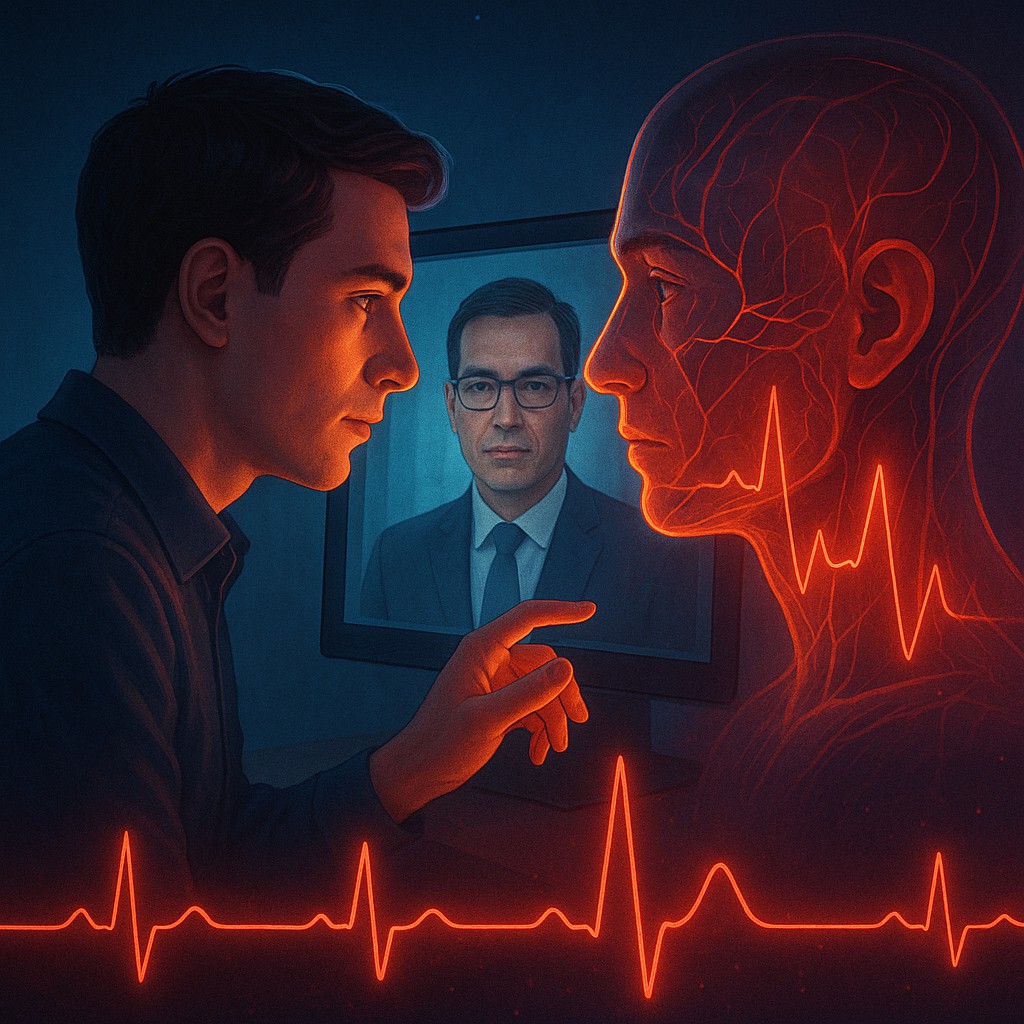
Imagine for a moment that you are on a high-stakes video call with your company’s Chief Financial Officer. The voice is unmistakable, the mannerisms are spot on, and even that slight squint they make when weighing budget projections is perfectly captured. You are seconds away from authorizing a multi-million dollar transfer when a tiny, invisible red flag pops up on your security software. It is not triggered by a glitch in the audio or a smudge in the pixels, but by a startling realization: the person on the other end of the camera doesn't have a pulse. Or rather, their face isn't "blushing" in time with a human heart.
In our modern digital world, the line between "real" and "rendered" has become a thin, blurry smudge. Generative AI has reached a point where it can mimic lip movements, the glint of light in an eye, and the specific rhythm of a human voice with terrifying accuracy. We have moved past the era of "uncanny valley" deepfakes where the eyes looked like dead glass. Today’s fakes are vibrant, fluid, and convincing. To catch them, security experts are no longer looking at what the AI shows us, but at what the AI often forgets to include: the subtle, biological rhythms of a living, breathing body. We are entering the era of the heartbeat as a digital watermark.
The Secret Language of Your Skin
To understand how we can "see" a heartbeat through a computer screen, we first have to understand a process called photoplethysmography, or PPG. While that sounds like a word designed for a spelling bee, the concept is beautifully simple. Every time your heart beats, it pushes a fresh wave of oxygen-rich blood through your body. When that blood reaches the tiny vessels just beneath the surface of your face, it causes a microscopic change in how your skin absorbs and reflects light.
As your heart pumps, your face actually undergoes minute color changes. You cannot see this in the mirror because the change is too fast and too subtle for the human eye to catch. However, to a high-definition camera and a smart computer program, your forehead and cheeks are essentially flashing like a very dim, rhythmic neon sign. By analyzing these "blood flow fluctuations," detection tools can map out a pulse wave that matches the rhythm of a human heart. This isn't just a trick of the light; it is a direct biological signal of life.
Deepfake programs are generally trained on massive sets of images and videos to copy how people look and move. They are masters of the surface. They know how a mouth should move to form the letter "F" and how shadows should shift when a head turns. But these AI models don't typically "know" that a human face is a living organ powered by a pump. Because they aren't simulating a circulatory system, they don't produce those rhythmic color shifts. When a detector looks at a deepfake, it sees a face that is perfectly still at the microscopic level, a digital mask that is "biologically silent."
Comparing the Digital Mask to the Living Face
The difference between a sophisticated AI and a human being often comes down to the "messiness" of biology. While AI seeks perfection through smooth textures and consistent lighting, humans are a chaotic symphony of pulses, twitches, and chemical reactions. These differences provide the foundation for the next generation of cybersecurity. If we compare the two across several key markers, we can see why blood flow is becoming such a vital tool for verification.
| Feature |
Authentic Human Video |
AI-Generated Deepfake |
| Color Fluctuations |
Present; rhythmic changes in skin tone synced to heart rate. |
Absent; skin tone is mathematically consistent or "static." |
| Micro-Expressions |
Spontaneous, tiny muscle movements often tied to emotion. |
Calculated; often repeated or missing secondary muscle cues. |
| Pulse Consistency |
Variable; heart rate changes slightly with speech or stress. |
Non-existent; no internal "clock" governing skin color. |
| Light Interaction |
Light reflects off layers of skin, including blood beneath. |
Light is rendered on a surface without internal depth. |
| Blinking Patterns |
Irregular and subconscious. |
Historically predictable, though improving in newer models. |
As the table suggests, the primary weakness of early and mid-tier AI models is their lack of an "internal engine." They are effectively puppets. You can make a puppet look like a person, but you cannot easily give it a functioning circulatory system that interacts with light in real-time. This realization has shifted the "arms race" between hackers and security experts. Instead of looking for glitches in the pixels, we are now looking for the presence of life itself.
The Invisible Pulse in Your Pixels
The way these detection tools work in practice is nothing short of technological sorcery. When you join a video call protected by this tech, the software divides your face into many small zones. It might focus on your forehead, your cheeks, and your chin, as these areas tend to show more blood flow activity. The software then ignores the actual "image" of your face and instead looks at the raw color data, specifically the green channel, which carries the strongest pulse signal.
By tracking the intensity of these colors over several seconds, the system can extract a wave. If that wave looks like a jagged, rhythmic "thump-thump" pattern, the system gives a green light. If the signal is a flat line or contains random digital noise that doesn't match a human heart rate, the alarm bells go off. What makes this so powerful is that it is incredibly difficult for a deepfake to fake this in real-time. To spoof a pulse, the AI would not only need to create your face, but it would also need to apply a transparent, pulsing color layer that perfectly matches the lighting of your room and the movements of your head.
This technique, often called "Remote PPG" or rPPG, is being built into high-stakes environments. Banks, government agencies, and even dating apps are looking at rPPG to ensure the person on the other end is "alive and present." It is an elegant solution because it doesn't require the user to do anything. You don't have to hold up an ID or perform a "liveness check" like turning your head or blinking on command. You just have to sit there and let your heart do the work of proving you are you.
The Challenge of Designing a Heartbeat
Of course, the villains in this story are not sitting idly by. As soon as word got out that security researchers were using heartbeats to catch fakes, advanced AI developers began trying to build "synthetic pulses" into their models. Recent research has shown that it is technically possible for a deepfake to mimic a heartbeat signal. If the AI "knows" it is being tested for a pulse, it can be programmed to make the skin color pulse at 70 beats per minute.
However, simulating a heartbeat is much harder than it sounds. A real human pulse isn't a perfect, mechanical clock. It fluctuates based on what you are saying, how you are breathing, and how nervous you are. If you are lying or excited, your heart rate climbs. If the AI displays a perfectly steady, unchanging 60 beats per minute while you are giving an impassioned speech, the detector can still flag it as suspicious. This has led to a more localized approach to detection. Researchers are now looking at how blood flows across different parts of the face. In a real human, the pulse doesn't hit the forehead and the chin at the exact same micro-second; there is a tiny, measurable delay as the blood travels. An AI that just "blinks" the whole face red and white will fail this check.
This is the beauty of biological signals. To truly fool a blood-flow detector, an AI would need to simulate a full human heart and lung system, complete with fluid movements and real-time emotional responses. Every layer of complexity we add makes it more expensive and difficult for bad actors to create convincing fakes. We are essentially forcing the AI to become "too human" to be profitable for a standard scammer.
Challenges and the Shadow of Doubt
While blood-flow detection is a massive leap forward, it isn't a magic wand that solves the deepfake problem overnight. Like any technology based on light and sensors, it has its weaknesses. For the software to see those tiny color changes, it needs a clear, well-lit view of your skin. If you are sitting in a dark room, or if you have a low-quality webcam from ten years ago, the "noise" in the video might drown out the pulse signal.
This creates a high risk for "false negatives" or, even worse, "false positives." A false positive occurs when the software looks at a real human being and says, "I don't see a heartbeat; this is a fake." This can happen if the lighting flickers, like from a cheap LED bulb, or if the person has very dark skin, which can sometimes make the light reflection harder to pick up for certain unoptimized programs. Developers are working hard to ensure these tools are inclusive and work well for everyone, regardless of skin tone or environment, but we aren't quite there yet.
Furthermore, there is the issue of video compression. Platforms like Zoom or Microsoft Teams shrink video files to save data. This often "smooths out" the very details we need to see the pulse. If the video quality drops too low, the heartbeat effectively disappears into a sea of blurry pixels. Therefore, heartbeat detection is currently most effective in high-speed, high-security environments rather than your average casual chat over spotty Wi-Fi.
The Future of Digital Trust
Looking ahead, we are likely to see a "multi-layered" approach to verifying identity. We won't just rely on blood flow; we will combine it with other biological signatures that AI finds difficult to copy. This might include tracking how your pupils change size in response to the light from your screen, or the way your eyes make tiny, involuntary twitches as you read a sentence.
We might even see the rise of "challenge-response" biological checks. Imagine a security system that briefly changes your screen color to a bright blue and then checks to see if your skin reflects that specific blue light in a way that fits human tissue. Because an AI is just projecting an image, it might struggle to react instantly to a change in room lighting it didn't expect. By turning the computer screen itself into a scientific instrument, we create a "biological sandbox" where only a real human can play.
This transition is about more than just security; it is about reclaiming our sense of reality. In a world where we can no longer trust our eyes, we have to start trusting the science of life. The fact that our very biology provides a "built-in" security code is a fascinating reminder of how complex we truly are. Even in the face of the most advanced digital intelligence ever created, the simple, rhythmic thumping of a human heart remains one of the most difficult things in the universe to fake.
As you navigate this increasingly digital world, take a moment to appreciate the "noise" of your own existence. Those tiny pulses in your fingertips, the slight warmth in your cheeks when you laugh, and the rhythmic beat in your chest are more than just life signs; they are your ultimate digital credentials. The next time you log into a video call, remember that you are carrying a biological watermark that no computer program can perfectly mirror. In the battle between the fake and the real, your own blood flow is the ultimate truth-teller, ensuring that even in a world of ghosts and shadows, the human element remains unmistakable.