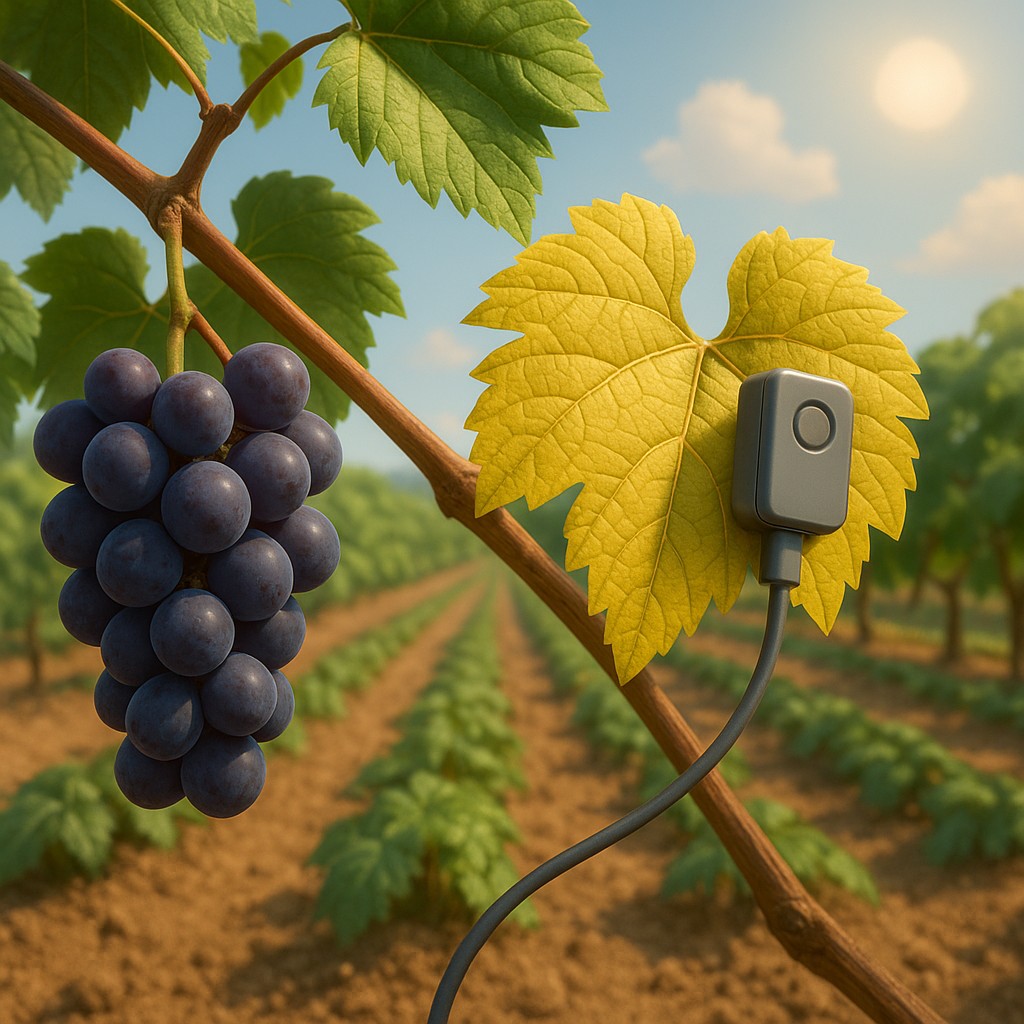
Imagine you are a grape on a vine under the blistering California sun. Your roots are buried several feet deep, and while the dirt there might be slightly damp, your internal reality is a different story. The sun is pulling water out of your leaves faster than your internal plumbing can keep up, causing your once-firm cells to go floppy. In the world of traditional farming, a person might walk by, stick a probe in the ground, see that the soil is "fine," and keep walking. Meanwhile, you are experiencing a cellular crisis. You are thirsty, stressed, and your fruit quality is beginning to slip. But because the dirt is damp, no one is coming to save you.
This disconnect between the soil and the plant is the central challenge of modern agriculture. For decades, we have watered the earth rather than the organism. We treat the ground as a giant reservoir, hoping that if we keep it full enough, the plants will manage. However, plants are not passive straws sticking out of the mud; they are complex biological systems that regulate their internal pressure with the precision of a Swiss watch. We are finally entering an era where we can stop guessing what the soil wants and start listening to what the plant is actually saying. By using leaf turgor sensors, crops are essentially gaining the ability to text their farmers for a drink exactly when their internal biology demands it.
The Hidden Engine of Leaf Turgor Pressure
To understand how a plant "speaks," we have to look at the concept of turgor pressure. Think of a plant cell like a sturdy cardboard box with a balloon inside. When that balloon is full of water, it presses against the walls of the box, making the entire structure rigid and strong. This internal hydraulic pressure is what allows a sunflower to stand tall or a blade of grass to pierce through a crack in the sidewalk. When a plant has high turgor pressure, its cells are "turgid," and its metabolic engines are humming at maximum efficiency. This pressure is also what drives cell expansion, which is simply another way of saying "growth."
When water becomes scarce, or when the air is so dry that the plant loses water through its leaves faster than it can pull it up from the roots, that internal balloon starts to deflate. This is the first stage of wilting. While we usually only notice wilting when a plant looks like a sad, soggy noodle, the physiological damage starts much earlier. Long before the plant physically droops, the drop in turgor pressure signals the plant to close its stomata, which are the tiny pores on the leaves used for breathing. Once those pores close to save water, the plant stops taking in carbon dioxide, meaning photosynthesis grinds to a halt. The plant isn't just thirsty; it is effectively holding its breath and starving.
By the time the soil looks dry enough for a farmer to notice, the plant has often been in this "starvation mode" for hours or even days. This creates a cycle of stress that limits the size of the harvest and the sweetness of the fruit. Turgor sensors change the game by measuring this internal pressure in real time. Using tiny, gentle clips that attach to a single leaf, these sensors use ultrasonic pulses or magnetic pressure plates to detect microscopic changes in leaf thickness and rigidity. They monitor the pulse of the plant's hydraulic system, providing a live data feed of its metabolic health.
Beyond the Mud: Why Soil Sensors Aren't Enough
The tradition of monitoring soil moisture is logical, but it is an indirect measurement that often leads to "luxury consumption." In agricultural terms, luxury consumption happens when a plant is given far more water than it actually needs to grow. Because farmers want to avoid the risk of crop failure, they often over-saturate the soil. This does more than just waste water; it can actually hurt the plant by drowning the roots, washing nutrients out of the soil, and encouraging fungus growth. It is the equivalent of force-feeding someone a gallon of water every hour just to make sure they never get thirsty.
Soil sensors are also notoriously "patchy." In a single ten-acre field, the soil composition can vary wildly. One corner might be heavy clay that holds water like a sponge, while another corner is sandy and drains in minutes. A soil probe placed in the clay might tell the irrigation system that everything is fine, while the plants in the sandy patch are dying of thirst. Leaf turgor sensors bypass this "dirt lottery" by focusing on the only thing that actually matters: the biological state of the crop itself. If the plant is stressed, it doesn't matter what the soil says.
| Feature |
Traditional Soil Monitoring |
Leaf Turgor Monitoring |
| Measurement Focus |
Environmental (the dirt) |
Biological (the plant) |
| Data Accuracy |
Indirect and often delayed |
Direct and real-time |
| Water Efficiency |
High risk of over-watering |
Minimizes "luxury consumption" |
| Stress Detection |
Detects lack of water in ground |
Detects cellular stress in seconds |
| Automation Link |
Based on moisture thresholds |
Based on metabolic demand |
By switching the focus to the plant, we move from a reactive model to a proactive one. If a sudden heatwave hits, the leaf turgor will drop long before the soil dries out. The sensor detects this drop and triggers the irrigation system immediately. Conversely, on a cool, cloudy day when the plant is perfectly happy with very little water, the system stays off, even if the soil isn't "saturated." This precision can reduce water usage by up to 30%, which is a staggering figure when applied to industrial-scale farming.
Converting Biological Pressure into Digital Signals
The technology behind these clips is a triumph of miniaturization and biophysics. One of the most common methods involves clamping two small sensors onto a leaf. These sensors do not hurt the plant; they are light enough that they don't interfere with the leaf’s ability to move or catch the sun. One side of the clip emits a tiny amount of pressure or an ultrasonic signal, and the other side measures how much of that signal makes it through the leaf tissue. As the plant loses water and its turgor pressure drops, the leaf becomes more compressible or changes how it vibrates.
These micro-measurements are then converted into a digital signal and sent via a cellular network to a central hub. This is the "texting" part of the process. The farmer receives an alert on their phone, or even better, the hub talks directly to the irrigation controller. The system functions like a thermostat for a house. Instead of turning the heater on at 8:00 AM every day regardless of the temperature, the turgor sensor turns the water on only when the internal pressure falls below a specific set point.
This granular control allows for something called "Precision Deficit Irrigation." In the world of high-end winemaking, for example, a little bit of stress is actually a good thing. If you give a grapevine too much water, it spends all its energy growing big, green leaves. If you strategically withhold just the right amount of water, the plant panics slightly and puts all its resources into making its grapes sweeter and more flavorful to ensure its seeds survive. Turgor sensors allow vine growers to walk that razor-thin line, keeping the plant stressed enough to produce world-class wine, but not so stressed that it actually starts to die.
Correcting the Myth of the Constant Drinker
One of the most persistent misconceptions in home gardening and professional farming alike is that plants need a constant, steady supply of water to be healthy. We often treat plants like pets that need a bowl of water kept full at all times. In reality, plants have evolved over millions of years to thrive in shifting environments. Many crops actually benefit from a "dry down" period between watering. This encourages the roots to grow deeper into the earth in search of water, creating a more robust and resilient plant.
The problem with manual watering or timer-based systems is that we are bad at judging when a plant is at its "sweet spot" of thirst. We either wait until the plant is visibly suffering, or we water so frequently that the roots become "lazy" and stay near the surface. Turgor monitoring corrects this by showing us the plant's recovery curve. We can see exactly how long it takes for a plant to bounce back after a drink, and we can identify the specific point where "just enough" water turns into "wasted" water.
Another myth is that if a plant is wilting, it definitely needs water in the soil. Sometimes, a plant wilts because the air is so hot and dry that the roots simply can't move water fast enough to keep up with evaporation, even if the soil is soaking wet. This is known as "atmospheric demand." In this scenario, adding more water to the soil won't help and might actually rot the roots. Turgor sensors help identify these specific environmental bottlenecks. A farmer might see that turgor is low but soil moisture is high, leading them to use misting systems to cool the air instead of dumping more water into the ground.
Navigating the Challenges of High-Tech Agriculture
While the idea of texting plants is revolutionary, it isn't without its growing pains. One of the primary hurdles is the sheer diversity of the plant kingdom. The "ideal" turgor pressure for a thick, waxy leaf on a citrus tree is completely different from the pressure needed for a thin, delicate leaf on a spinach plant. Each crop requires its own specific baseline and its own set of "stress triggers." Scientists are currently working on massive databases to map out these biological signatures for every major commercial crop.
There is also the challenge of placement. Which leaf do you choose? A leaf at the top of the canopy gets more sun and will lose pressure faster than a leaf shaded at the bottom. To get an accurate picture of the whole field, sensors have to be placed strategically on "sentinel plants" that represent the average condition of the crop. Maintenance is another factor; in an outdoor farm environment, sensors have to contend with dust, rain, wind, and the occasional curious bird or insect.
Despite these hurdles, the cost of the technology is dropping rapidly. As sensors move from experimental laboratory tools to mass-produced agricultural equipment, they are becoming an affordable option for more than just high-value vineyards. Small-scale vegetable farmers and even greenhouse operators are beginning to adopt "plant-aware" systems. As global water supplies become more unpredictable and fresh water becomes a more precious resource, the shift toward biological monitoring isn't just a cool tech upgrade; it is a necessity for food security.
The Future of the Green Conversation
Looking forward, the integration of Artificial Intelligence with turgor sensing promises to make farms even more autonomous. Machine learning algorithms can take the data from a turgor sensor and combine it with local weather forecasts and satellite imagery. If the sensor says the plant is thirsty, but the AI knows a rainstorm is coming in two hours, it can hold off on irrigation to save water. This creates a level of harmony between technology and nature that was previously unthinkable. We are moving toward a world where the farm functions as a giant, self-regulating organism, with every leaf contributing its voice to its collective health.
This isn't just about saving money on the water bill or getting a slightly higher corn yield. It represents a fundamental shift in our relationship with the natural world. For the first time, we aren't just imposing our will on the environment or guessing what it needs based on external clues. We are developing the "translator" needed to understand the internal life of plants. When we learn to listen to the subtle hydraulic whispers within a leaf, we become better stewards of the land.
The next time you bite into a particularly juicy peach or enjoy a crisp salad, consider the possibility that the plant it came from might have asked for its last drink. By bridging the gap between biology and digital communication, we are ensuring that agriculture can keep pace with a changing climate while respecting the delicate balance of life. The plants have been trying to tell us what they need for thousands of years; we are finally smart enough to listen.