Classic Western
He Shorted a Time Machine and Kept a Boy's Wooden Horse
September 19, 2025
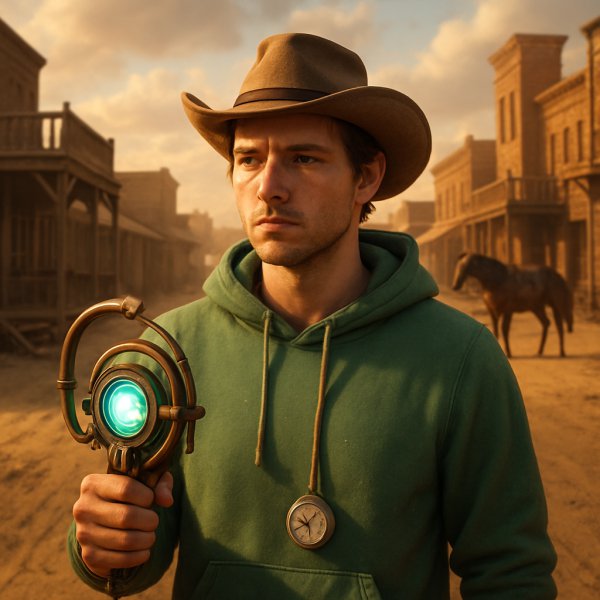
I woke up on a plank floor that smelled like beer and leather, with sunlight cutting through slats and a ceiling fan that did not belong. My hoodie was a bright hospital-green against the rough wood, my jeans still wet with sweat from the alley, and when I pushed myself upright a voice rolled over me like a wagon wheel.
"Well look at that," the voice said, thick and drawling and a little like a radio from another country. Men in hats were watching. So were women polishing glasses at the bar. The saloon felt bigger than a city block and smaller than a sky. I had no idea how I had gotten here. My phone was dead. My watch, because of course I always wear the cheap digital thing, had no signal, just 12:00 and a blinking line.
I should have panicked. Instead I cataloged: hoodie, jeans, sneakers without dust, a Québécois phrase in my head - tiens la porta - and the terrible fact that I stuck out like a neon sign in a black-and-white movie. People pointed. The bartender said my clothes sounded like a foreign language.
"Friend," I said, because being polite is sometimes enough. "Estoy perdido. Je suis perdu." French and Spanish landed like soft pebbles. A few eyebrows rose. The bartender spoke back in a rapid, clipped accent that took a map to unpack. "You from away? Ain't seen your kind round these parts."
"I - yes. From Montreal," I lied, because Montreal was far enough and people in the far west might have heard of it. That small white lie bought me a curious look and a drink of black coffee with more sugar than a hospital candy jar. I sipped and listened. Learning tongues is what I do; I code languages for a living, then teach them to machines. Learning accents felt like the same work with different tooling.
There was another person watching who did not look like the rest. He sat near the piano, fingers on the keys but not playing. His hat was too clean, his coat too plain. He had a way of watching that suggested he was counting heartbeats. When I blinked he smiled the precise, faint smile of someone who had calculated outcomes and liked none of the options. A name floated into my head before I could stop it - Gasparago Steed - like an alert from a program I had not yet run.
My memory returned in pieces. One dinner, a lecture on temporal paradoxes, a paper with the name Gasparago Steed in the margins and an old photograph where the man looked like he might have stepped out of a future I couldn't afford. I had not believed in time travel. I had not known I would need to.
"You're safe to borrow a shirt," the bartender said, after a pause. "If you mind not killing my customers with city talk."
I took a shirt from a peg, handed over what little cash I had, and stepped outside. The town was a single line of buildings and a dirt street, wagons wetter than my sense of timing. The sun was higher now, and the air tasted like iron and horse and dust. Kids chased a hoop. A woman with flour on her hands shouted for a mule. All of it fit a picture I had seen in old films, except the conversation tools in my head, the phrase from Montreal sliding in and out like a song.
The first day was about disguise. I traded my hoodie for a battered coat and my sneakers for boots that smelled like a barn. I learned quickly that accents were not barriers when you smiled with your eyes. People liked me. I am good at liking people back. I fixed a broken latch at the smithy, explained how a pulley might be rigged in simpler terms, and in exchange received spare shirts and a hat I could pull low.
You cannot stay incognito forever in a town with a single barber and fewer secrets. It was a judge who first mentioned the name aloud, in that formal way adults use when they do not want trouble to start but know trouble is already a foot in the door.
"Gasparago Steed passed through last night," the judge said over a ledger. "Odd fellow. Bought a ticket for the south line but didn't board. Asked about telegraph lines. Said he was a traveler looking to correct a wrong."
Gasparago. The name moved under my skin. A traveler looking to correct a wrong meant doors that should not be opened. Time travel was not a thought experiment on a whiteboard now. It was a person with boots and a plan.
I asked the judge where he was headed. "To the old telegraph station up by the ravine. Folks say the stranger has a pocket-watch and speaks like he reads too many books."
That afternoon I found the ravine and the telegraph station, a squat building with a sagging roof and enough wire to tangle a spider's patience. The station keeper, a stooped man named Elias, had the look of someone who earned his living counting the distance between storms.
"Gasparago was here," Elias said before I could ask. He had a cigarette that belonged in a black-and-white postcard. "Left in a hurry. Left a device in the booth - like clockwork, but humming. I thought it was a radio at first."
A device. An entry point. I asked if I could see it. Elias's face softened; he had the curiosity of a child and the caution of a man who understood when curiosity might burn. We pried open the device together under a low sun. Inside were gears, glass tubes, a coil like something between a watch and a science fair volcano. It hummed faintly like a distant train.
I touched it. The hum climbed into my chest and left a cold taste of future metal on my tongue. I thought, ridiculously, about servers in a datacenter humming away in Quebec. I thought about the man in the saloon watching like he held a countdown. The device should not exist. Someone who tinkered with time should not exist either, not in any timeline I had been told was safe.
At dusk a rider came to the station. He was mid-thirties, clean-shaven, and not entirely Western. Up close his color was wrong for the place - the way a photo might be sepia except for one bright red scarf. He said his name was Gasparago Steed with a voice like a well-tuned bell. I thought of the photograph, the paper with notes. I felt for the device and found my fingers closing on the cold brass.
"You're not from here," he said, not a question so much as a program scanning for variables. "No tech, no practice. Where are you from, monsieur?"
"Montreal," I answered because truth at least kept the story simpler.
His eyes narrowed. "Ah. So you are the one. The one who followed."
I did not follow him. That was not the truth. But his accusation contained light. I told him I had found his device, and he laughed, a sound that chewed the air.
"That thing is dangerous," he said. "It is anchored here. It is tethered by decisions made in this town. If I let it run the way I plan, one woman in our future does not die. But that means many other things fail to happen. Machines do not get built. Rivers are redrawn. The world you know - the one you came from - would be a different country."
I thought of my mother and the code I wrote that let strangers talk in gently translated tongues. I thought of the quiet life in Montreal. All the small, expected things pulsed inside my chest like a catalogue of reasons to stop him.
"Show me proof," I said. "One change, one plausible set of consequences. Not stories."
He showed me a photo. It was grainy but clear: a woman I had seen earlier at the saloon, holding a child, smiling. Gasparago's hand closed around the photograph with a tenderness that made nausea in my mouth.
"She's my anchor," he said. "I love her. I can prevent her death. I can rewrite her train's route, or collapse a bridge so her carriage never goes through. But to do it - to change that one night - the ripples will be massive."
The surprise was not that he loved someone. The surprise was that the woman in the photograph was the widow who ran the bakery and the child was Miguel - the boy with flour on his nails who had helped me lace my boots. Miguel had given me a wooden horse the first day I arrived. He had told me in a mixture of English and Spanish about his dream of seeing the sea.
If Gasparago changed that night, Miguel might never be born. Or the world might bend and make a different son, or none at all. The choices inside me stacked like rails. I had to choose whether to preserve the broad world I returned to, likely filled with the people I loved, or to allow one small person's fate to be rewritten for the sake of the man who had lost. My code-writing brain wanted a decision tree. My heart wanted both.
"You can take it and leave," Gasparago whispered. "Help me patch the anchor and I will go. No harm to your world if I succeed."
I looked at the device. In my pocket my phone was still a dead rectangle of glass. Here in my hands was the only thing that proved time bent like metal. The choice bent me too.
That night the turning point came when Miguel brought me a slice of bread and, without knowing the calculus I had done, put it into my hand and said, "For you, amigo. Stay."
His small palm felt like a compass. It pointed a direction I did not want to go but could not ignore. Gasparago stood outside the station, blue coat like a shadow, and watched us through the window. He had tears at the edge of his gaze and resolve at the center.
In the end I acted. Not with the violence of a man who would command armies, but with the stubbornness of someone who builds and understands failure modes. I took a piece of wire from the telegraph pile, wrapped it around the coil in the device, and bridged two contacts in a way I suspected would scramble the oscillator. I had taught myself more than lines of code; I knew about circuits, about shorting things intentionally. The device clicked and hiccuped and then, with a tiny scream of glass, it died.
Gasparago's face folded in a way that made him older. He did not hit me, though he had every right to. He dropped to his knees by the ruin and looked at the photograph he couldn't save. Then he looked at me.
"You saved the world you loved," he said, voice small. "And you do not know the cost."
I knew the cost in an abstract way. I had not saved the woman he loved. I had saved Miguel and the town and the long, slow line of things that led to me. I had also closed the door on someone else's grief turned righteous.
"You could have changed it," I told him. "You could have tried."
He shook his head. "I did. Many times. The paradox tightened like a noose. I thought I could play god. I only made the cord shorter."
If there is one thing worth stealing from a stranger's collapse, it is the lesson that absolute power mostly yields absolute loneliness. Gasparago folded himself into a quiet that felt like acceptance. He passed me the photograph and with it the knowledge that love sometimes demands impossible things. He left the town at dawn, without a device and with pockets full of regrets.
The saloon's clockkeeper kept time as if nothing had happened. The sun rose, people lined up for bread, and Miguel sat on the curb and carved a horse from a chunk of wood. I stayed. I took a job helping a carpenter mend a roof. It was not high tech. It was honest. I worked with muscles I did not know I had, learning how to read the grain of a plank like I read a line of code.
At night I would sit on the porch and think of Montreal, and my mother, and the servers humming in a room I would likely never see again. I kept one small token from the hoodie I had given away - a plastic button with a faded logo - and tied it to my belt. It was a little piece of a future that no longer needed me, a reminder that a man can make choices that matter.
Once, when Miguel had a fever, I stayed up with him and told stories in French mixed with Spanish and English. He slept with his thumb in his mouth, breathing quietly, not yet aware of the wider world. I thought of Gasparago in whatever place he had gone, or whatever consequences would catch him, and I thought of the woman he loved and the impossible night he had wanted to erase. I thought of how the world holds people like fragile keepsakes, and how sometimes keeping them is the only mercy.
When the sun set and the town threw long shadows across the street, I walked down Main in a hat that fit my head, boots kicking up neat puffs of dust. People nodded. A woman called, "Good night!" I touched the button at my belt and felt the metal cold for a second. The sky above the far west was a vault of stars too honest to lie.
I had come here by accident, or by design that my brain had not consented to. I could have chased a man across years, or tried to fix someone else's pain with a device that hummed like a heart in a drawer. Instead I learned the small, stubborn truth that sometimes keeping the present intact is the bravest thing you can do.
Miguel waved, then returned to his carving. He had made me a small horse with a crooked mane. I put it on my windowsill. The town would not teach me how to go home. Maybe home would come to me in other ways. For now, under that wide, honest sky, I had a town that needed a pair of steady hands and a man who could listen. I had a button on my belt, a wooden horse on the sill, and the memory of a photograph that had tilted two lives.
That night I slept with the window open to the sound of horses breathing, and dreamed of a future where people I loved still existed. I woke with a plan - not to chase impossible machines, but to learn to be useful where I had landed. The past had no right to be rewritten by a man broken by love. It had a right to be lived.
Classic Western