He Gave His Code to Steampolustopu and the City Learned To Breathe
September 18, 2025
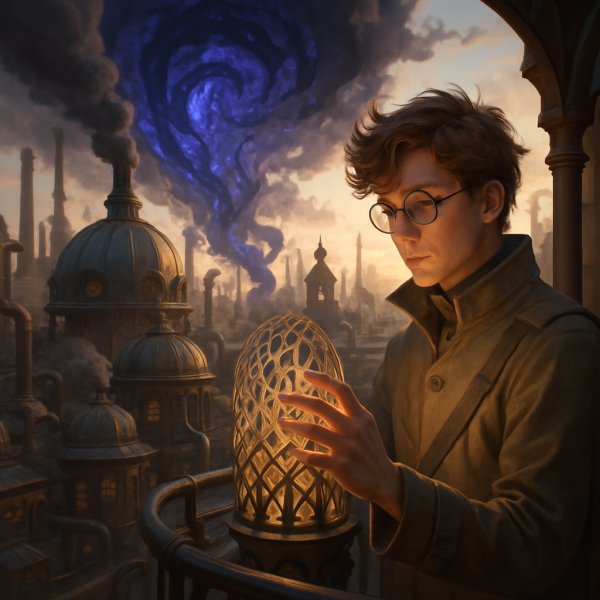
The first bell in Steampolustopu rang like a warning, low and metal, and the steam that should have curled from a hundred chimneys sank inward like a living thing taking its last breath. Pipes clacked, gears shuddered, and somewhere deep below the city a great machine stuttered. Hubert felt it in his bones before he saw it, a hollow note that set his teeth on edge.
He had left Quebec with a bag, a wrench, and a head full of code. Parisian nights were a memory, Montreal winters a ghost, but the way machines thought, the way systems failed and woke again, that he carried like a map. Hubert stepped off the tram into the fog-stung streets, his coat smelling of oil and rain. Around him faces peered from behind goggles and scarves, eyes bright with fear. He smiled the sort of smile that made people trust him without knowing why.
"Bonjour," he said to a woman holding a child. "We will fix this."
She whispered thank you in a language of smoke and hope. Hubert spoke in what people needed - French to calm, English to reason, Spanish to joke and ease a tense brow. His words were small bridges. They carried him forward.
The city itself was a beast made of brass and spell. Towers rose like stacked pistons, glass lungs puffed, and a lattice of runes pulsed under catwalks. At the heart of it lay the Condenser, a room the size of a cathedral where cold sea-air met fired metal and the city drew its life. Lira, the wind-mage, met him at the gate, fingers blue with frost even though the air was thick and warm.
"You should not be here," she said, but there was relief in her voice. "We have no one who reads the old codes. We have runes, we have rites, but someone must think like the machine."
"Je peux aider," Hubert said. He bowed his head in a small joke, the accent soft. He had not trained as a mage, but he had built logic from nothing. He had rewired failing systems with lines of code and the patience of someone who listened to how things failed.
Inside the Condenser the air tasted of salt and hot iron. Gears the size of houses were frozen mid-turn. Runes glowing like veins were dark in places. A central core hummed, then hiccupped, then went still. On the far wall a pattern crawled like a living virus, blackening the carved script. Brusk, the chief machinist, cursed in a dozen languages and then in none.
"The Nullfog," Lira said, as if naming a plague could lessen it. "A corruption in the lattice. It eats the runes that bind the steam. If it reaches the Core, Steampolustopu will die."
Hubert walked to the core and ran his fingers along the metal. It was warm, and under his touch the faintest memory of a clockwork heartbeat. He knelt and looked at the runes, at the spaces between them. They were patterns, rules, sequences. To Hubert they looked like lines of code written in stone.
"I can debug it," he said aloud, hearing the thought as if it were a line of code solving itself. "But the lattice will only accept a true rewrite if you feed it a new template. It needs a mind-like anchor to rewrite its patterns, something that understands logic and can stand where the runes meet meaning."
Lira's eyes narrowed. "You ask to bind yourself to the lattice."
"Not bind forever," he said, and the word sounded thin. He pictured his mother on a small porch in Saint-Jean-sur-Richelieu, the smell of wood smoke and coffee, the soft cadence of her voice. He pictured the friends who believed in him, the easy laughter in three languages. He pictured a city that would suffocate without his taking a risk.
"You do not know what you will lose," Brusk said. He looked at Hubert with more sorrow than anger. The machinist's hands were thick with oil and regret.
Hubert closed his eyes. "Maybe," he said. "But I do know how to speak to machines. And I like Steampolustopu. There is no other way."
The plan was simple and terrible. The lattice accepted not just runes, but anchors - living minds willing to become mirror and mouth for the rewrite. Once connected, the anchor's pattern would be merged into the lattice, shaping the new code. But the anchor would not step away unchanged. Memories might be altered, parts of the self folded into the city's mind. Some anchors returned, different. Some returned empty.
They prepared the chair like a throne of gears. Lira wove breeze around it to steady blood, Brusk greased the joints, and a dozen citizens pressed notes and charms into Hubert's pockets. He smiled crookedly as he took them. "Gracias," he told a man who spoke Spanish, and the man touched his shoulder and said, "Mi amigo." The sound steadied him.
When he sat in the chair, he placed his hands on the cold metal and let the lattice scan him. It was intimate, like letting someone read your handwriting and then your dreams. Runes slid across his skin in blue light, translating memory into pattern. The first hooks were gentle - childhood games, the tilt of a winter sun in Quebec - and then the Nullfog pushed back. The room shuddered.
Images flooded him: a clock tower falling into the river, a child lost in a market of steam, a woman singing in Spanish in a laundromat in a city he had never seen. He knew these were not all his. The lattice had soaked up the city's memories over the years, mixing them like oil in water. The Nullfog had eaten edges and left a blur. Hubert felt his own thoughts rub against those foreign ones, like two languages struggling to share a word.
He began to hum a tune his mother used to sing. Lira's eyes closed and the runes answered her breath. The coaching lines he mentally typed - if this, then this - became spells. The grid took to them, then spat out error messages like sparks.
"This is it," Brusk said, his voice a ragged thread. "If it fails, the core collapses."
Hubert found a rhythm. He thought of loops and breaks, of how to patch a leak without stopping the flow. The lattice accepted the patterns in slow waves, and the Nullfog struck back with a memory not its own - a child's scream that felt like betrayal. Hubert flinched as a face rose, a woman's face he did not know, full of anger and love. He realized then why the Nullfog had started - the city had been taking, draining magic from surrounding lands to feed itself. The lattice had become sick from living on borrowed power. Saving Steampolustopu meant more than repairing gears. It meant changing what the city would be.
He could rewrite the code to draw from its own wells, to balance with the sea and sky. But that change would strip a certain hard edge from the city. Its factories would run quieter. Brass would lose some of its shine. Some people, who had grown fat on the city's old hunger, would be angry. The twist landed like a stone in his chest. This was not only a mechanical fix. It was a soul decision.
He thought of the woman at the market who had lost a child when the factories choked the river. He thought of Brusk, who had kept the city running but who when he was younger had stolen magic to save his family. He thought of the child in the crowd who had clutched a small wooden horse and looked at him with eyes that asked for a future.
Hubert typed the pattern in his head. He would anchor the lattice to humility. He would build checks, limits, a way to draw power in a way that gave back to the land. It was what his logic demanded. It was what his heart demanded.
"Are you certain?" Lira whispered. Her hand found his and squeezed.
"Sí," he said, because Spanish felt like home when he needed courage. He felt the lattice close around him and then open, and he poured himself into it - not his face from childhood or the exact shape of his mother's laugh, but the way he thought, the way he wrote solutions, the kindness that made him listen. It was a strange thing to give: personality, not facts. He offered his curiosity, his ability to make friends, his patience. Those were the code the city needed more than any algorithm.
As the rewrite took, the Nullfog lashed. It tried to claim his memories, to use his own sense of self as bait. For a moment he felt himself dissolve into the runes. He saw the city as a living creature, ribs of brass, lungs of glass, eyes of lamp and steam. It opened and closed its mouth, and for an instant he saw behind those lamp-eyes the faces of all who had lived there - not just names but the pattern of how they loved, fought, and forgave. He wanted to keep it all, but then a bright clean line of thought appeared - a child's laugh returned to rivers, a field beyond the city breathing again. He chose that.
When the lattice sealed, the room was silent and full. The hum returned, deeper and softer. Gears took up their rhythm like a recovered heartbeat. Steam curled from chimneys, not greedy but steady. The city breathed.
Hubert slid from the chair with a weakness in his legs. The world felt a little thicker, as if reality had been rewoven. He put his hand to his head. He could not remember the name of his first bicycle. He could, however, remember the smell of his mother's coffee and what the word "home" felt like. His languages came in a jumble at first - French words first, then Spanish, then English - and sometimes a sentence mixed them all without meaning. People laughed and cried and pressed their hands to his cheeks.
A child climbed onto Brusk's shoulders and shouted, "He saved us!" The machinist wept openly. Lira held him and said, "You changed us, Hubert. You did not just repair the machine. You made it choose better."
Hubert smiled, and the smile was not small now. "Je suis content," he murmured. He did not remember every step of the path that brought him to this engine, but he understood the choices he had made. He felt their weight, and they fit.
There was grief hidden among the celebrations. A ledger clerk announced that some factories would close or be cut back, that work would change. Voices rose angry and loud. Hubert listened. He had no easy answers, but he remembered the small truth that had begun the day he left Quebec - people were worth the cost. He walked into the crowd and spoke, sometimes French, sometimes English, sometimes Spanish, finding the right word for someone who needed calm or a joke or a promise. People answered him with the trust they always gave him.
At night, the city sparkled under a rain of tiny lamps, each bulb soft and warm. Hubert stood at a bridge and watched the river flow more clear than it had in years. Lira came and rested her hand on his shoulder.
"You did not lose yourself," she said. "You became more like the city should be."
He reached into his pocket and found a small coin his mother had given him, stamped with a maple leaf and a word in French, rubbed smooth by a life of moving. It was proof that somewhere the man who came from Quebec still existed. He turned it and then placed it on the bridge railing, watching it send a silver point into the light.
"Merci," he whispered into the night, and the word felt right. A child nearby answered in a chorus of three languages, and Hubert made a noise like a laugh and a sob at once.
The next morning the market reopened, but the stalls sold fish and bread in steadier light. The factories sounded different, like a heart that had learned to rest. Brusk took on new apprentices and taught them to mend machines with respect for the ground under their feet. Lira flew among the rooftops and seeded wind back into the sea. The man who had been a stranger with a bag and a mind full of code became a citizen they called friend.
He lost some memories, and he gained others that belonged to the city. That was the cost. Sometimes he would turn on the tram and forget which stop to take, and a kind face would point him home. He never found his first bicycle. But when a child asked him how he could be so calm in a crisis, he would look at them with tired eyes and say in a jumble of three tongues, "Parce que j'aime les gens, porque la gente importa, because people matter." The child would repeat the words, and the city would listen.
Steampolustopu did not become perfect. It would never be perfect. But it learned to breathe, and that made all the difference. Hubert walked its streets tall in his own quiet way, as if a code had been written into the air and into his chest that said, keep going. The machine he had saved hummed like a promise, and when fog crawled low on a night no different from any other, someone would see the brass shine a little truer and smile because a man who loved three languages and many people had given the city a new heart.