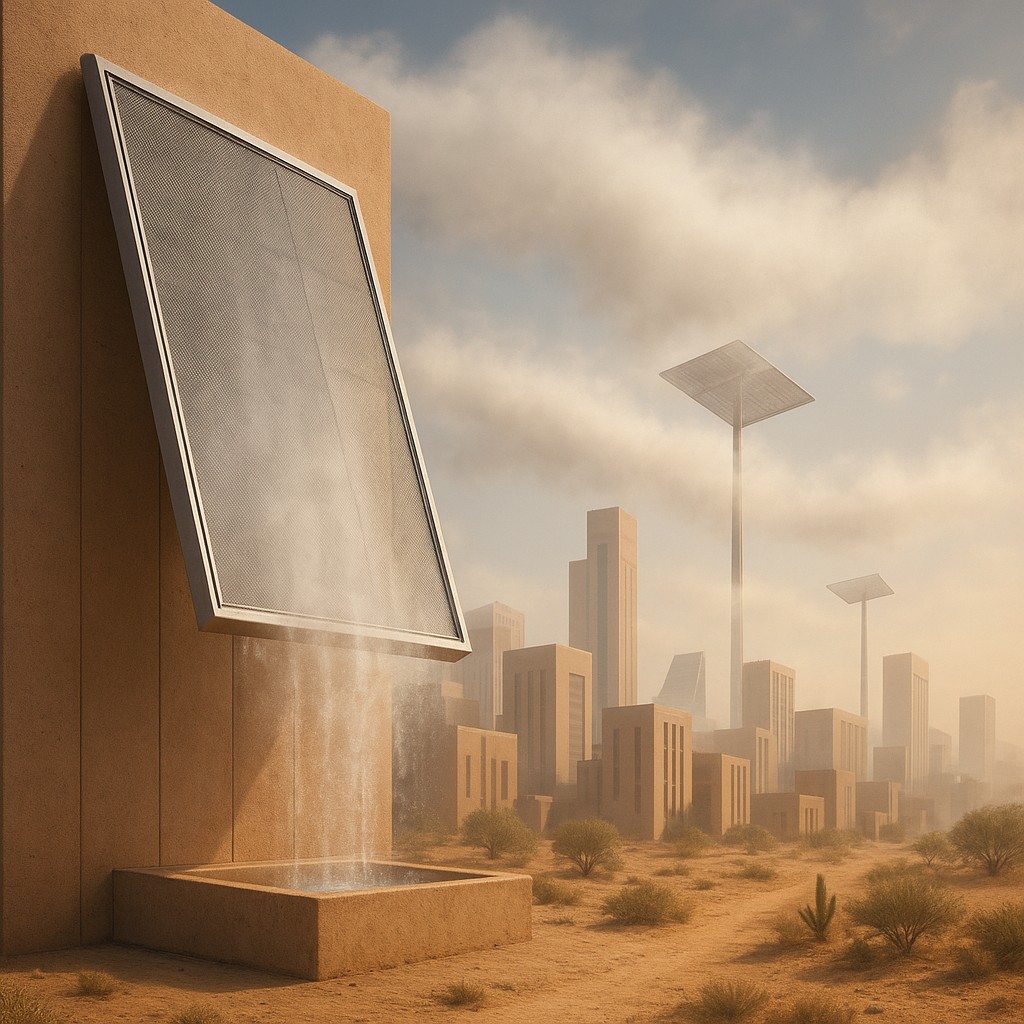
Imagine walking through a scorching desert city, miles from the nearest river or lake, where the sun beats down with relentless intensity. You might assume such a place is a biological dead end, where life must ration every drop of water as if it were gold. Yet, just above your head, passing through the thin, dry air of morning, there is often a hidden, watery ghost. Coastal deserts, despite their reputation for being bone-dry, frequently host blankets of sea-born fog. This fog drifts inland, carrying thousands of gallons of potential drinking water that simply vanishes into the heat.
For decades, we viewed these landscapes as barren. We focused our engineering on drilling deeper into ancient, finite underground water supplies, or on massive, energy-draining desalination projects to remove salt from seawater. We are now entering a new era of urban design where we stop looking down at the sand and start looking up at the sky. By treating our architecture like an atmospheric filter, we can harvest the thin veil of moisture that nature provides for free. This is not science fiction, but a clever application of surface physics that turns a city from a passive consumer of water into a living, collecting organism.
The Physics of Trapping a Ghost
To understand fog harvesting, you must abandon the idea of using a simple bucket or net. If you just put up a standard mesh, the fog would likely drift straight through it. If droplets did collect on the surface, they would cling to the wires, blocking airflow and evaporating before they could be gathered. The secret to modern harvesting lies in the geometry of surface tension and the deliberate creation of a pressure gradient that tells water exactly where to go. Modern collectors use what engineers call asymmetric wettability, a design that treats the front and back of the mesh differently to control how a droplet behaves the moment it forms.
When a microscopic droplet of fog hits the collector, it lands on a surface designed to act like a slide rather than a sponge. If the surface is too sticky, the water stays put, creating a film that clogs the mesh and halts the collection process. By using specialized polymers or nano-textured coatings, we ensure that as soon as a droplet reaches a critical weight, surface energy forces it to detach and roll downward. Think of it like a crowded doorway at a concert where one side of the frame is slippery, allowing people to pass through with zero resistance. Once the droplet detaches, it is guided into tiny veins built into the grid, directing the water via gravity into a storage tank in the basement or within the building walls.
Architecture as an Atmospheric Reservoir
In the past, urban planners viewed the desert climate as something to shield against, building structures that emphasized insulation and shadow. Incorporating fog-harvesting grids turns the building envelope into an active player in the city's hydration. A rooftop is no longer just a place for an air conditioning unit to bake; it becomes an expansive, vertical intake zone. By integrating these meshes into building faces or atop existing steel structures, we treat the city wind as a delivery service, bringing the atmosphere right to our doorstep.
This approach works because it is entirely passive. It requires no electricity, no buzzing pumps, and no complex intake valves that might fail in the heat. The energy required to move the water is supplied by the wind itself and the simple pull of gravity. When we design these systems, we think of them as an atmospheric organ: the mesh is the lung capturing the vapor, the veins are the capillaries moving the liquid, and the storage system is the heart that holds the resource for the dry afternoon. It shifts the burden of water security away from centralized, fragile infrastructure and puts it, literally, in the hands of the buildings themselves.
The Crucial Variable of Turbulence
Every mechanical system has its kryptonite, and for fog harvesting, that weakness is wind speed. We might intuitively think that stronger wind equals more fog passing through the mesh and thus more water, but that is a mistake in the world of fluid dynamics. If the wind speed climbs too high, the air molecules move past the mesh faster than the condensation process can actually occur. Surface tension requires a specific amount of contact time for a microscopic vapor particle to coalesce into a droplet large enough to fall.
When the wind rushes past at high velocity, the fog particles strike the mesh with such force that they bounce off or break apart rather than sticking to the surface. It is like trying to catch rain with a net while riding a motorcycle; at high speeds, the net moves through the rain differently than it would if you were standing still. For urban harvesters, this means the grid design must be adjustable or tuned to a city's specific wind patterns. If we ignore this, we end up with an expensive, beautiful mesh that acts more like a high-tech windbreak than a water source.
Quantifying the Harvest Potential
To see how this stacks up against traditional infrastructure, it is helpful to look at how we measure the efficiency of these systems. We often categorize the performance of a collector by its water yield per square meter, a metric that changes based on local humidity and average wind patterns. The table below outlines how these systems interact with the environment compared to the traditional, underground aquifer reliance models we have used for the last century.
| Feature |
Traditional Aquifer Model |
Fog-Harvesting Grid Model |
| Primary Energy |
High (pumps/extraction) |
Zero (passive gravity/wind) |
| Sustainability |
Low (non-renewable depletion) |
High (atmospheric replenishment) |
| Urban Footprint |
External (pipes/pipelines) |
Integrated (rooftops/facades) |
| Major Constraint |
Deep-well maintenance |
High-wind turbulence |
| System Logic |
Mining a finite resource |
Farming an ongoing cycle |
This comparison highlights a fundamental shift in philosophy. We are moving from a mining mindset, where we extract resources until they are gone, toward a cyclical mindset, which recognizes that even the most barren-looking desert possesses a constant, daily influx of moisture. By adapting our mesh technology to handle wind velocity and surface tension correctly, we can tap into a reservoir that never runs dry.
The Future of Self-Sustaining Metropolises
The true promise of fog harvesting lies not just in the water it collects, but in what it teaches us about our relationship with the environment. When we stop viewing the desert as an enemy to be conquered with heavy machinery and start viewing it as a space with its own specific physical inputs, the environment becomes a partner. You are not just building a house anymore; you are building an oasis that breathes in the coastal fog and exhales drinkable water for its residents.
This is the next frontier of sustainable urbanism. It requires us to move past the blunt engineering of the twentieth century in favor of a subtle, elegant approach that respects the tiny, invisible forces governing our world. Each time you see a breeze push through a desert street, recognize the kinetic energy and moisture it carries. We are learning to harvest the air, and in doing so, we are finally learning how to thrive in places we once thought impossible to inhabit. As you consider these systems of the future, remember that the most profound engineering breakthroughs often don't come from massive machines, but from the quiet, rhythmic interaction between a cleverly designed surface and the natural world around it.