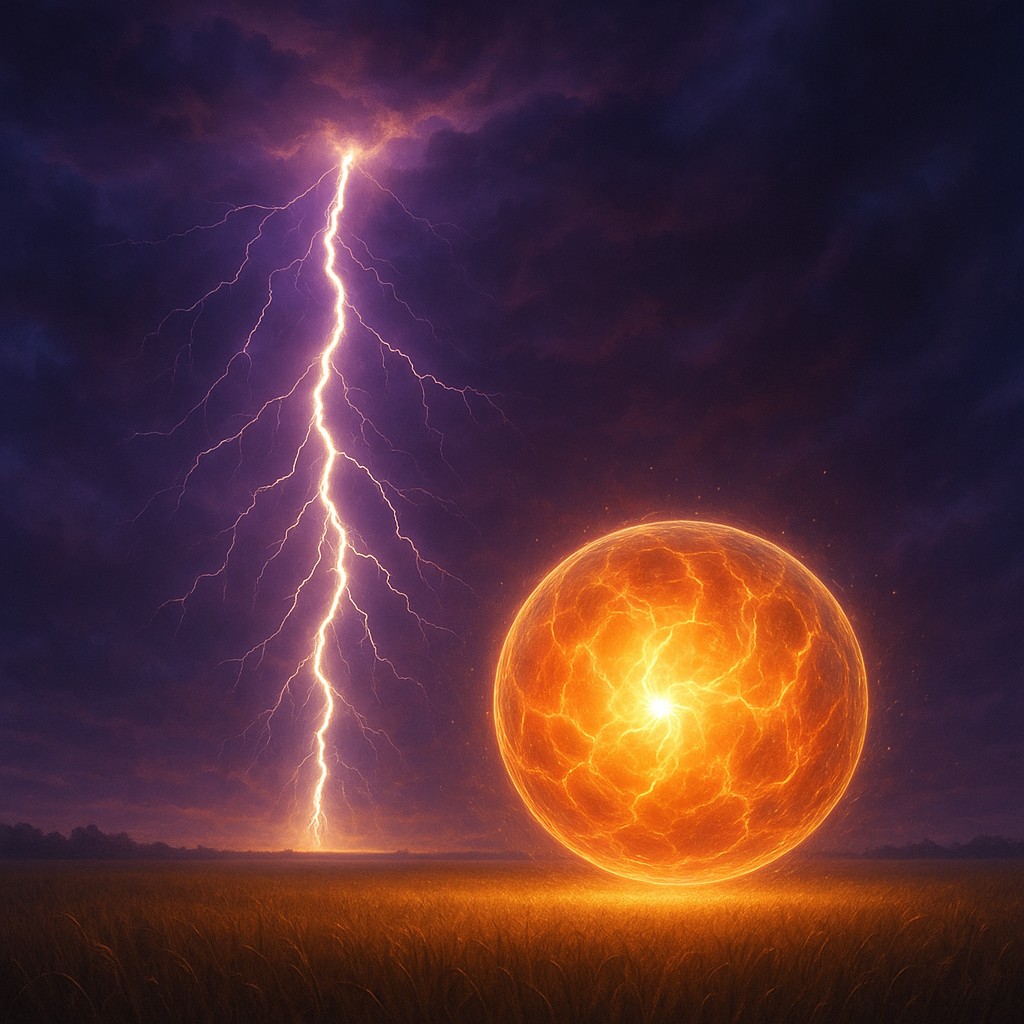
Picture yourself standing in a wide, open field during a summer thunderstorm. The sky has turned a bruised purple, and suddenly, a jagged bolt of lightning rips through the air. That flash heats the atmosphere around it to temperatures hotter than the surface of the sun, discharging a massive burst of energy that lights up the landscape for miles. Now, imagine if we could shrink that raw, chaotic power down to the size of a microscopic speck and use it to provide clean, endless energy for the entire planet. This isn't a plot from a sci-fi novel; it is the real-world pursuit of functional nuclear fusion, often called the "Holy Grail" of physics.
For decades, we have powered our cities using nuclear fission, which works by splitting heavy atoms apart. While it is effective, fission has its downsides, specifically long-lived radioactive waste and the risk of meltdowns. Fusion, by contrast, is the process of squeezing light atoms together until they merge into one. This is the exact same reaction that keeps the sun burning and the stars shining. If we can copy this "star power" in a controlled environment on Earth, we would essentially solve the global energy crisis forever. However, as simple as it sounds in principle, the race to get more energy out of a fusion reaction than we put into it has been one of the toughest scientific marathons in history.
The Recipe for Bottling a Star
To understand how we might pull this off, we first have to look at the ingredients. In most fusion experiments, scientists use two types of hydrogen: deuterium and tritium. Deuterium is easy to find because it is abundant in seawater, but tritium is rare and much harder to handle. When these two meet under the right conditions, they fuse to create helium and a high-energy neutron. The "magic" happens because the resulting parts actually weigh slightly less than the original hydrogen atoms. According to Einstein’s famous equation, E=mc², that tiny bit of missing mass turns into a staggering amount of energy.
The challenge is that atoms do not want to be squeezed together. Protons have a positive charge, and just like two magnets with the same poles, they push each other away with incredible force. To break through this "Coulomb barrier," you have to make the atoms move so fast that they crash into each other before they have a chance to veer away. This requires two things: extreme heat and immense pressure. In the center of the sun, gravity does most of the heavy lifting. On Earth, we don't have the luxury of a star's massive weight, so we compensate by cranking the temperature up to over 100 million degrees Celsius. That is significantly hotter than the center of the sun itself.
Magnetic Donuts and Laser Blasters
Since no material on Earth can hold a gas that hot without instantly melting or cooling the fuel down, scientists have had to design creative "bottles." One of the most popular designs is the Tokamak, a device that looks like a giant, high-tech metallic donut. Inside this donut, powerful magnets create a magnetic field that suspends the scorching plasma-the hot, charged gas-in mid-air, keeping it away from the walls. If the plasma touches the sides, the process fails: the temperature drops and the reaction stops. It is a delicate balancing act, like trying to hold a wriggling balloon of jelly using only rubber bands.
Another approach, which recently made headlines at the National Ignition Facility (NIF), is called Inertial Confinement Fusion. Instead of using magnets to hold the plasma for a long time, this method uses some of the world's most powerful lasers to blast a tiny pellet of fuel from all sides at once. The lasers compress the fuel so quickly and violently that it collapses inward, reaching the density and temperature needed for fusion before it can explode outward. In late 2022, NIF achieved "ignition," meaning for the first time in history, a fusion reaction produced more energy than the laser energy used to start it. It was a landmark "Wright Brothers moment" for clean energy.
Weighing the Pros and Cons of Nuclear Power
While there is a lot of excitement around fusion, it helps to compare it to our current ways of making electricity. We often lump all nuclear power together, but fission and fusion are as different as ice and fire. Fission is like breaking a large rock into smaller, jagged pieces that stay hot and dangerous for thousands of years. Fusion is like merging two small drops of water into one, creating a harmless byproduct (helium) and a lot of heat. The following table shows the core differences that keep scientists determined to move toward this energy of the future.
| Feature |
Nuclear Fission (Current) |
Nuclear Fusion (Future) |
| Basic Process |
Splitting heavy atoms (Uranium) |
Joining light atoms (Hydrogen) |
| Fuel Supply |
Requires limited mining |
Found in seawater (virtually infinite) |
| Radioactive Waste |
High-level, long-lived waste |
Very low-level, short-lived waste |
| Meltdown Risk |
Possible (needs safety systems) |
Impossible (reaction stops if disturbed) |
| Energy Density |
High |
Extremely High |
| Technology Stage |
Fully Mature |
Experimental / Prototype |
The Engineering Mountains Left to Climb
Even with recent breakthroughs, we aren't ready to plug a fusion reactor into the power grid just yet. Reaching "scientific breakeven," where the reaction creates more energy than was put into it, is only the first step. The next hurdle is "engineering breakeven." This takes into account the massive amount of electricity needed to run the entire facility, including the cooling systems for the magnets, the vacuum pumps, and the sensors. Currently, we are still putting more energy into the building than we are getting out of the wires. We need to scale these reactions up and make them much more efficient before they can pay for themselves.
Then there is the issue of the materials themselves. The high-energy neutrons released during fusion are quite destructive. They bombard the walls of the reactor, making the metal brittle and slightly radioactive over time. Engineers are currently searching for new alloys and materials that can survive this internal "stellar weather" for years without needing to be replaced. Furthermore, we need a reliable way to "breed" tritium inside the reactor. Since tritium doesn't exist in large amounts in nature, future reactors will likely use a lining of lithium to catch neutrons and transform them back into the fuel the reactor needs to keep running. It is a self-sustaining loop that we are still learning how to perfect.
Debunking the Myths of the Atomic Age
Whenever people hear the word "nuclear," they naturally feel a sense of worry. However, one of the most important facts about fusion is that it is inherently safe. In a fission reactor, you have a massive pile of fuel that wants to react, and you have to work hard to slow it down. In a fusion reactor, the situation is the opposite. The plasma is so finicky and hard to maintain that if anything goes wrong, the reaction simply fizzles out and stops. There is no risk of a "meltdown" because there is only enough fuel in the chamber at any given moment to burn for a few seconds.
Another common myth is that fusion is always "thirty years away." While this has been a joke in the scientific community for half a century, the pace of progress has sped up dramatically in the last five years. Private money is pouring into fusion startups, and new technologies like High-Temperature Superconductors are allowing us to build smaller, more powerful magnets. These advances mean we can build smaller reactors that are cheaper and faster to test. We aren't just waiting for one big government project anymore; we are seeing an explosion of different designs that make the goal feel closer than ever.
A Future Powered by the Stars
Moving to a fusion-powered world would be one of the most significant shifts in human history. Imagine a world where the cost of electricity drops so low that we can easily turn ocean water into drinking water for everyone on Earth, or pull carbon dioxide directly out of the atmosphere to reverse climate change without worrying about the energy bill. Fusion is more than just a new way to boil water and spin a turbine; it represents human creativity overcoming the limits of our planet's resources. It shows what we can achieve when we stop looking for fuel in the ground and start looking at the physics that runs the universe.
As you go about your day, remember that every bit of life on this planet, from the grass in the park to the sandwich you had for lunch, is already powered by a fusion reactor 93 million miles away. We are simply trying to build a much smaller version here on the ground. The journey is difficult and the engineering is tough, but the prize is the ultimate dream of a clean and bright future. By staying curious and supporting this technology, we are part of a grand experiment: the attempt to finally master the fire of the stars and bring it home to light our way.