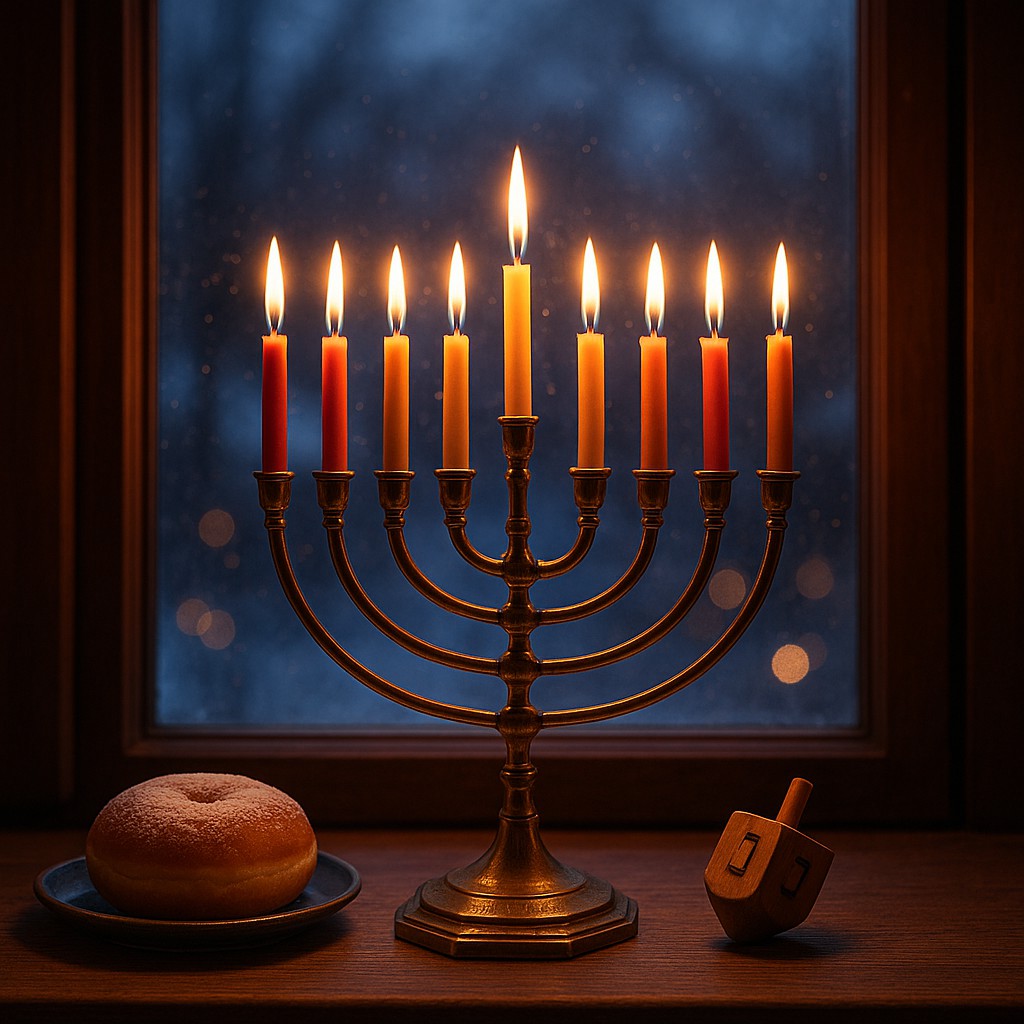
If you have ever walked past a window on a winter night and seen a line of candles glowing like a tiny runway for hope, you have already met Hanukkah out in the world. It shows up when the days are at their shortest, when people are craving warmth and light, and when even one small flame feels like a firm answer to the dark. It is festive, family-focused, and yes, it comes with snacks that are basically, “What if potatoes were a holiday?”
Hanukkah is also often misunderstood, especially outside Jewish communities. Some people call it “the Jewish Christmas,” mostly because it falls in the same season and, in many homes, includes gifts and decorations. But Hanukkah has its own story, its own rituals, and its own themes, many of which have nothing to do with Christmas and everything to do with identity, grit, and what happens when a culture is squeezed.
Let’s look at what Hanukkah is, where it came from, and how people celebrate it today, from ancient history to modern living rooms full of candlelight, songs, and suspiciously intense dreidel games.
A winter festival with a backstory full of drama and courage
Hanukkah (also spelled Chanukah) is a Jewish holiday celebrated for eight nights and days. The name “Hanukkah” means “dedication,” and that matters because the holiday marks the rededication of the Second Temple in Jerusalem. It is traditionally observed on the 25th day of the Hebrew month of Kislev, which usually lands in late November or December on the Gregorian calendar. The date is not random, it follows a lunar-solar calendar (a calendar that tracks both the moon and the sun).
The story goes back more than 2,000 years, when Judea was ruled by the Seleucid Empire (a successor kingdom that came after Alexander the Great). Many Jews faced harsh limits on religious practice, and the Temple in Jerusalem was desecrated. A Jewish rebel group called the Maccabees led an uprising and, against long odds, retook Jerusalem and reclaimed the Temple. Hanukkah begins with political struggle and spiritual resolve, plus a strong “small group refuses to quit” energy.
The celebration centers on what came next: the Temple had to be cleansed and rededicated. According to tradition, when it was time to light the Temple’s menorah (a sacred lampstand), there was only enough ritually pure oil for one day. But the flame burned for eight days, long enough to make more oil. This is the famous “miracle of the oil,” and it is why Hanukkah lasts eight nights.
The menorah (hanukkiah) and what the candles are actually saying
The main Hanukkah ritual is lighting a special candelabrum called a hanukkiah, often called a “Hanukkah menorah.” Strictly speaking, a menorah is the seven-branched lampstand linked to the ancient Temple, while the Hanukkah version has nine branches. Those nine spots include eight candles for the eight nights, plus one extra candle called the shamash, meaning “helper” or “attendant,” which is used to light the others. If you count nine, your math is fine.
Each night you light one more candle, so the light builds across the holiday. That growing brightness is not just decorative, it is the point. Hanukkah leans into the idea that hope and holiness can grow through small, steady actions. Candles are usually lit after nightfall, set somewhere visible like a window, and left burning for a set amount of time, often at least 30 minutes.
One key detail: Hanukkah candles are for looking at, not for using. You do not light them to read by or to find the remote. Their purpose is to “publicize the miracle,” a traditional idea called pirsumei nisa. That is why many families gather nearby, sing, and take a brief pause from everyday tasks while the candles shine, as if to say, “For a few minutes, we let the light speak.”
The candle-lighting order, made simple
Candle lighting follows a familiar pattern, though small details can vary by community:
- Place the candles in the hanukkiah from right to left (since Hebrew is read right to left).
- Light them from left to right, starting with the newest candle for that night.
- Use the shamash to light the other candles.
- Recite blessings (typically on the first night, and then on later nights with slight changes).
- Sing songs and enjoy the moment, ideally without lighting your sleeve on fire.
This “add one, then light the newest first” pattern helps the holiday feel like it is moving forward. It is an eight-night countdown where the ending is brighter than the beginning.
Food, games, and songs: the homey side of the festival
If Hanukkah were only candles, it would still matter. But it is also a holiday built for families and community. Over eight nights, people gather, visit, eat, and build a rhythm that feels both cozy and steadily more festive. Many traditions revolve around oil, for obvious miracle reasons, which is a very good excuse to fry food and call it history.
Classic Hanukkah foods include potato latkes (crispy pancakes, often served with applesauce or sour cream) and sufganiyot (jelly-filled doughnuts). Different Jewish communities have their own oil-based favorites, such as bimuelos, fritters, or other fried pastries. It is not supposed to be a cooking contest, though it sometimes becomes one anyway.
Music and stories are part of the mix, too. Families sing songs like “Ma’oz Tzur” (Rock of Ages) and other Hanukkah tunes, and kids often learn simple versions of the Maccabee story. Hanukkah is made for storytelling because it already reads like an epic: oppression, resistance, restoration, miracle, lights.
And then there is dreidel, the small spinning top that has started countless living-room tournaments. The dreidel has four Hebrew letters, one on each side: Nun, Gimel, Hei, and Shin (or Peh in Israel). Together they stand for “Nes gadol hayah sham,” meaning “A great miracle happened there,” or “...happened here” in Israel. People usually play with coins, candy, nuts, or chocolate gelt, and the rules are simple enough that very young kids can join in.
Gifts, gelt, and the modern “is it like Christmas?” question
One misconception is worth clearing up with care: Hanukkah is not the most important Jewish holiday, and it is not a Jewish version of Christmas. In Jewish tradition, holidays like Rosh Hashanah, Yom Kippur, Passover, and Shavuot carry more religious weight. Hanukkah matters, but it is considered a “minor” holiday religiously, even if it can feel major socially, especially in places where it becomes a public sign of Jewish identity in December.
So why do many families exchange gifts? In part, because giving gelt (money) has older roots, often linked to charity or supporting Jewish learning. In modern times, especially in countries where Christmas dominates the culture, some Jewish families expanded gift-giving to make the season feel joyful for children and to express pride rather than lack. That is not “copying,” it is adaptation, which cultures do all the time, often with snacks.
Some families do one gift per night, some do a few total, some focus on experiences, and some keep it simple with gelt and games. There is no single universal rule, which can feel freeing and also a little chaotic if you are the one wrapping everything.
A quick myth-busting checklist
A few common misunderstandings, gently corrected:
-
Myth: Hanukkah is the Jewish Christmas.
Reality: Different origins, different meaning, different religious role. The timing overlap is just how the calendars fall.
-
Myth: The miracle story is the only point.
Reality: The holiday also highlights religious freedom, cultural survival, and dedication.
-
Myth: All Jews celebrate it the same way.
Reality: Customs vary by family, community, and country, while candle lighting remains the central shared ritual.
What the eight nights can look like in practice
Because Hanukkah lasts eight nights, it feels less like one big event and more like a festival that builds. Each night repeats the core ritual but leaves room for variety, which is why people may host multiple gatherings or plan something special on different evenings. One night might be quiet, another might be a party, another might be a community candle lighting outdoors.
To make the flow easy to picture, here is a simple summary of common traditions and what they mean:
| Hanukkah tradition |
What people do |
What it symbolizes |
| Lighting the hanukkiah |
Light one more candle each night using the shamash |
Increasing light, hope, public remembrance of the miracle |
| Blessings and songs |
Recite traditional blessings, sing Hanukkah songs |
Gratitude, connection to Jewish history and community |
| Fried foods |
Eat latkes, sufganiyot, or other oil-cooked treats |
Remembering the oil and celebrating abundance |
| Dreidel game |
Spin a top with Hebrew letters, play for coins or candy |
Playful learning, cultural memory, community fun |
| Gelt and gifts |
Give coins, chocolate gelt, or presents |
Generosity, supporting learning, modern family celebration |
| Charity (tzedakah) |
Donate or do acts of kindness |
Turning celebration into responsibility and care |
That mix is part of Hanukkah’s appeal. It is ancient and flexible, meaning it can fit into modern life without losing what makes it Hanukkah.
The deeper themes: identity, freedom, and the courage to stay yourself
On the surface, Hanukkah is about candles. Underneath, it asks a bigger question: what do you do when your values and identity are threatened or pushed to the edges? The Maccabees’ fight is often told as a struggle for religious freedom and the right to live as Jews without coercion. The “dedication” in Hanukkah is not only about a building, it is about recommitting to a way of life.
It is also a holiday where small things matter. A tiny bit of oil. A small group standing up to a powerful empire. One candle in a window. Hanukkah does not pretend darkness is not real. Instead, it insists that even limited light still counts, and that adding a little more each night is a strategy, not just a feeling.
Many people also connect Hanukkah to public identity. Lighting candles where others can see them is a quiet kind of visibility. It says, “We are here, we remember, we celebrate.” In times and places where Jewish communities have faced discrimination, that visibility can feel brave, giving the ritual a serious note under the cozy glow.
Different Jewish communities, shared candles
Judaism is not one single culture, and Hanukkah customs reflect that. Ashkenazi Jews (with roots in Central and Eastern Europe) are often linked with latkes and certain melodies, while Sephardi and Mizrahi communities (with roots in Spain, North Africa, the Middle East, and beyond) may have different fried foods, songs, and storytelling traditions. Even the way candles are displayed, or who lights them, can vary.
Practice also differs across Jewish denominations and levels of observance. Some families focus on candle lighting and a simple meal. Others add nightly gatherings, synagogue events, or large public lightings. In some homes, everyone lights their own hanukkiah. In others, one person lights for the household. These differences are not “right vs wrong,” they are the normal range of Jewish life across places and time.
What stays steady is the idea of marking eight nights with light and remembrance. The table may change, but the flame is familiar.
Celebrating with respect if you are not Jewish
If you are not Jewish and you are curious, you can absolutely learn about Hanukkah, and you can enjoy being included if you are invited. The best approach is the same as for any cultural or religious celebration: ask, listen, and follow the lead of the people who observe it. If someone invites you to a candle lighting, it helps to arrive on time, dress comfortably, and expect a short ritual moment before the snacks arrive (because the snacks will arrive).
It also helps not to turn Hanukkah into a generic “festival of lights” without its specific Jewish story. Many cultures have winter light celebrations, and that is wonderful. But Hanukkah is rooted in a particular history and tradition. Respect looks like being specific. Learn the name, learn the basic story, and pronounce it the way your host pronounces it. You do not need to argue about spelling like it is a competitive sport.
Ending with light you can actually use in your life
Hanukkah lasts eight nights for a reason. It is not a one-time burst of inspiration. It is practice: adding light again and again, when the world is cold, when you are tired, when the first candle looks almost laughably small against the dark. That is a lesson you can carry whether you celebrate Hanukkah religiously, culturally, or simply as a curious learner.
If you remember nothing else, remember this: Hanukkah is dedication made visible. One flame becomes two, then three, until a full row of light says, without shouting, that hope can be built on purpose. And if you ever need proof that small, steady actions matter, a window full of candles in December makes the case beautifully, one night at a time.