For decades, we have viewed the human body as a sort of complex chemical factory. When something goes wrong, such as the chronic joint pain of rheumatoid arthritis or the digestive "fire" of Crohn’s disease, we reach for a chemical solution. We swallow pills or inject biologics - specialized drugs designed to hunt down and neutralize specific proteins, much like a cleanup crew scrubbing a spill. While these drugs have saved countless lives, they often come at a high price. Because a drug floats through the entire "chemical soup" of the bloodstream, it can hit targets you never intended to touch. This leads to side effects ranging from mild nausea to a dangerously suppressed immune system. It is a broad, "broadcast" solution for what is often a localized problem.
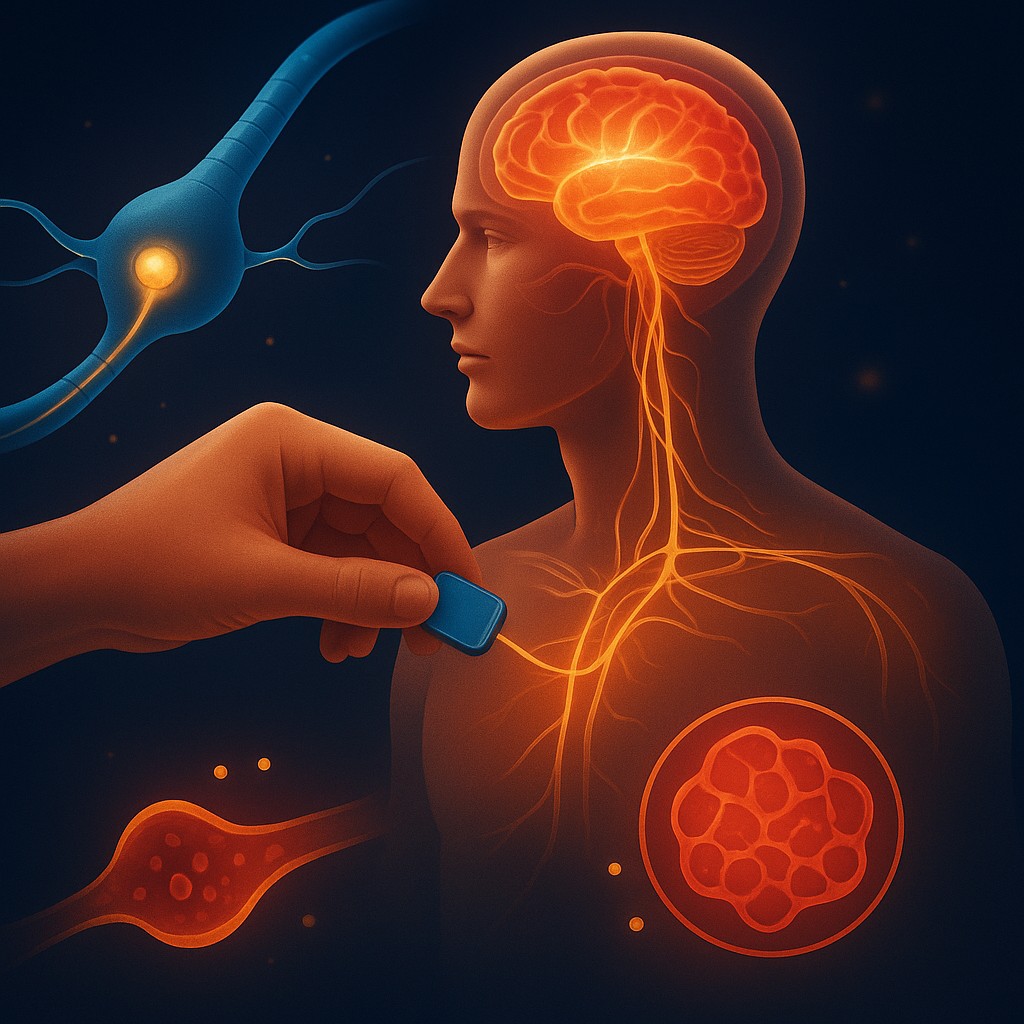
But what if the body isn't just a vat of chemicals? What if it is actually a finely tuned electrical grid? If you look under the hood of human biology, every movement, every heartbeat, and even every immune response starts with a flash of electricity. Our nerves are the body's copper wires, carrying lightning-fast instructions from the brain to the organs and back again. Researchers in the growing field of bioelectronic medicine are now asking a radical question: instead of trying to change the body's chemistry with external molecules, why not "hack" the electrical signals that tell those chemicals what to do in the first place? By using tiny, implanted electrodes to speak the language of the nervous system, we are learning how to flip the "off" switch on chronic inflammation.
The Information Highway Behind Your Ear
To understand how we can electronically program the immune system, we have to look at the vagus nerve. Its name comes from the Latin word for "wandering," which perfectly describes its path. It starts in the brainstem and meanders down through the neck, past the heart and lungs, and deep into the abdomen. It is the longest and most complex of the cranial nerves. It acts as the main communication line for the parasympathetic nervous system - the "rest and digest" counterpart to our "fight or flight" instincts. For a long time, we thought the vagus nerve mostly handled keeping your heart rate steady and making sure your stomach churned after a heavy meal.
In the late 1990s, however, a neurosurgeon named Kevin Tracey made a startling discovery while studying a brain-swelling drug in rats. He found that a signal sent through the vagus nerve could actually tell the spleen - a major headquarters for immune cells - to stop producing inflammatory cytokines, which are the proteins that trigger swelling. This was a "Eureka" moment. It revealed the existence of the Inflammatory Reflex, a biological circuit that lets the brain monitor and adjust the immune system in real time. It turns out the brain isn't just watching inflammation happen; it is the conductor of the orchestra. If the music gets too loud and the immune system starts attacking the body's own tissues, bioelectronic medicine aims to give the conductor a baton made of silicon and electricity to restore peace.
From Chemical Doses to Electrical Pulses
The shift from traditional drugs to bioelectronics is like moving from a megaphone to a laser pointer. When you take a drug like ibuprofen or a sophisticated biologic for arthritis, the molecule has to survive the digestive tract, pass through the liver, and circulate through every limb and organ before it reaches its target. This "systemic" approach - meaning it affects the whole system - is why a medicine meant for your knees can accidentally cause issues in your stomach or kidneys. In contrast, a bioelectronic implant is a localized tool. A device smaller than a vitamin is surgically placed around the vagus nerve in the neck. Once turned on, it sends precise, low-energy electrical pulses meant only for the fibers heading toward the immune system.
This "digital drug" approach offers a level of control that pills simply cannot match. A doctor can tune the frequency, strength, and timing of the electrical pulses using a tablet or computer, much like a technician adjusting a soundboard at a concert. If a patient’s symptoms flare up in the morning, the device can be programmed to deliver a "dose" of stimulation at exactly 7:00 AM. This eliminates the "peak and trough" effect of medication, where a drug is strongest right after you take it but wears off hours before your next dose. By tapping into the body's natural reflex circuits, these devices trigger the release of neurotransmitters like acetylcholine. This chemical signal effectively tells white blood cells to stop pumping out the proteins that cause swelling and pain.
The Challenge of Living Hardware
Despite the immense promise, turning the human body into a programmable network is not as simple as plugging in a USB cable. The vagus nerve is not a single wire; it is a massive bundle of roughly 100,000 individual fibers, each with a different job. Some control the speed of your heart, others manage stomach acid, and others monitor oxygen in your blood. The "holy grail" of bioelectronic medicine is surgical and electrical precision. If you stimulate the nerve too broadly, you might treat a patient's arthritis but accidentally cause their heart rate to drop or trigger constant nausea. This is why bioelectronic medicine is a high-stakes game of "location, location, location."
Current research focuses on mapping these fibers in incredible detail to ensure that electrodes only "talk" to the specific strands that lead to the immune system. This requires sophisticated engineering to create "cuff" electrodes that wrap around the nerve without damaging the delicate tissue. Furthermore, the body’s own defenses can sometimes treat the implant as an invader, covering it in scar tissue that insulates the nerve and blocks the signal. Scientists are currently testing new materials and soft, flexible electronics that mimic the texture of human tissue to keep the connection clear for years or even decades.
| Feature |
Traditional Pharmaceuticals |
Bioelectronic Medicine |
| Delivery Method |
Chemical molecules via blood |
Electrical pulses via nerves |
| Targeting |
Systemic (affects the whole body) |
Localized (targets specific nerve fibers) |
| Side Effects |
Often widespread and chemical-based |
Limited to "off-target" nerve stimulation |
| Dosing Control |
Fixed by metabolism and schedule |
Real-time, adjustable via software |
| Cost Structure |
Recurring cost per pill or injection |
Higher upfront cost for surgery/device |
Debugging the Body Instead of Treating Symptoms
One of the most profound shifts this technology brings is how we think about "disease" itself. In a bioelectronic framework, many chronic illnesses aren't seen as permanent chemical imbalances, but as "software bugs" in the body's communication system. If the vagus nerve fails to transmit the "stop" signal to the immune system, the result is chronic inflammation. By installing a bioelectronic bypass, we aren't just masking the pain; we are correcting the transmission error. This concept is already being tested in clinical trials for conditions beyond arthritis, including inflammatory bowel disease, migraines, and even depression.
The beauty of this mechanism lies in its elegance. We are using the infrastructure that evolved over millions of years to keep us healthy, rather than trying to override it with synthetic compounds. For a patient with severe rheumatoid arthritis who has not responded to any drug on the market, an implanted pulse generator can feel like a miracle. They aren't introducing anything "new" to their body's chemistry; they are simply reminding their body how to heal itself. As we get better at reading and writing the electrical code of the nervous system, the pharmacy of the future might not be a cabinet full of orange bottles, but a small, silent chip that keeps your biological network running in perfect harmony.
Correcting Myths About the Electric Body
As with any cutting-edge science, it is easy for the "bionic" narrative to move faster than reality, leading to several common misconceptions. The first is that bioelectronic medicine is the same as the "vagus nerve hacks" seen on social media, such as splashing cold water on your face or humming. While those activities can mildly stimulate the nervous system, they are like a light breeze compared to the targeted, high-precision power of an implanted electrode. For someone with a debilitating autoimmune disease, a "hack" isn't enough; they need a consistent, calibrated dose that only medical-grade hardware can provide.
Another misconception is that these devices will turn us into "cyborgs" with less control over our bodies. In reality, patients often report feeling more in control because they aren't suffering from the "brain fog" or fatigue that often comes with heavy immune-suppressing drugs. Finally, some fear that "electrifying" the nerves is dangerous or painful. Because the pulses are so small and the nerves don't have pain receptors for electricity in the same way your skin does, many patients don't feel the stimulation at all. The goal isn't to shock the body into submission, but to whisper to it in its own native tongue.
The Dawn of the Programmable Human
We are standing at the threshold of a new era in medicine where the line between "hardware" and "biology" begins to blur. The idea of "switching off" a disease with a laptop and a tiny electrode sounds like science fiction, yet for hundreds of trial participants, it is a daily reality. This transition from a "chemical soup" model to a programmable network model represents one of the most significant leaps in medical history. It promises a future where we can treat the most stubborn chronic conditions with the same precision we use to update the software on our phones.
As you go about your day, remember that your body is currently humming with billions of electrical messages every second, maintaining the delicate balance of life. The fact that we are finally learning to listen to those messages, and even join the conversation, is a testament to human ingenuity. Bioelectronic medicine reminds us that we are more than just a collection of cells; we are an incredible, living symphony of signals. By learning to conduct 그 internal orchestra, we aren't just fighting disease - reunlocking a new level of human resilience. The future of health isn't just in the lab; it is in the wires already inside you.