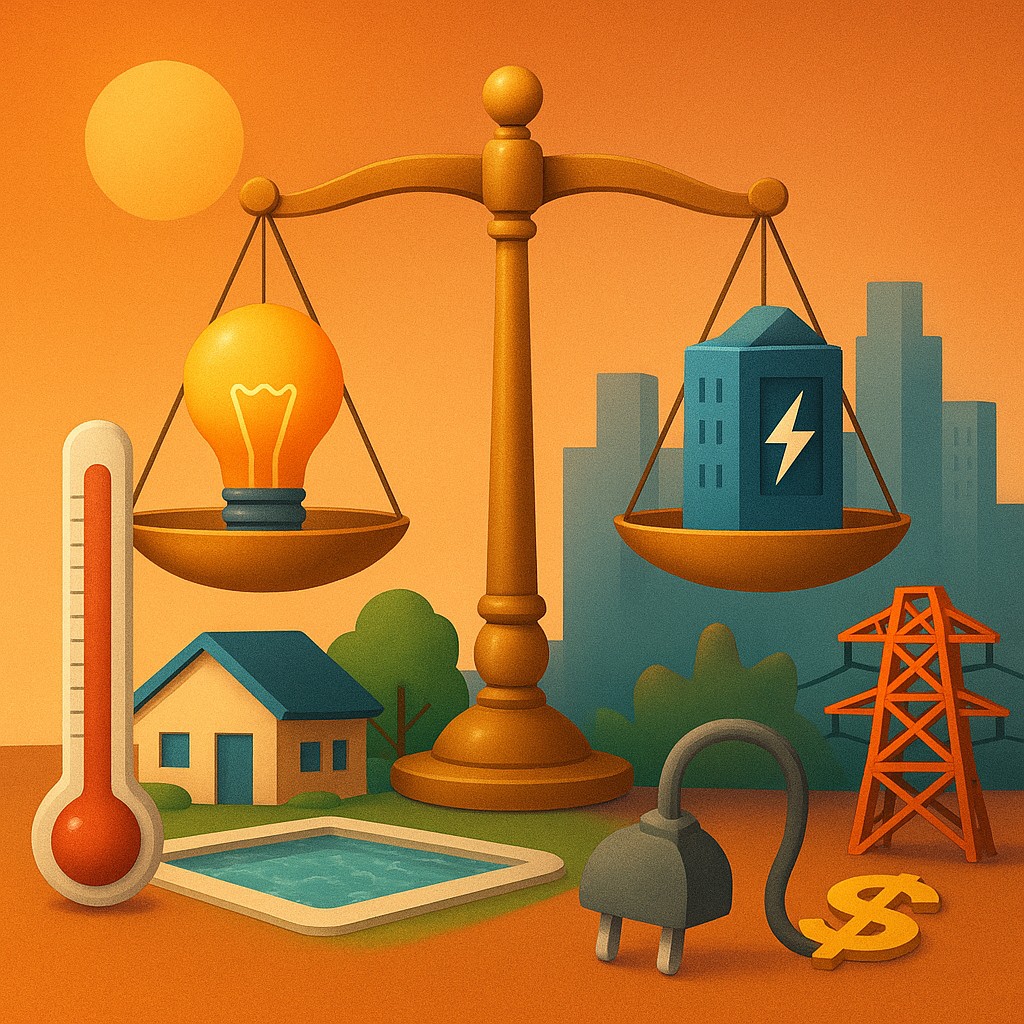
Imagine for a moment that you are a high-level logistics manager for a city’s water supply. Usually, your job is easy: people drink water, take showers, and wash their cars at various times throughout the day, and your pipes handle the flow perfectly. But then, a massive heatwave strikes. In a sudden, synchronized movement, every single citizen decides to fill up a backyard swimming pool at exactly 5:00 PM. The pressure in your pipes drops to zero, the main pumps groan under the strain, and eventually, the whole system collapses. This is exactly what happens to our electrical grid during a summer heatwave. The only difference is that instead of water, we are dealing with electrons, and instead of empty pools, we are dealing with millions of air conditioners humming at full blast all at once.
The challenge of the modern power grid is that electricity is a "just in time" product. We haven't yet mastered the art of storing massive, city-sized amounts of energy in batteries cheaply enough to handle every spike. This means that at any given second, the amount of electricity being generated must perfectly match the amount being used. If the demand side of the scale suddenly outweighs the supply side, the grid doesn't just "slow down" like a congested highway; it breaks. To prevent catastrophic blackouts, grid operators have historically relied on "peaker plants." These are expensive, high-pollution backup generators that only run a few days a year. However, a smarter, more elegant solution is emerging: using the power of the wallet to change how we use the wires.
The Invisible Hand on the Thermostat
To understand congestion pricing for electricity, we first have to look at how we usually pay for power. For decades, most of us have paid a flat rate. Whether you toast a bagel at 3:00 AM or run a clothes dryer at 4:00 PM on the hottest day of July, the price per kilowatt-hour remains the same. This is convenient for the consumer, but it creates a massive disconnect between the cost of the service and the reality of the infrastructure. In the world of flat rates, there is zero incentive to wait until midnight to run your dishwasher. You are essentially being shielded from the "traffic jams" of the energy world, even as you help cause them.
Congestion pricing, often called "dynamic pricing" or "time-of-use" (TOU) rates, removes that shield. It introduces a financial feedback loop where the price of electricity fluctuates based on how much strain the grid is under. When the sun is high and the air is thick with humidity, the price goes up. When the city goes to sleep and power plants are idling, the price drops significantly. By sending these price signals, utility companies are asking consumers to act as mini-grid managers. If you see that electricity will be three times more expensive between 4:00 PM and 9:00 PM, you might decide to wait until the "off-peak" hours to do your laundry, effectively smoothing out the "clog" in the system without needing a single new power plant.
Taming the Duck Curve with Financial Signals
Renewable energy has introduced a fascinating and slightly adorable-sounding problem known as the "Duck Curve." During the day, solar panels across the country crank out massive amounts of clean energy, often producing more than we can use. This creates a "belly" in the demand curve as the need for traditional power plants drops. But as the sun sets, solar production nose-dives just as people come home from work and turn on their lights and appliances. This creates a "neck," a steep, vertical spike in demand that traditional power plants must scramble to meet in a matter of minutes.
Congestion pricing is the primary tool used to bridge this gap. By making electricity incredibly cheap or even free during those high-solar afternoon hours, utilities encourage people (and automated smart home systems) to "load shift." This might mean pre-cooling your home at 2:00 PM when energy is abundant, then letting the temperature drift up slightly during the evening peak. It turns the grid from a rigid, fragile system into a flexible, breathing organism that adapts to its environment. Instead of forcing supply to always chase demand, we are finally asking demand to follow the rhythm of supply.
| Pricing Model |
How it Works |
Consumer Behavior |
Grid Impact |
| Flat Rate Pricing |
One price regardless of time or grid health. |
Use power whenever; no incentive to save. |
High risk of peak-hour overloads. |
| Time-of-Use (TOU) |
Pre-set windows (e.g., cheaper at night). |
Shift chores to predictable low-cost times. |
Moderates "Duck Curve" spikes. |
| Critical Peak Pricing |
Rates skyrocket only during emergencies. |
Drastic temporary reduction in usage. |
Emergency stabilization; prevents blackouts. |
| Real-Time Pricing |
Prices change hourly based on market. |
High engagement (often automated by tech). |
Maximum efficiency and flexibility. |
The Mechanics of the Load Shift
You might wonder how a few cents difference per kilowatt can actually save a multi-billion dollar grid. The secret lies in "aggregated impact." While one household delaying a load of laundry doesn't matter much, a hundred thousand households doing so creates a massive "virtual power plant." If a utility can convince a city to reduce its collective demand by 50 megawatts during a heatwave, that is 50 megawatts of electricity they don't have to buy from an expensive, polluting gas turbine. It is far cheaper and cleaner to pay people to stay off the system than it is to build more infrastructure.
This shift is increasingly being managed not by humans, but by algorithms. Modern smart thermostats and Wi-Fi enabled appliances can be programmed to respond to these pricing signals automatically. Your water heater might "see" that prices are rising and decide to shut off for two hours, knowing that the water inside will stay hot enough for your needs. Your electric vehicle might wait until 2:00 AM to start charging because it was notified by the grid that the "congestion" has cleared. This creates a world where the consumer saves money, the utility avoids a crisis, and the environment breathes a sigh of relief.
Navigating the Equity and Logic Gap
Despite the mathematical elegance of congestion pricing, there is a significant human challenge to overcome: the flexibility gap. Not everyone has the luxury of choosing when they use power. A high-income family might have a well-insulated home, a smart thermostat, and a battery-powered Tesla that can feed power back into the grid. For them, congestion pricing is a game they can win. However, a low-income family living in a poorly insulated apartment with older, inefficient appliances might not have the same agency. If they are working a late shift and need to cook dinner for their children at 6:00 PM, they are forced to pay the highest rates without any alternative.
Public policy experts are currently grappling with how to make these "smart" grids fair. Suggestions include providing subsidies for weatherization - making homes more energy efficient - in low-income neighborhoods or offering "bill protection" during the first year of a transition to dynamic pricing. There is also the "misconception factor." Many people fear that dynamic pricing is a hidden tax or a way for utilities to price-gouge. In reality, when implemented well, it is a revenue-neutral tool. The goal isn't to make more money for the utility, but to lower the total cost of running the grid, which eventually lowers everyone's bills by avoiding the need for those incredibly expensive backup plants.
Moving Toward a Responsive Future
We are entering an era where the relationship between the consumer and the socket is becoming a two-way conversation. The "silent" grid of the 20th century is being replaced by a digital marketplace where every light bulb and battery can contribute to stability. Congestion pricing is the language of that conversation, translating the physics of the grid into the incentives of the household. It requires us to think a bit more about our habits, but the reward is a system that is more resilient, much greener, and ultimately more intelligent.
As you consider the gadgets in your home, think of them not just as tools for your convenience, but as participants in a global mechanical orchestra. By understanding the ebb and flow of energy, you become more than just a consumer; you become a vital part of the solution to one of our greatest engineering challenges. The next time a heatwave rolls in, you won't just be hiding from the sun, you will be part of a sophisticated, synchronized effort to keep the lights on for everyone. The future of energy isn't just about better batteries or bigger windmills; it's about better thinking, and you are now leading the charge.