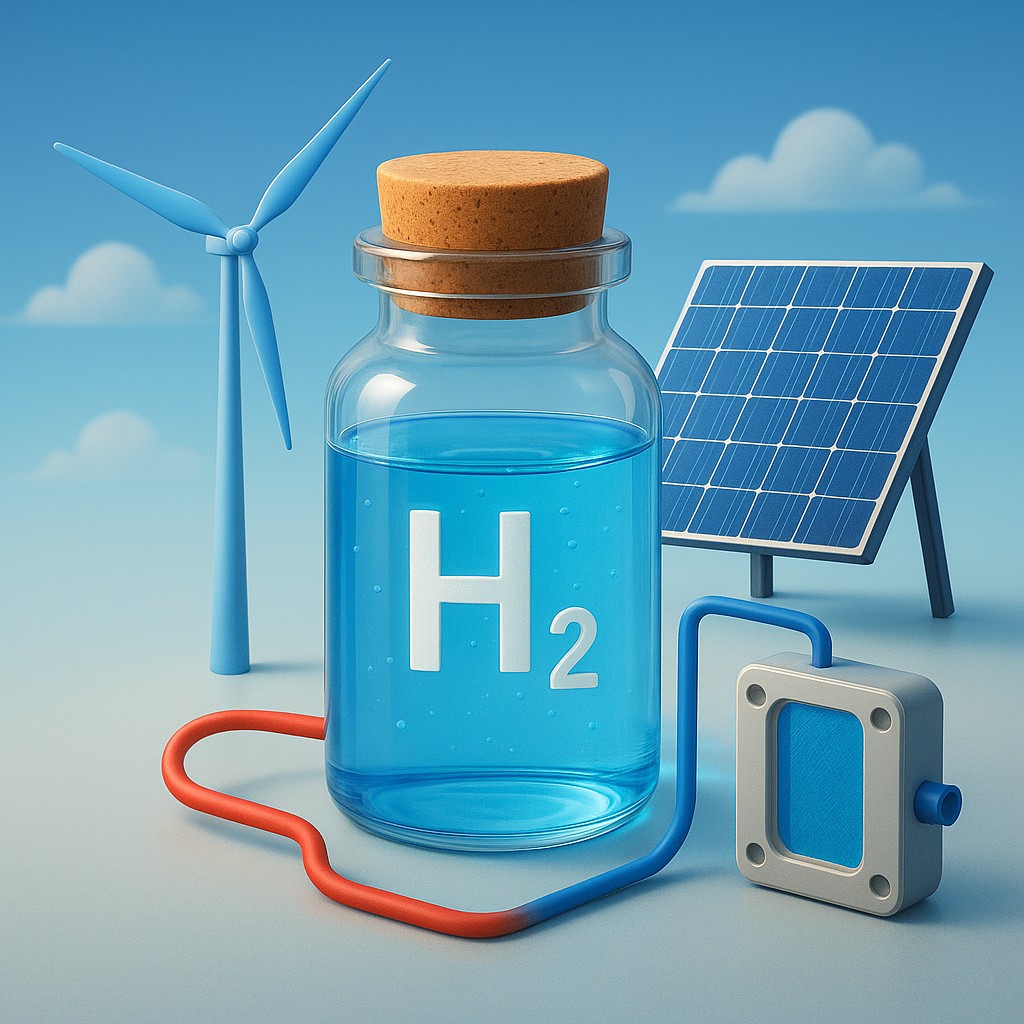
Imagine trying to capture a hurricane in a bottle or store a bright sunny afternoon in a closet to use on a cold November night. This is exactly the puzzle facing modern power grid engineers. The wind blows whenever it feels like it, and the sun shines on its own schedule, often producing massive amounts of power right when we need it least. This "surplus" energy is one of the greatest wastes of our time. If we don't use it instantly, it literally vanishes into thin air because we lack reservoirs large enough to hold it for the long term.
This is where a fascinating technology steps in, turning volatile electricity into a tangible, storable, and transportable fuel. By using chemistry instead of giant batteries, we can now convert these gusts of wind into hydrogen molecules. This method does more than just smooth out spikes in production; it offers a bridge between the world of electricity and heavy industry. When you understand how a simple membrane can dictate the future of our energy mix, you realize that the green transition isn't just about panels and blades - it’s about knowing how to keep what nature generously offers.
The Secret Inside a Drop of Water
To understand how we make this "green hydrogen," we have to go back to a chemistry concept many of us saw in middle school: electrolysis. The principle is move-your-feet simple. You take water (H2O), dip in two electrodes connected to a power source, and watch the molecules split apart. On one side you get oxygen, and on the other, hydrogen. However, for this reaction to be truly "green," the electricity used must come from renewable sources. If you use a coal plant to do this, the carbon footprint is a disaster. But with a wind turbine, it becomes something like magic.
The cutting-edge technology currently leading the market is called Proton Exchange Membrane electrolysis, or PEM. Unlike older methods that used corrosive liquids, PEM relies on a solid material - a specialized polymer filter. This filter has a very specific mission: it only lets protons pass through. This selectivity is what allows the system to produce exceptionally pure hydrogen, ready to be compressed and stored without needing complex extra processing.
This process is perfectly suited to the whims of the weather. Unlike traditional electrolyzers that need time to "warm up" and stabilize, PEM systems can switch on and off in seconds. If a cloud passes over the sun or the wind suddenly dies down, the machine adjusts its consumption almost instantly. This flexibility makes it the ideal partner for intermittent energy, acting like a sponge that can soak up power surpluses the moment they appear.
A Selective Membrane for Molecular Sorting
The heart of the PEM system is a masterpiece of materials engineering. Imagine a very sophisticated sheet of plastic acting like an ultra-selective club bouncer. Inside the electrolyzer, water is sent to the anode (the positive side). Under the force of the electric current, the water molecules are torn apart. Oxygen is released, but the hydrogen nuclei stripped of their electrons - known as protons - must cross the membrane to reach the cathode (the negative side). Meanwhile, the electrons are forced to go around the membrane through an external circuit, creating the flow necessary for the chemical transformation.
Once the protons cross this polymer border, they reunite with their electrons on the other side to form hydrogen gas (H2). This gas is then collected, ready to be stored in large high-pressure tanks or even in underground salt caverns. What makes PEM superior is that the membrane is so thin and efficient that it allows for very high current densities. You can produce a lot of hydrogen in a relatively small device, which is crucial for installing them at industrial sites or near offshore wind farms.
Other types of electrolysis exist, of course, such as alkaline electrolysis, which has been around for over a century. While the latter is cheaper to buy, it is much bulkier and less reactive. The following table provides a better look at the fundamental differences between these two major approaches competing in the global energy market.
| Feature |
Alkaline Electrolysis |
PEM Electrolysis |
| Reaction Environment |
Liquid potassium solution |
Solid polymer membrane |
| Responsiveness |
Slow (hard to sync with grid) |
Ultra-fast (ideal for wind/solar) |
| Gas Purity |
Moderate (requires cleaning) |
Very high (ready to use) |
| System Size |
Bulky and heavy |
Compact and modular |
| Materials Used |
Nickel and steel (inexpensive) |
Platinum and Iridium (very expensive) |
The Precious Metal Dilemma and the Race for Innovation
If PEM technology is so efficient, why don't we see it on every street corner yet? The main obstacle lies deep inside the machine. For the chemical reaction to happen quickly and efficiently, catalysts are needed. These are substances that speed up the reaction without being consumed. The problem is that the best catalysts for PEM are extremely rare and expensive metals, mainly platinum and iridium. Iridium, in particular, is one of the rarest elements in the Earth's crust, produced in tiny amounts each year.
This reliance on precious metals creates an economic and geopolitical bottleneck. As long as we need large amounts of iridium for every megawatt of capacity, the price of green hydrogen will stay higher than hydrogen produced from natural gas. Researchers around the world, from Europe to China, are working hard to reduce this load. The goal is to "sprinkle" the metal so thinly - almost at the atomic level - that we can get the same performance with ten times less material.
Recent projects lead by major industrial groups in Germany and Australia are already testing next-generation membranes that require fewer noble metals. Scientists are also exploring alternative alloys or nanoscale structures to maximize the contact surface. It is a true race against time: if we can lower the manufacturing costs of these electrolyzers, green hydrogen will become competitive with fossil fuels in no time.
A Fuel Cell in Reverse to Clean Up Industry
Once we have produced and stored this hydrogen, what can we do with it? This is where the magic of versatility comes in. Hydrogen isn't just a way to store electricity; it is also a vital chemical ingredient for sectors that are considered "hard to abate" or difficult to clean up. Think of steel manufacturing, which normally requires massive amounts of coal. By replacing coal with green hydrogen, we can produce steel where the only waste product is water vapor. This is a total industrial revolution.
You can also think of the PEM electrolyzer as the mirror image of the fuel cells found in some buses or trucks. In a vehicle, you inject hydrogen to create electricity and turn the wheels. In an electrolyzer, you do the opposite: you inject electricity to create fuel. This closed cycle makes it possible to imagine heavy-duty trucks or cargo ships crossing the oceans without emitting a single gram of CO2, simply using solar energy captured months earlier and turned into gas.
Furthermore, hydrogen can be processed into green ammonia for agricultural fertilizers or used in refineries to create synthetic fuels for aviation. This flexibility means that investing in PEM technology doesn't just benefit the power grid; it feeds the entire global economy. By connecting offshore wind farms directly to electrolyzers, we can create giant gas stations in the middle of the sea, capable of refueling the giants of the ocean with clean energy.
Toward a Future Where Energy Is Never Lost
There is still a long way to go before green hydrogen becomes the global standard, but the pieces of the puzzle are falling into place quickly. Electrolyzer "gigafactories" are popping up everywhere, signaling the shift from lab experiments to mass industrial production. By scaling up production, we will drive down prices, exactly as happened with solar panels a decade ago. PEM technology, with its ability to dance to the rhythm of renewable energy, is the cornerstone of this new energy landscape.
Imagine a world where a winter storm is no longer a threat to the grid, but an opportunity to fill our hydrogen reserves for the entire spring. Imagine isolated regions, rich in wind or sun, becoming the new energy superpowers by exporting their surplus as gas. This transition isn't just an environmental necessity; it is an invitation to rethink our relationship with resources. We are finally learning to stop simply enduring nature’s cycles and instead embrace them, capturing every stray electron to turn it into a molecule for the future. The journey to a carbon-free economy is complex, but with hydrogen as our compass and PEM technology as our engine, we finally have the tools to turn climate ambitions into a tangible, lasting reality.