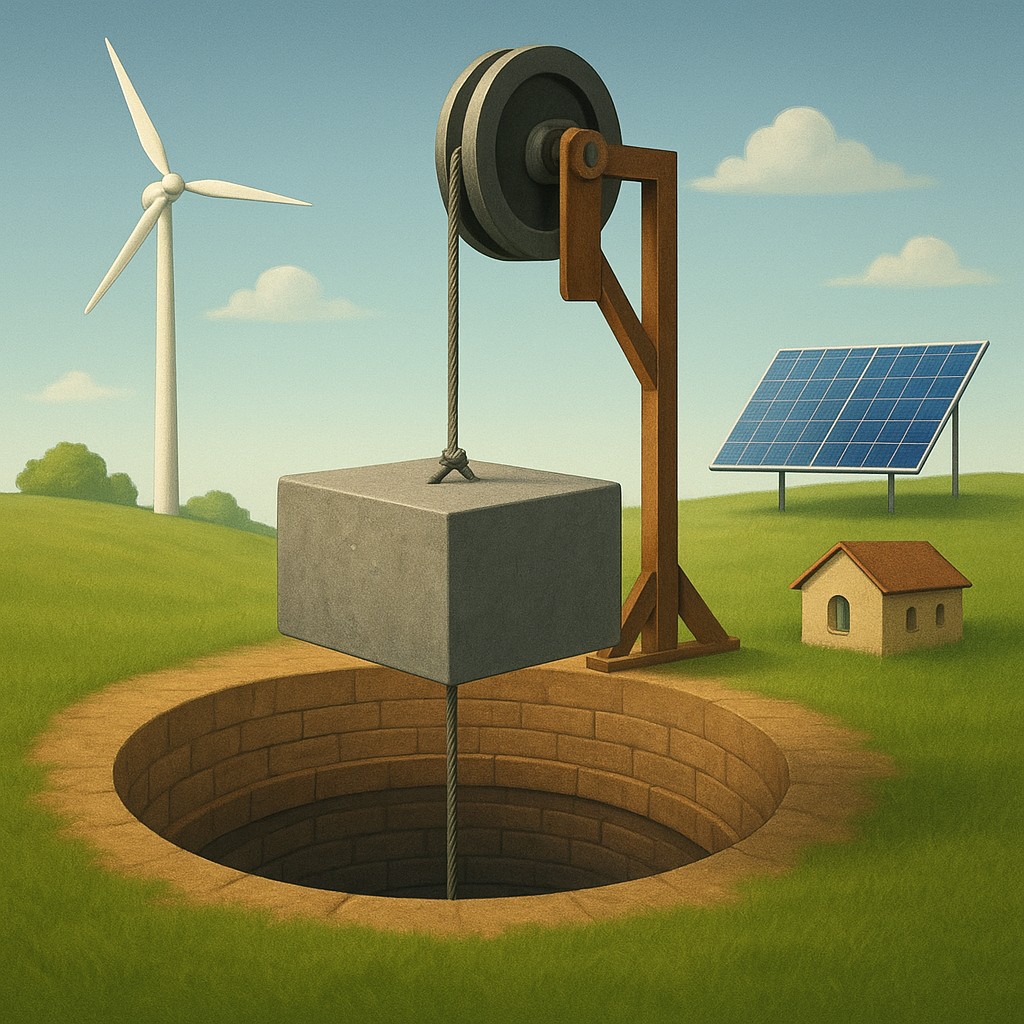
Imagine for a moment that you are holding a tennis ball above your head. In this exact second, nothing seems to be moving, yet you have "created" something fascinating: potential energy. If you let go, that energy immediately turns into motion. Now, swap that small ball for a concrete block as thick as a house, and imagine lifting it hundreds of feet into a deep, abandoned mine shaft. You have just built a massive battery capable of powering thousands of homes without using a single gram of lithium or cobalt.
The biggest hurdle in our transition to green energy isn't necessarily producing electricity - the sun and wind are already great at that. The real challenge is storing it for those times when the air is still or the sky is pitch black. While we desperately hunt for the "next big thing" in chemical batteries, science is revisiting a disarmingly simple solution based on the fundamental laws of Sir Isaac Newton. Gravity batteries turn old industrial sites into giant, mechanical "clocks" that can feed energy back into the grid with a level of reliability that modern tech struggles to match.
The Unlikely Marriage of Newton and the Power Grid
To understand how a weight dropping down a hole can light up your living room, you have to look at one of the most basic forces in the universe: gravity. Any object lifted against this force stores energy. The heavier the object and the higher it goes, the more "work" it holds in reserve, waiting to be released. This is the core principle of gravity batteries. When the sun is shining and our solar panels produce more electricity than we need, we use that extra power to run massive electric winches. These winches pull colossal weights - sometimes hundreds of tons - from the bottom of a mine shaft up to the surface.
The process flips the moment the demand for electricity outpaces what we are producing. The brakes are released, and gravity takes over. As the weight slowly descends, it pulls on a cable that spins a turbine or generator. It works exactly like a bicycle dynamo, but on an industrial scale large enough to stabilize a national power grid. This energy transfer is incredibly efficient, often reaching over 80 percent. This means very little electricity is wasted during the up-and-down cycle.
The most elegant part of this technology is how long the hardware lasts. Unlike a smartphone battery that starts losing its charge after a few hundred uses, a concrete block and a steel cable suffer almost zero chemical wear. You can "charge" and "discharge" them tens of thousands of times over fifty years without the system failing. It is a storage solution that doesn't overheat, carries no fire risk from flammable liquids, and doesn't degrade over time.
Digging into the Past to Power the Future
Using gravity isn't a brand-new idea. For decades, we have used pumped-storage hydropower, which involves pumping water up to a high reservoir. However, building dams requires specific geography, massive amounts of space, and carries a heavy environmental price tag. This is where old mines come in. All over the world, thousands of vertical shafts plunge to dizzying depths. Instead of letting them flood or sealing them off, energy companies see them as free, ready-made infrastructure.
Using an existing mine shaft slashes initial construction costs. The hole is already there, the support structure is often in place, and there is usually an existing connection to the power grid. Projects are already popping up in places like the Pyhäsalmi mine in Finland and abandoned coal shafts in Australia, turning these sites into "energy lungs." This shift also breathes new life into mining regions, creating green-tech maintenance jobs in places where fossil fuels left an economic void.
Moving from a coal mine - a symbol of a polluting past - to a gravity battery - a symbol of a clean future - is a rare bit of technological poetry. It is the ultimate circular economy: using the earth's scars to heal its atmosphere. By using weights made from mining waste or recycled concrete, the carbon footprint of construction is lowered even further. The system essentially becomes a giant physical "spring" built directly into the earth's crust.
Comparing Energy Storage Champions
To see where gravity fits into our energy toolkit, it helps to compare it to the current market leader: the lithium-ion battery. While lithium is unbeatable for cars and phones, it has its limits when it comes to storing enough power for an entire city over long periods. Here is how these two worlds stack up in the green energy transition.
| Feature |
Lithium-Ion Battery |
Gravity Battery |
| Lifespan |
10 to 15 years (limited cycles) |
30 to 50+ years |
| Environmental Impact |
Mining of rare metals |
Low (concrete, steel, iron) |
| Energy Density |
Very high (fits in small spaces) |
Low (requires great heights) |
| Maintenance Cost |
Low at first, then total replacement |
Simple but regular mechanical care |
| Response Time |
Instant (milliseconds) |
Fast (seconds to minutes) |
| Risk |
Chemical fires (thermal runaway) |
Standard mechanical risks (cable snaps) |
As you can see, gravity isn't going to replace the lithium in your pocket; the energy density is simply too low for that. To match the energy in a small electric car battery using gravity, you would have to lift a massive boulder to an impossible height. But for a city that needs to store daytime solar energy to keep the streetlights on all night, space isn't an issue if you go underground. Gravity's strength lies in its durability and the fact that it doesn't "thirst" for critical resources like cobalt.
Tempering Expectations Without Losing Momentum
Despite the excitement, we have to keep our feet on the ground. Gravity systems face major engineering hurdles. The first is scale. For a gravity battery to be profitable, the weights must be gargantuan. We are talking about blocks weighing up to 2,000 tons. Managing that much weight with precision - making sure cables don't snap and the weights don't swing - requires high-end engineering. The system must stay perfectly vertical, because any friction against the shaft walls would turn precious energy into useless heat.
Location is another roadblock. While there are plenty of abandoned mines, they aren't always located where people need the most power. Building new high-voltage lines to connect a remote mine to a major city can sometimes cost more than the battery itself. Because of this, some engineers are exploring "above-ground" versions, like storage skyscrapers that move concrete blocks within specially designed towers. However, these towers have to fight wind and weather, unlike their well-protected underground cousins.
Finally, there is the issue of "peak power." A chemical battery can dump a huge amount of energy all at once. A falling weight is limited by the speed at which it can safely descend. This makes gravity batteries excellent for providing steady power for several hours, but less suited for responding to ultra-fast power spikes that last only a few milliseconds. They are the marathon runners of the grid, not the sprinters.
A Future Anchored in Physical Stability
The beauty of science often lies in its ability to come full circle. We spent two centuries pulling materials out of the earth to power an industrial revolution based on burning fuel. Today, we are returning to those same holes to store the light of the sun. It is a strategy that values long-term wisdom over quick, temporary fixes. By choosing to work with massive mechanical systems, we gain a level of stability that complex chemical reactions can't always guarantee.
The future of our power grids likely won't rely on a single miracle technology, but on a mix of solutions. Lithium batteries will handle the fine-tuning and our cars, while gravity batteries provide the solid, tireless foundation for our modern lives. There is something deeply comforting about the idea that, as our gadgets become more complex and digital, our energy security might soon depend on something as tangible and honest as the weight of a stone block.
By learning to harness gravity once again, we aren't just storing kilowatt-hours. We are learning to build a world where technology respects the rhythm of the planet, using its own fundamental forces to protect the environment. It is an invitation to look beneath our feet with fresh eyes, seeing every old mine shaft not as a relic of the past, but as an opportunity for a cleaner, heavier, and far more stable future.