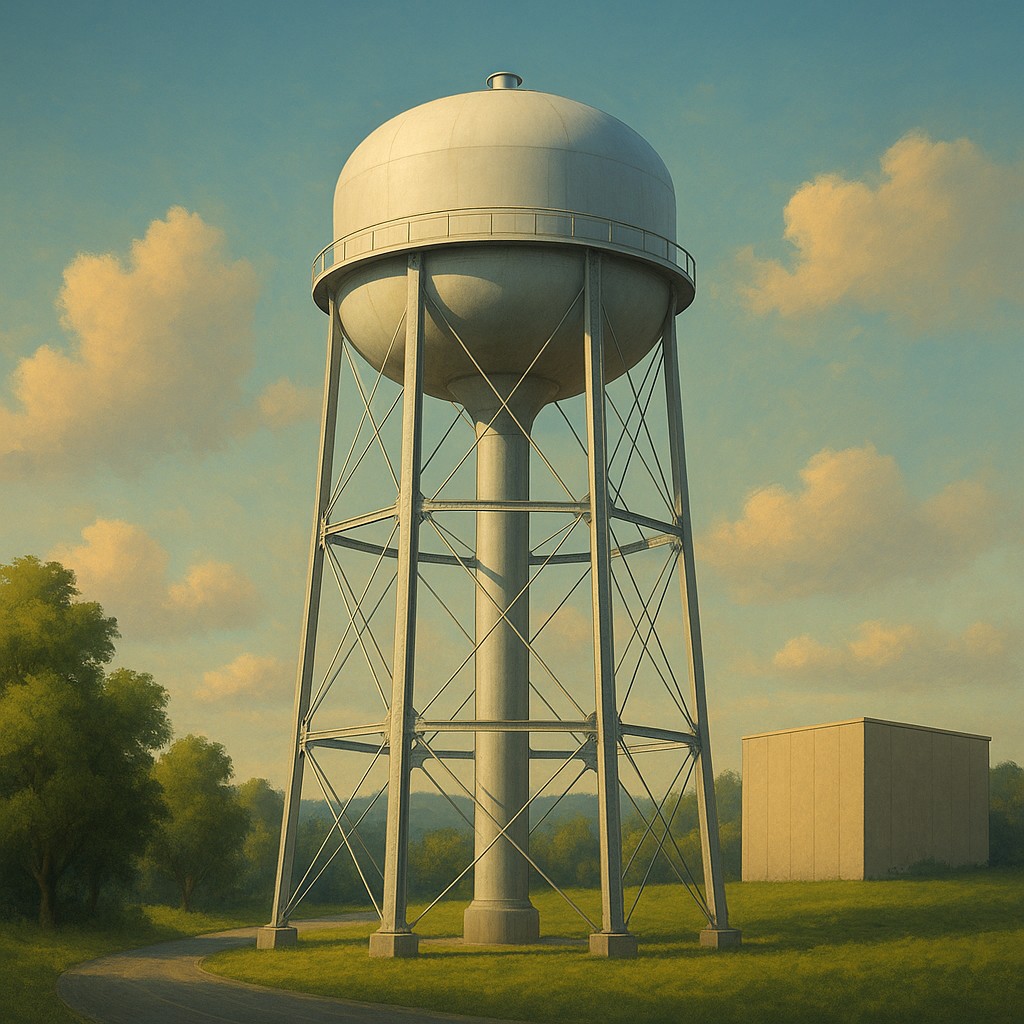
The next time you are driving down a highway and spot a giant, bulbous structure looming over the horizon, resist the urge to dismiss it as a mere industrial relic. These massive tanks, often painted with the name of a town or a high school mascot, are far more than passive containers. They are actually sophisticated mechanical batteries. They store physical potential energy to solve one of the most difficult problems in civil engineering. While we often think of "high tech" as something involving microchips and fiber optics, the water tower is a masterpiece of Victorian Era physics. It remains the most reliable way to keep your morning shower from turning into a pathetic trickle.
Imagine the chaos if a city tried to provide water by simply turning on a giant pump every time someone opened a faucet. Human demand for water is incredibly volatile. It swings from almost nothing at 3 AM to a massive, city-wide surge at 7 AM when everyone wakes up, brushes their teeth, and makes coffee. If the system relied solely on pumps, those machines would have to be enormous to handle the peak morning rush, yet they would sit idle and inefficient for the rest of the day. The water tower elegantly solves this by uncoupling supply from demand. This allows the city’s pumps to work at a steady, relaxed pace while gravity handles the heavy lifting of the morning rush hour.
The Architecture of Constant Pressure
To understand how a water tower functions, we have to look at the concept of hydrostatic pressure. Every foot you lift a column of water adds a specific amount of downward force, roughly 0.43 pounds per square inch (psi). If you want a town to have a standard household water pressure of about 50 to 60 psi, you do not necessarily need a fancy computer to regulate the flow. You just need to stick a massive tank of water about 130 feet up in the air. Gravity does not have a power switch, it does not need software updates, and it never takes a day off. It is the ultimate reliable employee.
This height creates a "pressure head." Because the water in the tower is connected to the pipes in your house, the weight of the water in that elevated tank is constantly pushing down on the entire system. When you open your tap, you are not waiting for a pump at the treatment plant to kick into high gear. Instead, you are simply opening a valve that allows the existing pressure, created by the height of the tower, to push water out of your faucet. It is an immediate, physical reaction that happens at the speed of falling weight rather than the speed of a mechanical motor starting up.
Balancing the Daily Load
Modern life is a series of spikes and valleys. If we look at the "diurnal demand curve," which is just a professional way of describing how much water people use throughout the day, we see two massive humps. The first is in the early morning, and the second is in the early evening when people come home to cook dinner and do laundry. During these peaks, cities actually use water faster than treatment plants can produce it. Without a tower, the pipes would simply run dry, or the pressure would drop so low that the water would barely move.
During these high-demand periods, the water level in the tower slowly drops. It is essentially "discharging" its stored energy to help the pumps. Then, late at night when the town is asleep and water usage is near zero, the pumps continue to hum along at their most efficient speed. Instead of the water going to people's homes, it is redirected up into the tower, refilling the tank and "recharging" the battery for the next morning. This allows the city to use smaller, more energy-efficient pumps that run at a constant rate, extending their lifespan and saving taxpayers a fortune in electricity costs.
| Feature |
Pump-Only System |
Water Tower System |
| Energy Efficiency |
Low (Pumps must work harder during peaks) |
High (Pumps run at steady, optimal speeds) |
| Reliability |
Fails immediately during power outages |
Provides hours of flow via gravity |
| Equipment Size |
Requires massive, expensive backup pumps |
Uses smaller, standardized pumps |
| Pressure Stability |
Hard to regulate; fluctuates wildly |
Incredibly stable and predictable |
| Emergency Use |
Limited by current pumping capacity |
Large reserve for firefighting and pipe breaks |
The Physics of the Elevated Battery
We often define a "battery" as a chemical cell, like the lithium-ion one in your phone. However, in the world of physics, a battery is simply any device that stores energy for later use. Water towers are a form of "pumped hydro storage." By using electricity to move water from the ground to the top of the tower, engineers convert electrical energy into gravitational potential energy. This energy can be stored indefinitely without leaking away. While a chemical battery might degrade or lose its charge over several months, a full water tower is just as "charged" ten years later as it was the day it was filled.
The shape of the tower is also a deliberate engineering choice. You might notice that many towers look like giant golf tees or mushrooms. This is because the goal is to keep as much of the water as possible at the same high elevation. If you used a tall, skinny cylinder, the pressure would drop significantly as the water level went down. By putting the majority of the water in a wide, bulbous bowl at the very top, engineers ensure that the pressure remains relatively constant even as the tank empties. This clever geometry creates a steady discharge rate, much like how modern electronics use voltage regulators to ensure your phone screen does not dim as the battery hits 20 percent.
The Quiet Guardian of Public Safety
Beyond the convenience of a good shower, these towers serve a much more critical role: fire protection and emergency resilience. When a fire hydrant is opened, it requires a massive, instantaneous volume of water that no standard pumping station could provide on its own. The water tower acts as a massive buffer, allowing firefighters to draw thousands of gallons per minute to douse a blaze. This is why insurance companies look at the proximity and capacity of water towers when calculating fire risk for a neighborhood. Without that elevated reserve, a single major fire could drain the pressure from the entire city's water system.
Furthermore, water towers provide a critical safety net during power outages. If a storm knocks out the electricity to the municipal pumps, the water does not stop flowing. Because the energy is already stored in the height of the water, the system can continue to provide pressurized, clean water to homes and hospitals for several hours, or even a day. This prevents the "backflow" of contaminated groundwater into the pipes, which can happen if the pressure in the lines drops to zero. The tower is not just about convenience; it is a vital layer of public health infrastructure.
Overcoming the Resistance of the Pipes
You might wonder why we need so much pressure in the first place. The answer lies in "friction loss." As water travels through miles of underground pipes, it rubs against the walls, losing energy and pressure along the way. This is known as "head loss." If a city is very spread out, the water tower at one end of town has to push hard enough so that the person at the far end of the pipe still gets a decent flow.
Engineers have to carefully calculate the "hydraulic grade line," mapping out how the pressure will drop as the water travels through various neighborhoods. In hilly areas, this becomes even more complex. A house sitting on a tall hill might have very poor pressure if it is nearly at the same height as the water tower. To solve this, cities often have different pressure zones, each with its own tower or set of booster pumps. It is a massive, invisible 3D puzzle that plays out beneath our feet every day, ensuring that regardless of whether you live in a valley or on a ridge, your faucet behaves exactly the same way.
Appreciating the Invisible Giant
It is easy to walk past a water tower and see it as an eyesore or a boring piece of concrete and steel. But in reality, it is a testament to the power of simple physics solving complex human problems. It is a mechanism that requires no computers to function, a battery that never wears out, and a silent guardian that ensures fire hydrants are always ready. It turns the chaotic, unpredictable nature of human life into a smooth, steady, and manageable flow.
As our world becomes increasingly reliant on complex digital systems, there is something deeply comforting about a technology that uses nothing more than the weight of the Earth itself to keep us safe. The water tower reminds us that the best solutions are often the ones that work with nature rather than trying to overpower it. So, the next time you see one of those steel giants standing tall above the trees, give it a little nod of respect. It has been working hard all night just so you can have your morning coffee without a second thought.