Imagine a material so thin you cannot see it with the naked eye, so light that a sheet the size of a notebook would weigh less than a single grain of rice, and so strong you could hang a car from a ribbon made of it. It sounds like science fiction, but this material is real and it has already changed how scientists and engineers think about materials. Its name is graphene, and its combination of simple structure and striking properties makes it one of the most exciting discoveries of the 21st century.
You have probably heard exaggerated claims: graphene will replace silicon, cure diseases, or make flying cars possible. Some of that is hype, but much of the enthusiasm is justified. This Learning Nib will take you from the basic idea of what graphene is to the ways it is used today, how it might reshape key technologies, and where reality still lags the headlines. Along the way you will learn the core science in plain terms, the practical obstacles, and how to tell real breakthroughs from marketing spin.
What a single layer of carbon can teach us about materials
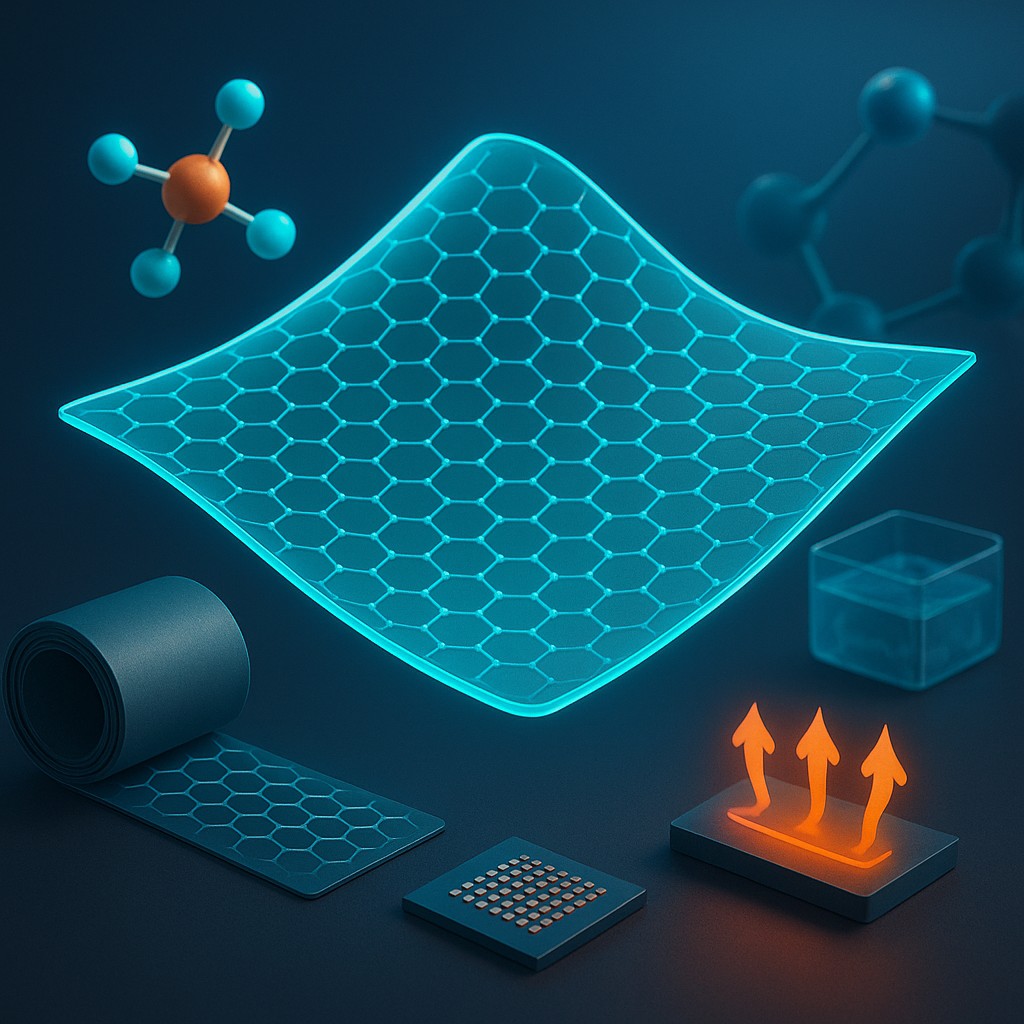
Graphene is a single, one-atom-thick sheet of carbon atoms arranged in a hexagonal, chicken-wire pattern. Picture an atomic-scale sheet of chicken wire where each vertex is a carbon atom. That simplicity matters because physics changes when a material becomes two-dimensional. Electrons in graphene behave differently than in ordinary materials - they act as if they have no mass and move at a substantial fraction of the speed of light inside the sheet. That produces exceptional electrical conductivity, mechanical strength, and unusual optical behavior.
Because it is one atom thick yet continuous over large areas, graphene combines properties that rarely coexist. It is both transparent and an excellent electrical conductor. It is flexible and incredibly strong - stronger than steel by strength-to-weight ratio. It lets scientists probe quantum physics with tabletop experiments, so it is both a fundamental research tool and an engineering marvel. The key point is that graphene is not a single miraculous property - it is the rare coexistence of many outstanding properties in one ultra-thin material.
How graphene is made today - simple to sophisticated routes
Making graphene ranges from peeling flakes off graphite with sticky tape - yes, that really happened - to advanced chemical and high-tech manufacturing methods. The first graphene samples came from mechanically exfoliating graphite with tape, a technique that earned Andre Geim and Konstantin Novoselov the 2010 Nobel Prize in Physics. That approach is ideal for lab experiments but not scalable for industry.
Three broad production routes dominate in practice. The first is mechanical exfoliation, primarily used for research. The second is chemical vapor deposition, or CVD, where carbon-containing gases form graphene on metal surfaces at high temperature. CVD can produce large-area sheets suitable for electronics and flexible displays. The third is chemical or liquid-phase methods, which exfoliate graphite into graphene oxide or reduced graphene oxide. Those solutions can be made into inks, composites, and membranes. Each method balances cost, quality, and scale - CVD yields high-quality sheets at higher cost, while chemical methods are cheaper but introduce more defects.
Quality and defect control are central concerns. Imperfections in the carbon lattice, grain boundaries, and contamination reduce performance. For many applications, such as high-frequency electronics or sensitive sensors, near-perfect graphene is required. For others, like composite materials or conductive inks, lower-grade graphene still delivers useful improvements. Choosing the right production route for a given application is a practical part of judging whether graphene can offer a revolutionary advantage.
The standout properties that make graphene special
Graphene's appeal rests on a handful of extraordinary but measurable properties. Summarizing them makes the later applications easier to follow.
- Electrical conductivity: Electrons travel extremely fast in graphene, giving it excellent conductivity and very high carrier mobility. That makes it attractive for high-speed electronics and sensitive sensors.
- Mechanical strength and flexibility: Per unit thickness, graphene is stronger than almost any known material. It can bend without breaking, which suits flexible electronics and composite reinforcement.
- Thermal conductivity: Graphene conducts heat very efficiently, useful for managing temperatures in devices and systems.
- Optical transparency: A single layer absorbs about 2.3 percent of visible light, so it is almost transparent while still conducting electricity - a rare combination for transparent electrodes.
- Impermeability: Perfect graphene is impermeable to gases and liquids of all sizes, opening possibilities for ultrathin barriers and membranes.
These are not advertising slogans. They are measurable, repeatable properties that in many ways outperform conventional materials. The challenge is scaling those properties from tiny lab samples to real-world components that are affordable, reliable, and manufacturable.
Where graphene is being used today - early wins and practical examples
Graphene already appears in a number of niche commercial and experimental products. While it has not replaced the capacitor in your smartphone, practical uses are emerging where graphene offers clear advantages.
- Composite materials: Adding small amounts of graphene to polymers or metals can increase strength, stiffness, and durability, useful in sports gear, aerospace parts, and automotive components.
- Conductive inks and coatings: Graphene-based inks are used for flexible electronics, printed sensors, and EMI shielding because they combine conductivity with mechanical flexibility.
- Sensors: Because graphene's conductivity shifts with tiny chemical or mechanical changes, it enables exceptionally sensitive gas, biological, and pressure sensors.
- Thermal management: Graphene is used in heat spreaders and other thermal interface materials to help cool electronics more effectively.
- Filtration and membranes: Graphene oxide membranes can selectively filter ions and molecules, showing promise in desalination, wastewater treatment, and energy-efficient separations.
Each of these areas represents a realistic near-term application where graphene's unique blend of properties delivers measurable improvement. Often the gains are incremental rather than revolutionary, but incremental improvements across many industries can become transformative over time.
How graphene could transform electronics, energy, and materials
This is the fun part - realistic revolutions that could reshape whole industries once practical issues are solved. The key is to imagine changes grounded in how graphene's properties uniquely match the problem.
Electronics and photonics - Graphene's high carrier mobility and thinness make it ideal for ultrafast transistors, terahertz devices, and flexible displays. It will not replace silicon everywhere, but it could enable new device classes - for example, transparent, flexible electronics that wrap around your wrist or smart glass that doubles as a display. Graphene photodetectors and modulators could speed up optical communications and sensing.
Energy storage and conversion - Graphene can improve batteries and supercapacitors by boosting conductivity and increasing electrode surface area. Graphene-enhanced electrodes allow faster charging, higher power output, and longer lifetimes. In solar cells, graphene electrodes may improve stability and enable flexible, lightweight photovoltaics. The potential revolution is faster-charging, longer-lasting energy storage that better supports electric vehicles and grid-level storage.
Water and gas separation - Graphene oxide membranes can let water molecules pass while blocking salts and contaminants. Scalable, low-energy desalination could transform water supply in arid regions. Similarly, ultrathin graphene-based membranes could enable highly energy-efficient gas separations for industry, cutting emissions and costs.
Structural materials and composites - Adding small amounts of graphene to plastics or metals can deliver major mechanical improvements without a big weight penalty. Lighter, stronger components in aviation and automotive sectors lead to fuel savings and lower emissions. Combined with additive manufacturing, that enables complex, optimized parts that can also contain embedded sensing capabilities.
Sensors and health - Graphene's surface sensitivity and biocompatibility open possibilities for wearable health monitors that detect biomarkers in sweat or tears, and for implantable sensors that provide continuous monitoring with minimal bulk. Paired with advances in AI and data analytics, real-time personalized health feedback becomes more plausible.
A quick comparison: graphene versus classic materials
| Property or use |
Graphene (single layer) |
Copper |
Silicon |
Steel |
| Electrical conductivity |
Very high, plus unique carrier behavior |
High |
Semiconductor - depends on doping |
Low |
| Mechanical strength (strength-to-weight) |
Exceptional |
Moderate |
Brittle - not structural material |
High absolute strength, heavy |
| Flexibility |
Extremely flexible |
Limited |
Rigid brittle wafers |
Limited, heavier |
| Thermal conductivity |
Very high |
High |
Moderate |
Moderate to high |
| Optical transparency |
Nearly transparent |
Opaque |
Opaque |
Opaque |
| Typical use case today |
Sensors, composites, electrodes |
Wiring, heat sinks |
Electronics, chips |
Structural components |
| Scalability/cost today |
Improving, variable |
Mature, low cost |
Mature, moderate cost |
Mature, low cost |
This table simplifies complex details but highlights why graphene fits into niches rather than outright replacing established materials. Its mix of lightweight strength, conductivity, and transparency is rare and valuable.
Common myths and realistic limits - separating hype from hope
Several recurring misconceptions about graphene deserve correction. First, graphene is not a single miracle material that will magically replace everything. Different applications require different grades and quantities of graphene, and in many cases traditional materials will remain superior or cheaper. Second, "graphene" is sometimes used loosely in marketing - graphene oxide, reduced graphene oxide, few-layer graphene, and graphite nanoplatelets are distinct materials with different properties. Not all of them behave like pristine single-layer graphene.
Third, large-scale, defect-free graphene production remains difficult. Defects, contaminants, and grain boundaries can drastically reduce performance, so manufacturing must improve for many high-end applications. Fourth, safety and environmental impacts need careful study. Some graphene forms could pose inhalation risks if mishandled, and lifecycle analyses are still developing. Responsible adoption requires understanding these limits and investing in manufacturing, standards, and testing.
How scientists and companies are solving the practical hurdles
Moving from lab bench to factory floor requires better production, quality control, and device integration. For production, researchers are refining CVD processes to grow larger, more uniform sheets and developing roll-to-roll techniques for continuous manufacturing. For chemical methods, improved reduction and purification aim to produce more conductive, less defective materials suitable for inks and composites.
Standards and testing protocols are emerging to ensure consistent quality. Collaborative efforts among universities, industry, and government labs focus on scaling membranes, integrating graphene into battery electrodes, and demonstrating long-term stability. Economies of scale matter - as production ramps, cost per unit area should fall, enabling broader use. Regulatory frameworks and safety guidelines are also being developed to reduce environmental and health risks during production and disposal.
How to spot genuine breakthroughs and what to watch next
With abundant press coverage, it helps to distinguish meaningful advances from press releases. A genuine breakthrough usually includes reproducible data from independent labs, demonstration of a scalable manufacturing route or integration into a useful device, and transparent reporting of limitations. Be wary of one-off demonstrations that lack details on longevity, environmental conditions, or manufacturability.
Watch the next 5 to 15 years for: commercially viable CVD films for large-area electronics, graphene-based electrodes in commercial batteries and supercapacitors, industrial-scale membranes for desalination, and graphene composites in aerospace components. Also follow standardization efforts and safety regulations, because market-ready technologies need both performance and trust.
Small practical ways graphene could touch your life soon
If you want tangible near-term impacts, here are realistic examples that could reach consumers within a decade. Smartphones or wearables with graphene-enhanced batteries might charge faster and last longer. High-end sports equipment could become lighter and tougher with graphene-reinforced composites. Water filters with graphene oxide membranes could cut energy costs for desalination or make point-of-use filters more effective. Medical sensors embedded in clothing could monitor heart or glucose signals more accurately thanks to graphene’s sensitivity.
These do not imply an overnight transformation. They point to gradual but meaningful improvements that, taken together, could change product expectations: faster charging, lighter gear, better medical monitoring, and cleaner water at lower energy cost.
A friendly nudge to stay curious and grounded
Graphene teaches a useful lesson about how science advances: tiny layers can reveal huge possibilities, but turning possibilities into daily realities takes time, craft, and patience. The excitement is real because graphene's properties are genuinely exceptional. The revolution it promises will not arrive as a single headline-grabbing moment, but as a cascade of better-performing devices, safer processes, and new industries built on its unique strengths.
To keep learning, follow reputable research journals, watch for reproducible demonstrations, and pay attention to manufacturing announcements that report scale, costs, and standards. If you are a maker, experiment with graphene inks or composite materials in small projects to get a hands-on sense of what the material can and cannot do. For everyone else, expect steady improvements in electronics, healthcare tools, and the materials around you rather than instant miracles.
Graphene is both a brilliant scientific achievement and a practical engineering challenge. Learning about it gives you the tools to judge future materials claims and an appreciation for how a single layer of atoms can change our view of the material world. Keep your curiosity wide and your expectations tuned to the real pace of innovation, and you will find following graphene a rewarding way to watch science and technology evolve.