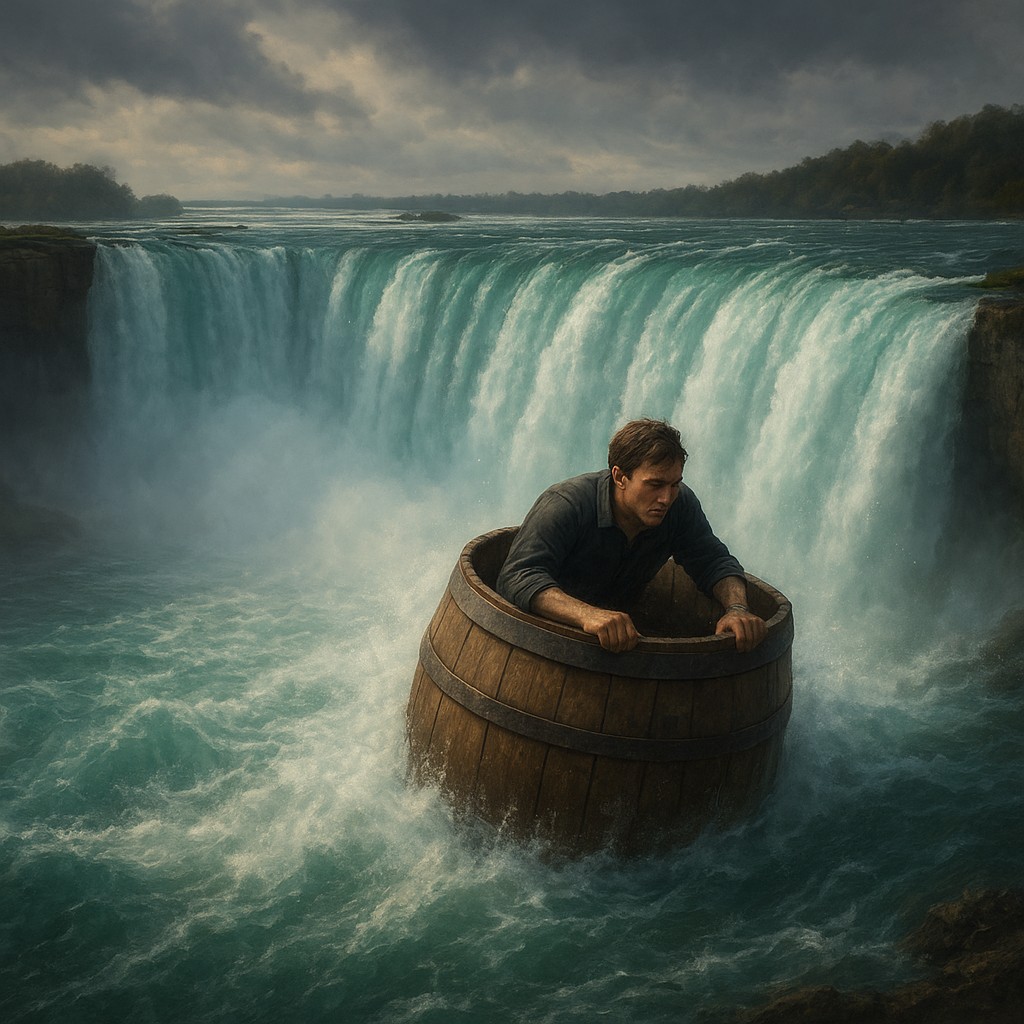
Niagara Falls has a knack for making sensible people forget they are sensible. You stand beside that endless white roar, feel the mist cool your face, and watch a river fold itself into a moving wall of chaos. It is beautiful the way a thunderstorm is: spectacular, loud, and totally indifferent to your plans.
That mix of awe and threat has drawn tourists for centuries. It has also tempted a particular kind of dreamer: people who looked at a 160-plus-foot waterfall and thought, "I could survive that... if I brought a barrel." Some did it for fame, some for money, some for a personal test, and a few for reasons best described as "unclear, but enthusiastic." The results read like an engineering lesson, a human drama, and a cautionary tale all at once.
Niagara's layout: the not-so-small detail barrel riders risked their lives on
Before we meet the barrel riders, it helps to know what they were actually attempting. "Niagara Falls" is not a single drop. It is a set of major falls on the Niagara River, with Goat Island splitting the flow into different sections.
The biggest and best known is the Horseshoe Falls (mostly on the Canadian side). It is wider, carries far more water, and drops roughly 170 feet (about 52 meters) depending on water levels and erosion. The American Falls (on the US side) has a shorter vertical drop, but it has a nasty feature for anyone arriving belly-first in a wooden cylinder: a chaotic rock talus at the base that can turn a survivable splash into a blunt-force disaster.
This is why most "barrel over the Falls" attempts focused on Horseshoe Falls. It was not "safe," but it was the version of Niagara where the landing was more likely to be deep water instead of jagged rocks. Think of it as choosing between "extremely dangerous" and "even more extremely dangerous."
The first celebrity barrel: Annie Edson Taylor and a lesson in unintended consequences
The modern legend starts in 1901 with Annie Edson Taylor, a schoolteacher who decided, at age 63, to become the first person to go over Niagara Falls in a barrel and live. If you are picturing a cheerful wine cask, think again. Taylor's barrel was purpose-built, padded, and designed to float and absorb impact.
She did not just hop in and hope. Taylor and her team tested the barrel with a cat first. The cat survived, which is both reassuring and very much in keeping with early 1900s stunt planning. On the day of the descent, Taylor went over Horseshoe Falls and survived with serious but not immediately fatal injuries.
Here is the twist: surviving Niagara did not automatically bring the riches she expected. Taylor did gain fame, but she struggled financially afterward. Her story has a modern moral: viral bravery does not equal stable income. Her feat launched the idea that a "Niagara barrel" was a possible stunt, though "possible" is doing a lot of work in that sentence.
The wooden-barrel era: courage, showmanship, and some grim outcomes
Once one person survived, others began to think survival was repeatable. That is how the early 20th century produced a wave of copycats, each trying a new twist, a new gimmick, or a new claim to the spotlight.
Bobby Leach: survival, then a bizarrely ordinary ending
In 1911, Bobby Leach, a performer and stuntman, went over in a barrel and survived. His descent was rough, and he suffered significant injuries, but he lived to tell the tale. Leach's story is remembered for an odd irony: after surviving Niagara, he later died from complications after a relatively ordinary slip and injury years later. The Falls did not get him, but everyday life eventually did.
This underlines a key point: surviving the big dramatic danger does not mean your body walked away untouched. Many survivors carried injuries for the rest of their lives.
Charles Stephens: the danger of "improving" a barrel with heavy ballast
In 1920, Charles Stephens attempted the Falls in a barrel and did not survive. One often-cited detail is that he used an anvil as ballast, intending to keep the barrel oriented correctly. The idea sounds tidy until you remember physics has no patience for tidy plans. A heavy object inside a violently tumbling barrel can become a wrecking ball. What might have been a bruising stunt turned deadly.
Stephens's death helped later designers focus on internal movement control. You want padding that soaks up energy, not a metal object that adds it.
George Stathakis: surviving the drop is not the end of the story
In 1930, George Stathakis went over in a barrel and is often remembered because he reportedly brought a pet turtle along. The turtle is frequently reported to have survived, which may be the most turtle-appropriate outcome imaginable.
Stathakis's attempt shows another reality: even if you survive the plunge, you must be rescued quickly. The base of the Falls is a churning, misty, deafening place, and barrels can get trapped or pummeled by currents. Stathakis ultimately did not survive the whole ordeal. Niagara is not a single obstacle. It is a sequence: entry, drop, impact, turbulence, and rescue. Failing any one stage can be fatal.
A quick reference of the best-documented barrel descents
Records from the early 1900s are not perfect, and many attempts used other craft (kayaks, jet skis, swimming, and other "please don't" ideas). Still, a core set of barrel-style descents is widely documented in public historical accounts:
| Person |
Year |
What they went over in |
Where |
Outcome (high level) |
| Annie Edson Taylor |
1901 |
Reinforced wooden barrel |
Horseshoe Falls |
Survived, injured |
| Bobby Leach |
1911 |
Barrel (stunt design) |
Horseshoe Falls |
Survived, injured |
| Charles Stephens |
1920 |
Barrel with ballast (often reported: anvil) |
Horseshoe Falls |
Died |
| George Stathakis |
1930 |
Barrel (reportedly with a turtle) |
Horseshoe Falls |
Did not survive overall event |
| Jean Lussier |
1959 |
Rubber "ball" style capsule |
Horseshoe Falls |
Survived |
| Karel Soucek |
1984 |
Purpose-built barrel |
Horseshoe Falls |
Survived |
| Steve Trotter |
1985 |
Barrel with added safety features |
Horseshoe Falls |
Survived |
| Steve Trotter and Lori Martin |
1995 |
Two-person barrel |
Horseshoe Falls |
Survived |
A pattern stands out: nearly everyone chose Horseshoe Falls, and survival is possible but far from guaranteed. The list is short for a reason. Niagara does not hand out second chances easily.
What a "Niagara barrel" actually needs to do (hint: it is not just "be round")
Barrels sound simple, but the survival problem is complex. When you go over Niagara, you are dealing with height, speed, tumbling, aerated water, violent currents, and the uncomfortable fact that humans are squishy. A successful barrel is basically a tiny one-drop spacecraft.
The core engineering problems (explained like you are building a very illegal egg-drop project)
A barrel has to solve several problems at once:
- Absorb impact energy so the rider's body does not take the full deceleration.
- Keep the rider from slamming into the walls as the barrel tumbles. Padding is not optional; it is everything.
- Provide enough air for the time inside the sealed container, including any rescue delays.
- Float and stay structurally intact while being battered by currents and collisions.
- Avoid internal hazards, such as loose objects that can crush a rider, or shapes that snag underwater.
Even when these are addressed, there is another issue people underestimate: Niagara water near the base is often highly aerated, meaning mixed with lots of air bubbles. Aerated water is less supportive than normal water, which lowers buoyancy and makes the barrel behave unpredictably. That is not comforting when you are counting on a clean float.
A misconception worth retiring: "The barrel makes it safe"
No. The barrel makes it less instantly fatal under some conditions, and even that is not guaranteed. Think of it like a seatbelt in a demolition derby. Helpful, absolutely, but you are still in a demolition derby.
The most dangerous moments are often not the freefall itself but the landing and the chaos afterward. A barrel can hit hard, get yanked into recirculating currents (the kind that keep dragging objects back toward turbulent water), or be smashed against rocks. Surviving Niagara means enduring everything the river does next.
The later era: rubber capsules, media attention, and authorities losing patience
By the mid-20th century, Niagara was no longer a remote wonder. It was a major tourist destination with organized rescue services, international borders, and laws meant to stop people from turning themselves into attractions.
Jean Lussier: changing the "barrel" into a capsule
In 1959, Jean Lussier went over Horseshoe Falls in a rubber ball-shaped device. This marked a shift in public imagination: the stunt moved away from literal wooden barrels and toward purpose-built capsules. Rubber deforms and absorbs energy differently than wood, and a spherical design can reduce certain kinds of snagging and spread forces more evenly.
Lussier survived, reinforcing the idea that better materials and design could improve the odds. But "improve the odds" is still not the same as "good idea."
Karel Soucek: modern stunts meet modern rules
In 1984, Karel Soucek went over in a barrel and survived. His attempt was part of a late-20th-century revival of daredevil culture, with bigger media coverage and more deliberate engineering. It is also remembered because the aftermath of these stunts increasingly clashed with legal restrictions. Niagara is a natural wonder, not a stunt park, and officials were understandably worried about copycats and risky rescues.
Soucek's survival did not make the world more welcoming to such attempts. If anything, it convinced officials they needed stricter enforcement.
Steve Trotter (and later, Steve Trotter with Lori Martin): pushing the limits of "survivable"
In 1985, Steve Trotter went over and survived. Then in 1995, Trotter and Lori Martin made a two-person descent and survived as well. Beyond the nerve it required, these later stunts show how much planning and design went into the containers compared with early wooden barrels.
But there is a sobering subtext: once single-person survival becomes possible, someone will ask, "What about two?" This is the daredevil version of feature creep, except the "bug" is gravity and the "crash" is literal.
The rules, the rescues, and the reality check tourists do not always hear
A common myth is that these stunts were charming old-time traditions authorities winked at. In reality, officials have long treated these attempts as dangerous and illegal, partly because they risk not only the performer but also rescuers.
Modern Niagara has strict regulations. Trying to go over the Falls can lead to serious legal consequences, including fines and prosecution. Exact penalties and enforcement vary by jurisdiction and over time, but the message is consistent: do not do this. That is not just bureaucratic grumpiness. Every rescue in that environment is risky, costly, and time-critical.
It is also worth noting a second misconception: people often assume most barrel riders survive because we mostly hear the famous success stories. That is selection bias. Dramatic survival becomes legend. Death is often a footnote, or disappears entirely in casual retellings.
What these barrel stories teach us about risk, physics, and human nature
If you strip away the spectacle, Niagara's barrel riders offer clear lessons about how humans deal with danger.
First, nature does not negotiate. The Falls are not impressed by courage, and they do not give partial credit for enthusiasm. The river applies the same forces every time. It is only a question of whether the device, the body, and the rescue timeline can handle them.
Second, engineering is not just technology; it is empathy for your future self. Padding, air supply, structural reinforcement, and secure positioning are not glamorous. They are how you turn "I want to live" into physical reality. Many failures came from underestimating forces, adding internal hazards, or failing to plan for the post-drop chaos.
Third, there is a psychological truth: people are drawn to edge experiences, moments that feel like stepping outside ordinary life. Niagara gives that feeling just by standing near it. Barrel riders tried to take it further, turning awe into a personal showdown with a landmark. That impulse is common; it is usually expressed in safer ways, like mountain climbing with proper gear, distance swimming with support teams, or pushing yourself in a craft you have trained for.
Leaving Niagara to be Niagara, and finding your own brave thing
The most enduring part of these stories is not the barrels. It is the Falls themselves, still roaring, still indifferent, still capable of making you feel small in the best possible way. The barrel riders, from Annie Edson Taylor onward, show that humans can be inventive, stubborn, and courageous, sometimes all at once and sometimes to a fault.
If you feel the tug of daredevil curiosity, treat it as a signal, not an order. Let it push you toward challenges that build skill instead of gambling on luck: learn the physics behind the spectacle, study the history clearly, and choose adventures where preparation actually improves the outcome. Niagara will keep thundering without your help, and you can leave the story feeling bolder, wiser, and very glad you kept your barrel use to home improvement projects.