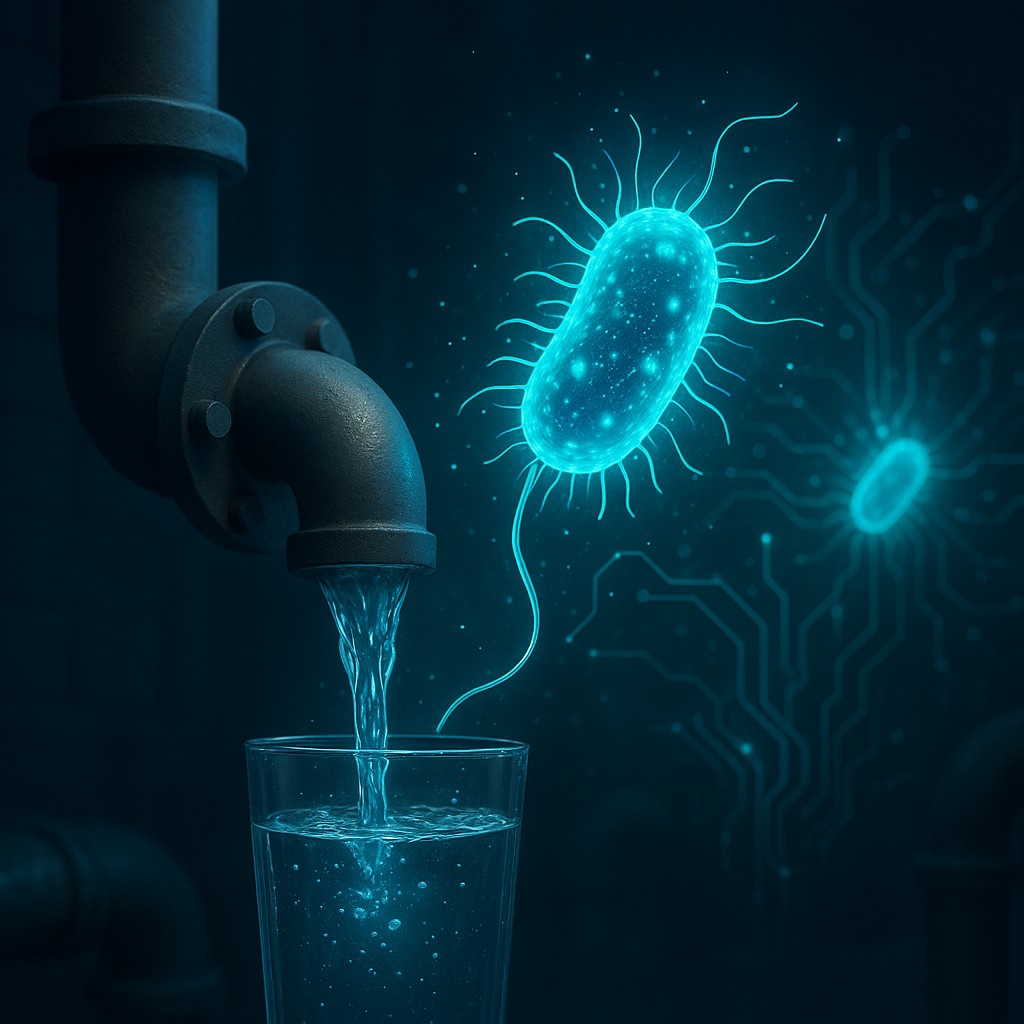
Imagine turning on your kitchen faucet to fill a glass of water, never suspecting that a mile away, a corroded pipe has just leaked a plume of industrial solvent or heavy metals into the local supply. In the traditional world of infrastructure, that contamination would travel silently toward your home. It stays hidden because it doesn't change the water's color, smell, or taste. By the time a technician pulls a manual sample, drives it to a lab, and waits 48 hours for a culture to grow or a machine to analyze the results, the crisis has already turned into a public health emergency. This "lag time" is the weak point of modern civilization, a gap where we are essentially flying blind while relying on 19th-century logistics to protect 21st-century citizens.
However, a quiet revolution is taking place beneath our sidewalks. Slow, human-led inspections are being replaced by a biological early-warning system. By using the genetic inner workings of specialized bacteria, scientists have created living sensors that "wake up" and glow the second they encounter a threat. These microorganisms act like a microscopic security force. They are permanently stationed inside our pipes and can communicate with digital networks at the speed of light. This shift moves water safety away from a reactive model of "test and clean up" to a proactive system. The water supply itself gains a decentralized nervous system, capable of sensing danger and shutting it out before it ever touches a human lip.
The Genetic Light Switch
To understand how a single-celled organism can act as a high-tech alarm, we have to look at how bacteria interact with their environment. In the wild, bacteria have evolved sophisticated "promoters." These are essentially genetic on-off switches that trigger specific responses when they hit certain substances. For example, if a bacterium bumps into a molecule of arsenic, its DNA might trigger a protein that pumps the poison out of its cell. In the world of bioluminescent biosensors, scientists have repurposed this natural defense. They take that arsenic-sensing switch and wire it to a gene borrowed from deep-sea jellyfish or fireflies, the gene responsible for creating light.
When these engineered bacteria live inside a sensor, they sit in a state of quiet readiness. If the water flowing over them is clean, they stay dark. But the moment a specific contaminant appears, even in tiny amounts, it flips the genetic switch. The bacteria immediately begin producing luciferase, the enzyme that creates a blue or green glow. It is a direct translation of a chemical presence into a flash of light. This approach focuses on the actual biological mechanics of safety. Rather than searching for a vague signal like "acidity," we use the specialized evolution of life to recognize exact molecules that traditional electronic sensors might miss.
Living Hardware in a Digital World
A glowing bacterium is a scientific marvel, but it isn't very helpful if it is buried three feet underground in a cast-iron pipe where nobody can see it. This is where biology meets digital technology. These microbes are held in specialized chambers called bioreactors, which are built into the "smart" pipes of a city's water main. Inside these chambers, highly sensitive light detectors, similar to high-end digital camera sensors, are pointed directly at the bacterial colony. These detectors monitor the darkness with constant precision, looking for the first hint of a glow.
Because these detectors are connected to the city's central network via fiber optics or cellular signals, the jump from biological detection to digital action is nearly instantaneous. If the sensors detect a spike in light, the system doesn't wait for a human to read a report. Instead, an automated program triggers mechanical valves. These valves act like a physical firewall, slamming shut to isolate the contaminated section of the pipe from the rest of the city. It is an autonomous "immune response" for the infrastructure, ensuring that tainted water is rerouted or contained long before it reaches a home.
Beyond the Limits of pH and Clarity
You might wonder why we need living bacteria when we already have high-tech probes that measure things like pH, turbidity (cloudiness), and conductivity. The reality is that these physical measurements are blunt instruments. A gallon of clear, sparkling water can be laced with a lethal dose of lead or cyanide, and a standard pH probe wouldn't move an inch. Physical sensors tell you if the water looks strange or feels acidic, but they cannot tell you if the water is toxic to life. This is the fundamental advantage of the biosensor: it uses life to protect life.
Bacterial sensors are uniquely sensitive to the "bioavailability" of a toxin. This refers to how much of a chemical is actually in a form that can harm a living organism. While a chemistry lab might find "trace amounts" of a metal that is actually stuck to a piece of harmless dirt, the bacteria will only glow if the metal is in a free, dangerous state. This reduces false alarms and provides a much more accurate picture of the actual risk to humans. By shifting our focus from the physical properties of the water to the biological impact of its contents, we are finally measuring what truly matters for public health.
| Feature |
Traditional Lab Testing |
Standard Electronic Probes |
Bioluminescent Biosensors |
| Detection Speed |
Days (Transport + Analysis) |
Seconds (Real-time) |
Minutes (Real-time) |
| Specificity |
Extremely High |
Very Low (Physical only) |
High (Chemical specific) |
| Deployment |
Manual / Reactive |
Constant / Stationary |
Constant / Stationary |
| Sensitivity |
Parts per Trillion |
Parts per Million |
Parts per Billion |
| Cost per Test |
High (Labor + Equipment) |
Low (Maintenance only) |
Medium (Nutrient supply) |
The Metabolism of Infrastructure
For all their brilliance, these biosensors introduce a unique challenge: they require a "life support" system. Unlike an electrical pulse or a mechanical valve, a colony of bacteria is a living population that needs to eat, breathe, and stay warm. To keep the bioluminescent alarm working, the smart pipes must be equipped with nutrient-delivery systems that provide a steady drip of sugars and minerals. If the bacteria die from starvation or extreme temperatures, the security camera effectively goes dark, leaving the system blind once again.
This creates a new way of thinking about civil engineering, where the city's infrastructure has a literal metabolism. Maintenance crews are no longer just fixing leaks; they are essentially "zookeepers" for the microscopic organisms that keep us safe. The pipes must maintain a stable internal environment, protecting the sensors from freezing winters or the stagnant heat of summer. While this adds a layer of complexity to city management, it is a small price to pay for a system that provides a 24/7, high-quality map of water safety across an entire city.
Misconceptions of the Microscopic Guard
One common fear regarding "genetically engineered bacteria" in water pipes is the risk of the bacteria escaping and causing an infection. It is a valid concern, but the engineering is highly controlled. First, the bacteria used in these sensors are typically weakened strains of common species like E. coli. They are designed with "kill switches" that make them unable to survive outside the specific, nutrient-rich environment of the sensor chamber. If they were to leak into the main water supply, they would find themselves in a cold, nutrient-poor, chlorinated environment that would kill them almost instantly.
Another myth is that these sensors replace all other types of water testing. In reality, they are a first line of defense, not the entire army. While biosensors are excellent at detecting known toxins like arsenic, mercury, or specific pesticides, they aren't designed to catch every possible chemical. We still need traditional laboratories for deep investigations and for checking for new contaminants that haven't been "programmed" into a bacterial strain yet. The biosensors are the smoke detectors; they tell us there is a fire immediately, but we still need the fire department to understand exactly what is burning.
Navigating the Decision to Deploy
When a city decides to use this technology, it isn't just a matter of swapping out a few pipes. City planners must balance the high initial cost of installing smart nodes against the long-term savings of preventing a health crisis. They have to decide where to place these sensors for the most impact. Should they be at the treatment plant, or at the "dead ends" of the network where water might sit for days? Most agencies choose a "bottleneck strategy," placing sensors near schools, hospitals, and major industrial junctions where the risks are highest.
There is also the question of "signal fatigue." If a sensor is too sensitive, it might shut down the water supply because of a harmless change in mineral levels. Engineers have to fine-tune the genetic switches so they only trigger a shutdown for a genuine threat. This requires microbiologists, who tune the DNA, to work closely with software engineers, who write the code that interprets the light levels. It is a perfect example of how different fields must work together to manage a modern city.
The Future of Living Cities
As we move deeper into the 21st century, the line between technology and biology will continue to blur. Our concrete and steel environments will start to feel more like an organism. Bioluminescent biosensors are just the beginning. Imagine air vents that change color when they sense a virus, or road surfaces that "heal" themselves using bacteria that fill cracks with limestone. We are learning that the most efficient way to solve complex problems is not always through more plastic and silicon, but by partnering with the biological systems that have been solving these problems for billions of years.
Building a safer world does not require us to control every atom of our environment. It only requires us to listen more closely to the signals life is already sending. When we put these tiny, glowing sentinels into the backbone of our cities, we are doing more than just upgrading plumbing. We are creating a partnership with the microscopic world. We provide the nutrients and shelter, and they provide the light that keeps us safe. It is a reminder that even in our most industrial achievements, nature remains our most sophisticated teacher.