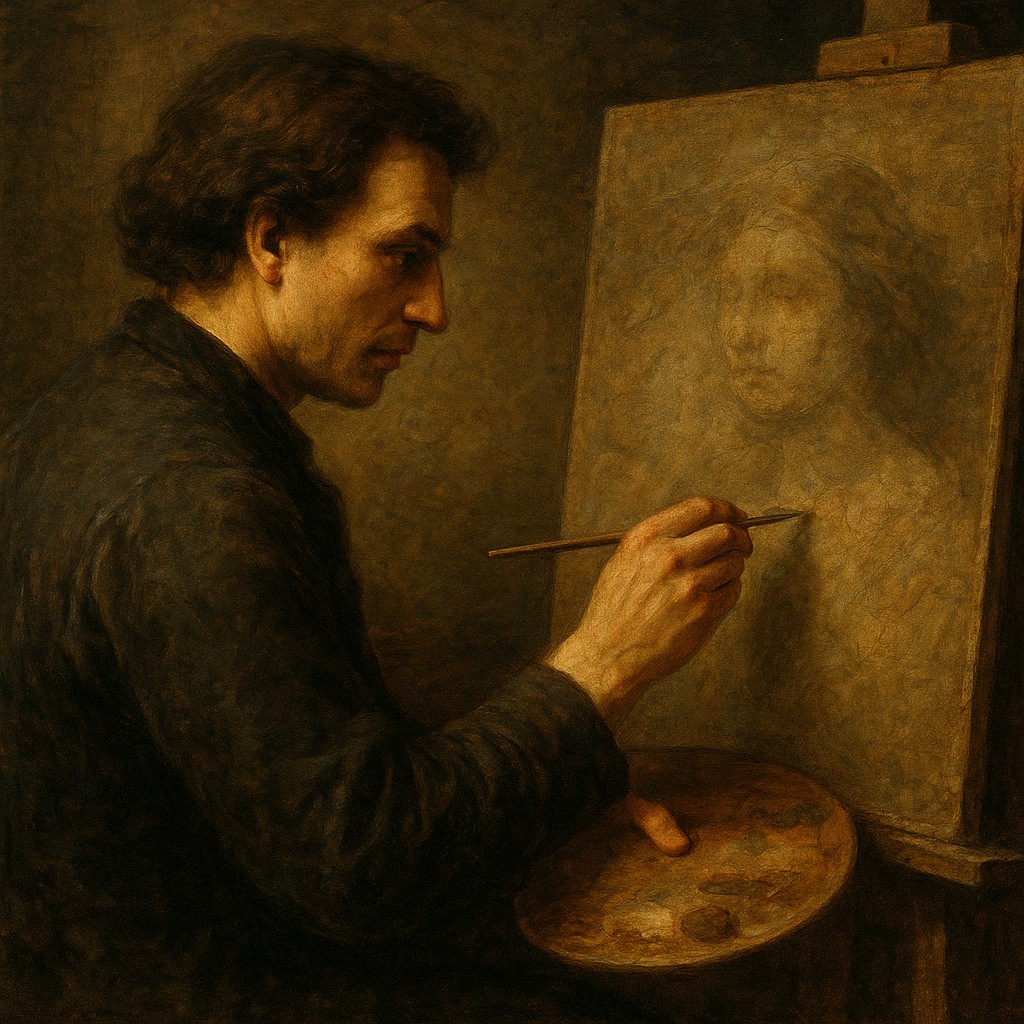
When you stand before a masterpiece in a quiet gallery, it is easy to imagine the artist approached the canvas with divine, unwavering certainty. We are taught to believe that genius is a straight line from inspiration to execution, resulting in the flawless surfaces of a Rembrandt or a Velázquez. Looking at the polished result, we assume the artist just "knew" where every stroke should land, as if they were merely tracing a finished image into existence. This perception, however, is a beautiful lie that time eventually exposes.
As centuries pass, the chemical makeup of oil paint changes. The lead whites and linseed oils that once provided a solid, hidden mask begin to lose their density and turn slightly see-through. Beneath the surface, the ghosts of the artist’s indecision start to stir. A third hand might emerge from the shadows of a portrait, or a dog painted out of a scene centuries ago might reappear in the center of a room. This phenomenon is known as pentimento, and it offers a rare, unedited look into the messy, human process of creation that artists usually try to hide.
The Language of Artistic Regret
The word pentimento comes from the Italian verb pentirsi, which means "to repent." In art history, this is more than just a language quirk; it is a literal description of an artist changing their mind. When a painter looks at a finished hand and decides the pose is awkward, or realizes a background figure distracts from the main subject, they do not throw the canvas away. Instead, they "repent" by painting over the section. They bury their mistakes or second thoughts under fresh layers of paint, believing the secret is safe. They are essentially editing their work in real-time, much like a writer deleting a paragraph or a programmer fixing a buggy line of code.
For a long time, these edits stayed secret. It was only as the paint aged that these hidden layers began to peep through. In the 20th century, the invention of X-ray photography and infrared light allowed researchers to look through the top layers of paint without damaging the art. What they found was a chaotic world of sketches, discarded layouts, and "ghost" figures. These discoveries shattered the myth of the perfect, one-shot masterpiece. Pentimento reveals that even the greatest masters struggled with the same creative anxieties we feel today. It proves that "getting it right" is usually a matter of trial and error rather than a single lightning strike of genius.
How Paint Chemistry Reveals the Past
To understand why these hidden marks appear, we have to look at the science of oil painting. Oil paint is not a static substance; it is a living chemical mix that evolves over hundreds of years. Most historical oil paints consist of pigments mixed into a drying oil, like linseed or walnut oil. These oils have a "refractive index," which determines how much they bend light. As the oil ages and reacts with oxygen, this index increases. At the same time, certain pigments become more transparent as the oil reacts with the lead or other minerals in the paint. This is especially true for "lead white," a basic tool for the old masters.
As the top layers become more transparent, light travels deeper into the painting, bouncing off the older layers beneath and returning to our eyes. This is why a landscape that once looked like an empty field might suddenly show the faint outline of a barn the artist removed at the last minute. It is not that the paint is "fading" in the usual sense; rather, the veil is thinning. The table below highlights the differences between these accidental reveals and other techniques that might look similar but serve different purposes.
| Term |
Purpose |
Visibility |
Intent |
| Pentimento |
To hide a mistake or change the layout. |
Originally hidden, revealed by age. |
Accidental (later on). |
| Glazing |
To build depth, glow, or a specific color. |
Meant to be seen from the start. |
Intentional. |
| Underdrawing |
To provide a map for the final painting. |
Usually invisible without X-rays. |
Practical/Internal. |
| Palimpsest |
Reusing a canvas by scraping off old work. |
Often leaves physical scars or ridges. |
Economic/Practical. |
Telling these apart is vital for art historians. A "glaze" is a skilled technique where an artist applies a thin, see-through layer of color over a dry layer to create a glowing effect, like the soft look of skin. A pentimento, on the other hand, is an act of concealment. One is a decorative choice; the other is a structural change. Spotting a pentimento is like catching a glimpse of a deleted scene from a movie, providing context the director originally thought we didn't need to see.
Case Studies in Creative Indecision
Some of the most famous pentimenti in history are found in works we think we know well. Take Pieter de Hooch’s Woman Peeling Apples. For centuries, viewers saw a quiet home scene. However, as the paint aged, a ghostly figure began to appear near the doorway. Investigation showed that de Hooch originally painted a person sitting in the background but later decided the room felt too crowded. By painting over that figure, he focused the viewer’s attention on the mother and child. The reappearance of that "ghost person" tells us that de Hooch was thinking deeply about how many people a room can hold before it stops feeling private.
Perhaps even more famous is Johannes Vermeer’s Girl Reading a Letter at an Open Window. For decades, the large blank wall behind the girl was considered a classic example of Vermeer’s simple, moody style. However, X-rays revealed a large painting of Cupid hanging on that wall. For a long time, historians assumed Vermeer himself had painted it out to create a more serious mood. Recent restoration, however, discovered that the "overpainting" was done by someone else long after Vermeer died. This is a rare case where the change wasn't a pentimento - a change by the artist-but a later alteration. True pentimenti, like the shift of a horse’s leg in a portrait by Velázquez, show the master himself struggling with the physics of the scene, moving a limb a few inches to better show movement.
These changes aren't just minor fixes. In some cases, pentimenti reveal that an artist started an entirely different painting on the canvas before changing their mind. This was often done to save money, as high-quality canvases were expensive. But more often, it represents a change in the story. An artist might start a battle scene and realize that a single, grieving widow tells the story better. Pentimento is the evidence of that pivot, the physical remains of a "better idea" replacing an "okay idea."
The Myth of Perfection and the Reality of the Grind
We often talk about artists having a "gift," a word that suggests talent was handed to them fully formed. This language ignores the hard work involved in creating great art. Pentimento serves as a powerful correction to the myth of effortless perfection. When we see a master like Rembrandt struggling with the placement of a hat or the angle of a shadow, it makes him more human. It shows he was not a channel for divine signals, but a worker who had to solve problems, make mistakes, and occasionally fail before he succeeded.
This "ghostly" evidence invites us to rethink excellence in any field. If the greatest painters in history needed to "repent" and redraw their work, why should we expect to get everything right on the first try? Pentimento is the visual version of a "rough first draft." It proves the final product is often just the top layer of a mountain of corrections. By embracing this idea, we can stop fearing our own mistakes and see them as necessary layers that build our eventual success.
The next time you look at a classic painting, try to look "through" it. Search for a slight ridge in the paint that doesn't match the image, or a faint shadow without a source. You might be looking at a moment of doubt from four hundred years ago. These marks are not flaws; they are the records of a human mind at work. They remind us that art is not about being perfect, but about being persistent. The hidden changes are what make the final image possible. The fact that we can see them now is a gift from the chemistry of time, allowing us to witness the silent conversation between an artist and their canvas.
Using Modern Tools for Discovery
Today, our understanding of pentimento has been changed by technology that would have seemed like magic to a Renaissance painter. We no longer have to wait three hundred years for paint to become transparent. Using X-ray tools that map chemical elements, scientists can see what is in every layer of a painting. If an artist used a mercury-based red pigment in a hidden layer and a lead-based blue in the top layer, these machines can "see" the hidden red sketch underneath the blue sky. This has led to a "gold rush" of hidden art discoveries in museums worldwide.
For example, researchers scanning Vincent van Gogh’s Patch of Grass found a detailed portrait of a peasant woman hidden under the green field. Van Gogh, who was often short on money, frequently reused canvases. Seeing the portrait beneath the grass doesn't take away from the landscape; it adds a layer of emotion. It tells us about the artist’s life, his subjects, and his financial struggles. These technological reveals allow us to build a timeline of an artist’s career using a single piece of fabric. We aren't just looking at a static object; we are looking at the history of an artist’s growth.
This sensing technology also helps spot fakes. A forger might be able to copy the brushstrokes of a master on the surface, but they rarely include the "logical mistakes" or the hidden sketches a real master would have made. A painting by a 17th-century master that has zero hidden changes is actually very suspicious. It suggests a copyist who was simply tracing a finished image rather than an artist wrestling with a new idea. In this way, the presence of errors and "repentance" becomes a mark of the real thing - a fingerprint of the genuine creative struggle.
The Philosophical Beauty of the Second Guess
In a world that values "instant" and "optimized" results, there is something deeply comforting about the concept of pentimento. It suggests our first thought is rarely our best, and that there is hidden value in abandoned ideas. Every project we take on and every skill we learn is a series of layers. We might try to hide our early, clumsy efforts from the world, but those layers give our lives depth and character. They are the structural support for the "you" that people see today.
If we view our own lives as a canvas, we can see our "mistakes" not as wasted time, but as necessary base layers. That career path you left or the project that didn't work out are not gaps in your history; they are your personal pentimenti. They provide the weight and body that allow your current successes to shine. Just as the old masters used their previous versions to improve their final vision, we can use our past experiences to guide our current actions. The beauty of the final image is tied to the struggle beneath it.
As you move forward in your own work and life, remember that the "perfect" results you see in others are almost always curated. Behind every smooth surface is a history of corrections and redirections. Do not be discouraged when you have to start over or change your mind. You are simply practicing the art of repentance. You are adding the layers that will one day make your work feel rich, complex, and true. Like a great oil painting, your progress might feel messy right now, but over time, those very changes will become the most interesting part of your story. Embrace the ghosts of your process, for they are the evidence of your growth and the true mark of a master in the making.