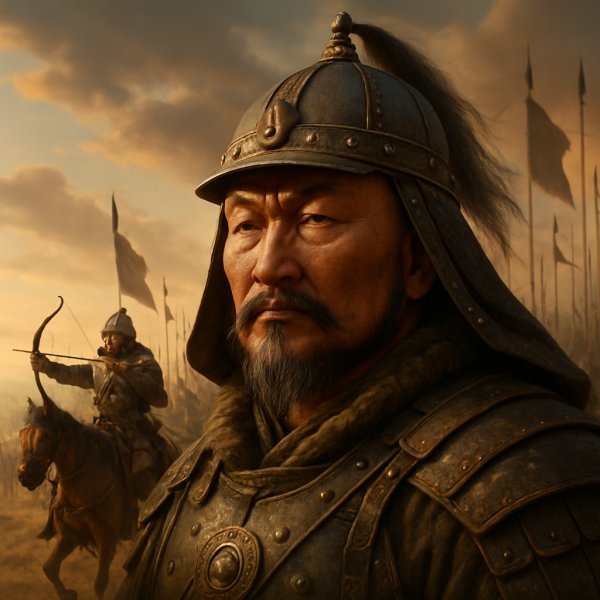
Imagine a horseman changing the map of the world: one surprising fact to start you off
Genghis Khan may feel like a figure from a marble statue, distant and monstrous, but here is a striking truth: a single male-line Y-chromosome lineage found across large parts of Asia has been estimated by geneticists to come from a man who lived about 800 years ago, plausibly Genghis Khan or his close male kin. That means his biological and historical traces are still literally written into the DNA of millions of people, while his political and cultural influence shaped trade, law, and communication across continents.
If you like stories that combine blood, books, and bureaucracy, Genghis Khan is a perfect case study: an orphan boy who became Temujin, the founder of the Mongol Empire, a ruler who mixed brutal campaigns with surprisingly modern administrative reforms. Let us unpack the life, methods, myths, and lessons, in a way that sticks with you.
Who was Genghis Khan - from Temujin to the founder of the Mongol world
Genghis Khan was born around 1162, probably under the name Temujin, into a fractured Mongol steppe environment where kinship mattered more than state institutions. As a young man he survived kidnapping, slavery, and exile, and then gradually built alliances by rewarding loyalty and enforcing clear rules, turning a band of tribes into a united fighting force. In 1206 he was proclaimed Genghis Khan, which roughly means "universal ruler," a title that codified his authority and launched the Mongol Empire.
Understanding his personal trajectory helps explain his methods: he prized merit over birth, promoted based on talent and loyalty, and bound diverse peoples into a coherent political and military system. These were not random acts of cruelty or genius; they were systematic strategies for survival and expansion in a competitive world.
How he built an empire - organization, intelligence, and timing
Making an empire on the steppe required more than brave riders. Genghis Khan reorganized Mongol society into decimal units - tens, hundreds, thousands - each answerable to commanders chosen for ability rather than aristocratic bloodlines. He created a fast, disciplined army with strict codes of conduct and a logistics system that allowed troops to move enormous distances quickly. He combined direct military action with shrewd diplomacy, using marriage alliances, hostage policies, and negotiated surrenders when useful.
Timing was crucial. The great states to the west and south were fragmented, and the Silk Road was ripe for control. Genghis exploited rivalries and used intelligence networks to pick targets, often devastating cities that resisted. His success was not just the result of violence, but of a coherent organizational model that could be scaled and adapted.
Military innovations that rewired how wars were fought
Genghis Khan did not invent cavalry, but he reengineered mounted warfare into a strategic art form. He deployed composite-bow horse archers who could shoot accurately while retreating, used feigned withdrawals to rout enemies, and employed surprise and speed at a continental scale. He institutionalized reconnaissance, signaling, and a relay system of mounted couriers - the Yam - that kept armies coordinated across vast distances.
These innovations were supported by concrete rules: strict discipline, severe punishment for theft or straggling, and incentives for initiative in the field. The result was an army that was faster, more flexible, and more reliably supplied than many of its opponents. Below is a compact list that summarizes the key innovations and why they mattered.
- Mounted archery combined mobility and sustained firepower, enabling hit-and-run tactics and wide operational reach.
- Decimal organization provided clarity of command and simplified logistics for massive troop movements.
- Intelligence networks and espionage allowed targeted campaigns rather than wasteful sieges.
- Communication systems like the Yam reduced delays and enabled strategic coordination across thousands of kilometers.
Governance, law, and the Pax Mongolica - the surprising civil side of conquest
Genghis Khan issued a code of law known as the Yasa, which combined military discipline with protections for merchants, religious freedom, and standardized weights and measures. He promoted trade by protecting caravans and reducing banditry, which helped create the so-called Pax Mongolica - a period of increased safety and exchange across Eurasia. He used meritocratic appointments, incorporated skilled administrators from conquered peoples, and set up a system of relay stations to support travel and commerce.
This was not benevolence for its own sake. It was pragmatic statecraft: secure trade meant more tax revenue, smoother logistics for armies, and faster dissemination of news and technology. The administrative features of the Mongol Empire anticipated aspects of modern governance, such as legal uniformity, diplomatic networks, and postal infrastructure.
Myths, controversies, and what the evidence actually supports
Many myths surround Genghis Khan: he is alternately a genocidal monster and a visionary modernizer. The truth sits between extremes. Contemporary and later sources vary widely, and much of what was written comes from biased chroniclers - Muslim historians wrote of slaughtered cities, while others admired his tolerance for different religions. Archaeological evidence and comparative studies show both massive destruction in specific campaigns and long-term stimulation of trade and cultural exchange in conquered regions.
Genetic research, notably the influential study by Zerjal and colleagues in 2003, found a Y-chromosome lineage that is unusually frequent across Asia and dates to the right period to plausibly be linked to Genghis Khan or his close male descendants. Historians like Jack Weatherford argue that the Mongol period transformed Eurasia in ways that hastened global integration. Still, quantifying mortality or economic impact remains complex and contested among specialists.
Case study - the campaign against Khwarezmia: logistics, diplomacy, and escalation
When the Khwarezmian shah executed Mongol traders and insulted a Mongol ambassador, Genghis Khan responded with a massive campaign. The conquest of Khwarezmia illustrates how diplomacy, intelligence failures, and military logistics interact: initial diplomatic breakdowns escalated into a calculated campaign that used speed and terror to subdue cities that resisted, while often sparing those that surrendered. This case shows that decisions by rulers, communication breakdowns, and local politics can trigger shifts with continental consequences.
For modern readers, the lesson is about escalation and the cost of diplomatic misjudgment. The Khwarezm episode highlights how punitive campaigns can secure short-term compliance but also reshape economic and geopolitical realities over generations.
Practical lessons from a brutal but organized conqueror - leadership takeaways you can use
Genghis Khan offers lessons that are applicable beyond warfare: build systems that reward merit and competence, invest in communication and logistics, gather and act on accurate intelligence, and make rules that create predictable incentives. He combined ruthless enforcement with institutional structures that made compliance easier and loyalty more durable. Translating this to business or civic life means designing clear hiring practices, rapid communication channels, data-driven decision processes, and enforceable standards.
Apply these principles in small steps: create a "decimal" organization by forming teams with clear spans of control, set up short feedback loops for information, and prioritize talent mobility over rigid hierarchy. Remember to balance rigor with ethics; tactics that worked through terror in the 13th century are not acceptable or legal today, but the structural ideas about systems, speed, and merit remain valuable.
Small challenges, reflective questions, and a "what if" to stretch your thinking
If you were advising a fledgling state, what three structural rules would you insist on to avoid chaos and encourage growth? Try writing them down and then imagine the incentives each rule creates. What if the Silk Road had remained unsafe and local rulers kept fragmenting instead of being integrated - how might modern globalization have been delayed?
Challenge yourself to a short exercise: map a modern organization you know onto the Mongol decimal system. Where are the tens and hundreds in that organization, and how could communication be made faster and clearer? These thought experiments help convert history into practical, memorable frameworks.
Where to read more - credible books, papers, and primary sources
For a popular, readable synthesis try Jack Weatherford, Genghis Khan and the Making of the Modern World, which argues for the transformative role of Mongol rule in global history. For primary-source translations, the Secret History of the Mongols is essential reading for understanding Mongol self-identity and narrative, though it requires critical reading. For genetics and population impact see the 2003 study by Zerjal et al. for the Y-chromosome findings, and scan recent archaeogenetic reviews for updated perspectives.
If you want to dig deeper with academic rigor, look for works by historians Thomas T. Allsen and Peter Jackson, and survey articles in journals of medieval history or comparative empires. These sources provide a balance of evidence, interpretation, and scholarly debate so you can judge conflicting claims for yourself.
"He who conquers the sea will conquer the land" - a paraphrase of Mongol pragmatism, reminding us that logistics and communication usually decide the fate of grand ambitions
A little humor to close: if Genghis Khan had a corporate logo, it would probably be a horse, a bow, and a very efficient postal system. Take that image, and you have a shorthand for an empire built on speed, skill, and systems - a mix of chaos and order that still teaches us how organization shapes history.