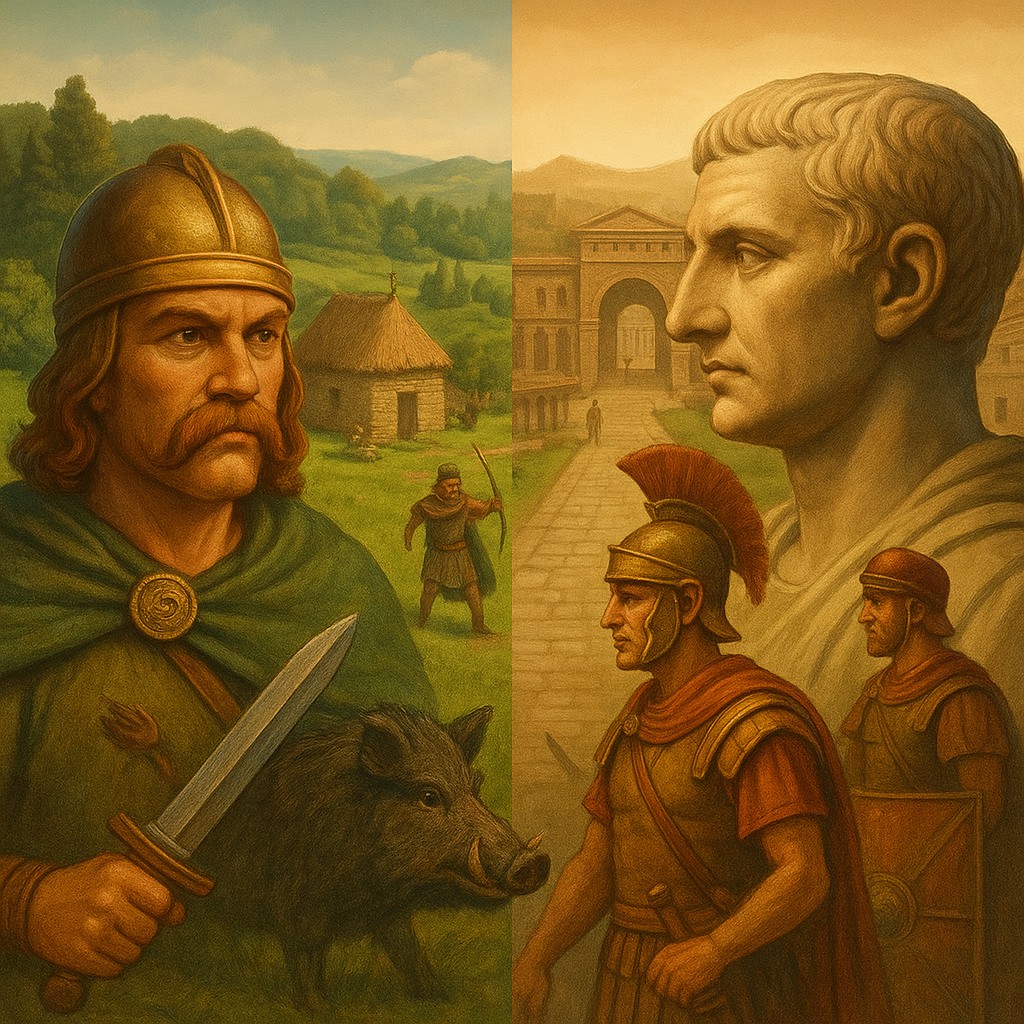
Gaul often gets stuck in a picture-postcard image: big mustaches, wild boars, and a certain little village that always resists. It is amusing, but it is also limiting. Long before the Romans arrived, the territory we call "Gaul" was already a dense, connected, inventive world - sometimes violent, often surprising. After the conquest, it did not simply "turn Roman" like flipping a switch. People and communities put together a new identity out of local habits and imported things.
Understanding Gaul before and after the Romans means watching a major moment of change. You see how Celtic societies organized themselves, traded, fought, and told their own stories, and then how they changed when an empire brought roads, towns, taxes, and a strong focus on writing and administration. It also breaks a persistent myth - that so-called "barbarians" were saved by Roman civilization. In fact, Gaul did not wait to be civilized. It had its own logic, and it negotiated, resisted, adopted, and adapted.
Before Rome: a Celtic Gaul, diverse and already well connected
When people say "the Gauls," they often picture a single people. In reality, Gaul was a mosaic of Celtic peoples - and sometimes non-Celtic groups - spread over a large area, roughly today's France, Belgium, part of Switzerland, and nearby zones. Names like the Arverni, Aedui, Sequani, Parisii, Veneti, and many others are not just textbook details. They point to real political networks, with alliances, rivalries, and practical interests.
These peoples did not live cut off in misty forests. They traded with the Mediterranean world for a long time, especially through the Greeks of Massalia (Marseille), the Etruscans, and later the Romans. Archaeologists find imported goods in elite graves, like amphorae of Italian wine or luxury tableware, showing that some Gallic elites liked fine things and could afford them. Pre-Roman Gaul was both rural and connected, crossed by informal roads, rivers used as highways, and markets where goods, ideas, and influences moved.
From oppida to the countryside: how people lived on the land
The image of the little Gallic village is misleading, because many people lived on scattered farms, hamlets, and small local centers. But from the end of the Iron Age - especially the 2nd and 1st centuries BCE - large fortified settlements called oppida (large fortified towns) appear or grow. They were not only refuges in wartime, they were centers of craft, trade, and power.
Oppida could have impressive ramparts, sometimes built with sophisticated techniques like the murus gallicus (a mixed stone-and-wood wall construction held with iron nails). Inside, you find artisan quarters, storage areas, and places for exchange. They show that some Gallic societies could concentrate population and production, and organize large public works. In short, "no state" does not mean "no organization."
Who ruled? Chiefs, aristocracies, and druids
Gaulish politics were not uniform, but they were not chaotic either. In many groups, power rested with warrior aristocracies - influential families whose prestige came from war, alliances, wealth, and control of networks. In some places you find kings, in others magistrates or councils. Reputation mattered a great deal, and personal ties could count as much as written rules.
Then there were the druids, often wrapped in mystery. We picture them as magicians, but they were more like specialists in sacred knowledge. They took part in education, rituals, and sometimes acted as arbitrators. Be careful with what we "know" about druids - most accounts come from Greek and Roman authors who were not neutral. They wrote with fascination, condescension, and even propaganda. What we can say cautiously is that religious and intellectual elites existed, and they carried influence.
The Roman conquest: a collision, not a simple "meeting"
The conquest of Gaul was not a cultural misunderstanding over a glass of cervoise (a type of ancient beer). It was a string of wars, opportunistic alliances, betrayals, sieges, and political calculations. When Julius Caesar began his campaigns (58-51 BCE), he acted as both a general and a Roman politician: winning in Gaul meant winning prestige in Rome. His account, The Gallic War, is a masterpiece of writing and a work of persuasion. He tells, justifies, stages himself, and at times simplifies a much more complex reality.
One key point: the Gauls were not all "against Rome" at the same time. Some peoples allied with Caesar to settle local scores. Others resisted fiercely, then negotiated, then rebelled again. The big uprising led by Vercingetorix in 52 BCE was spectacular, but it came after years of war and tension.
Vercingetorix, Alesia, and the myth of the "last stand"
Vercingetorix became a national symbol much later, especially in the 19th century when France sought heroic figures. In the ancient reality, he was an Arvernian leader capable of rallying several peoples - already a political feat. He also knew that facing Rome head on was risky, and used scorched-earth tactics to starve the Romans of supplies. Caesar, for his part, was a formidable logistician, and he turned a military campaign into a show of authority.
Alesia is not "the end of the Gauls." It was a major defeat, yes, but pockets of resistance continued, and daily life did not stop after the siege. Many Gallic elites later fit themselves into the new order, sometimes out of pragmatism, sometimes because Rome offered new political paths. The conquest was a tipping point, but not an extinction.
Roman Gaul: when the empire settles in, some things change - and some do not
After the conquest, Rome did not replace every Gallic house with a turnkey Roman villa. Rome put in place a framework: administration, taxes, law, the army, and, above all, a network of towns and roads to move troops, goods, and information. Gaul became a set of provinces, reorganized over time, with capitals, towns, and local institutions adapted to the Roman model.
"Romanization" makes more sense as a process. The Gauls did not become Roman overnight. They adopted some practices because they were useful, prestigious, or imposed, and they kept others because they worked and made sense. The pace varied by region: areas near trade routes and towns often changed faster than some rural zones.
Towns, roads, and baths: the empire as infrastructure
Rome loved building, and Gaul filled with paved roads, bridges, aqueducts, and rebuilt towns. Urban life picked up speed: forums, amphitheaters, temples, and baths appeared. Baths are a cultural clue - they were not just for washing, they were places to socialize, do business, and show status. Yes, the ancient world understood that "seeing people at the spa" is strategic.
Gallo-Roman towns were often hybrid places. Latin became common, but local place names could survive. People worshipped Roman gods and kept local deities, sometimes merging the two. Craftspeople made Roman-style goods while keeping local styles. Gaul became a large workshop, balancing tradition and imperial standardization.
Language, law, and citizenship: what it meant to become Roman
Latin spread, especially in administration, towns, and official exchanges. That did not make Gallic languages vanish overnight. For a time, people lived in bilingual or multilingual worlds where the state's language opened doors. Roman law reshaped contracts, property, and personal status. It changed how people resolved disputes, and it put the state into daily life.
Roman citizenship was another powerful tool. At first it was limited, then it gradually widened. The big turning point came in 212 with the edict of Caracalla, which granted citizenship to most free men in the empire. For many Gallo-Romans, being "Roman" became less about origin and more about status, rights, and participation in an imperial world.
Religions, cultures, and identities: Gaul did not "forget" who it was
You might picture Gaul shedding its gods and customs to don a toga. In reality, beliefs changed in layers. Local cults continued, sanctuaries stayed active, and syncretism - the mixing of gods - linked Gallic deities to Roman counterparts. This is not a contradiction - it is a practical way to make sense of the world when systems meet.
From the 3rd century and especially the 4th, Christianity grew. That growth was not an instant flip - it faced resistance, coexisted with older practices, and adapted. Even when Christianity became dominant, cultural habits, social forms, and territorial organization kept many mixed features. Gallo-Roman identity was built, not imposed.
To help memory, here is a quick comparison of broad trends "before" and "after" Roman presence (while remembering many exceptions):
| Aspect |
Gaul before Rome (tendencies) |
Gaul under Rome (tendencies) |
| Political organization |
Peoples, alliances, local elites, varied powers |
Provincial framework, administered cities, integration of elites |
| Settlement |
Scattered farms, oppida, regional centers |
Monumental towns, villas, a structuring road network |
| Economy |
Agriculture, crafts, active trade |
More integrated markets, imperial coinage and taxes, large-scale exchanges |
| Culture and language |
Celtic traditions, strong oral culture, local languages |
Latin dominant in writing, urban culture, hybrid forms |
| Religion |
Local gods, sanctuaries, varied rituals |
Syncretism, then rise of Christianity from late antiquity |
After Rome? Late antiquity: changes, not a "total collapse"
People often speak of the "fall of Rome" as if, one morning, someone switched off the empire and everyone fell into darkness. In Gaul, the change was more gradual. From the 3rd century the empire faced crises - military pressure, economic trouble, political instability - and Gaul sometimes felt like a frontline, sometimes like a rear area, often both. Some towns fortified, some trade slowed, but life went on with adjustments.
In the 5th century, so-called "barbarian" kingdoms took root in parts of the old imperial space - the Visigoths in the southwest, the Burgundians in the east, then the Franks in the north. The word "barbarian" is misleading - to Romans it meant simply "foreign," and it does not describe a lack of civilization. Many of these groups already knew the Roman world, served in its armies, adopted elements of Roman law and administration, and governed using imperial frameworks.
What emerged in Gaul was a shift toward the medieval world, with strong continuities - the Latin language evolving, Christian structures, some administrative practices - and real breaks - new power structures, changing military patterns, and an economy less tied to certain imperial networks. Think less of an abrupt end and more of a remix: Roman samples remain, but the beat changes.
Stubborn small falsehoods (and what to replace them with)
Many misunderstandings come from Roman authors or much later writers. Keep a critical mind and avoid these traps.
- "The Gauls were savages" - They had agricultural techniques, specialized crafts, trade networks, and complex fortified centers. They were not primitive, they were different.
- "Romanization wiped everything out" - It transformed things deeply, yes, but by adaptation, negotiation, and mixing. Continuities are common.
- "Alesia = the end of Gallic history" - It is a military and symbolic turning point, not a game over button.
- "After Rome, it was total chaos" - There was crisis and violence, but also institutional and cultural continuities. The world changed, it did not vanish.
To keep track: a simple timeline to hang in your mind
If you want an easy thread, think of four big moves. First, a plural Gaul organizing itself and trading long before Rome. Second, the conquest - a war and a political reshuffle. Third, Gallo-Roman Gaul - intense mixing and imperial integration. Finally, late antiquity, where the empire transforms and new powers reuse parts of the Roman inheritance.
If you want to really feel the story, keep one question in mind when you read or visit an archaeological site: who benefits from telling this version of events? Caesar, a Gallo-Roman notable, a 4th-century bishop, a 19th-century historian - each has an angle, and that is what makes Gaul so fascinating.
Ending this tour, understand that Gaul is not just the distant ancestor of France. It is a lab of cultural change. It shows how a society can absorb an imperial shock, keep roots, and invent new things. If you dig deeper, you will see history is not a line of closed boxes - Gauls then Romans then Franks - but a woven fabric of transitions. That is good news: the more you learn, the more you read the shades, and the past comes alive.