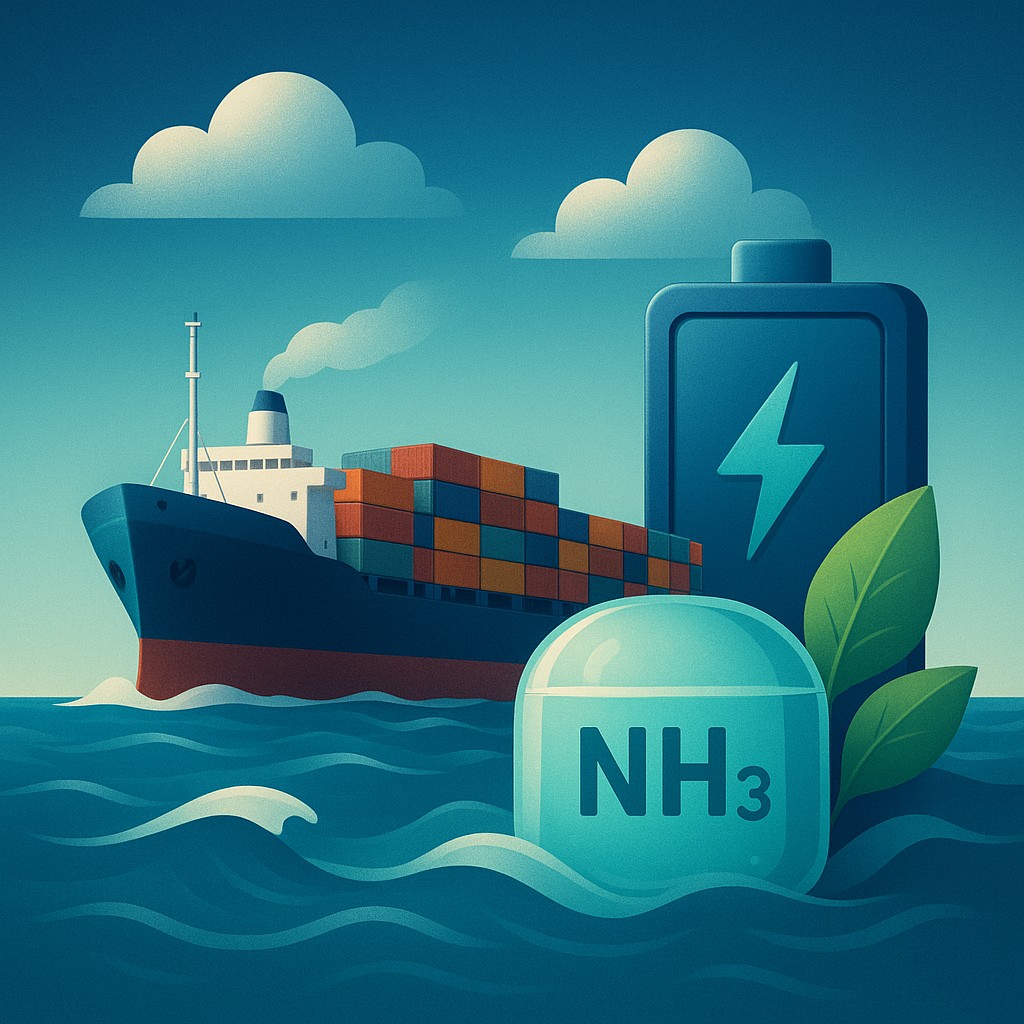
Imagine the scale of the global supply chain for a moment. At any given second, thousands of massive steel ships are cutting through the salt spray of the Pacific or Indian Oceans. They carry everything from your morning coffee beans to the smartphone in your pocket. These vessels are the hidden heart of modern life, but they come with a heavy environmental price tag. Shipping accounts for nearly three percent of all global greenhouse gas emissions. That figure is surprisingly high when you realize these ships are essentially floating power plants burning some of the dirtiest fuel known to man.
Fixing this isn't just a matter of good intentions; it is a matter of stubborn physics. While we can easily plug a car into a wall charger and drive a hundred miles, a container ship traveling from Shanghai to Los Angeles requires a staggering amount of energy that batteries simply cannot provide. If we tried to power a massive cargo ship with current lithium-ion technology, the batteries would take up so much space that there would be no room left for the freight. To save the seas, we need a fuel that behaves like a liquid, packs the punch of a chemical, and leaves the atmosphere exactly as it found it. This is where ammonia comes in, a pungent chemical that might just be the shipping world’s secret weapon.
The Energy Density Dilemma and the Battery Wall
When we talk about removing carbon from transport, we often assume one solution fits every problem. But what works for a bicycle will not work for a bus, and what works for a truck definitely will not work for a 200,000-ton ship. The key metric here is energy density, which is the amount of energy you can squeeze into a specific weight or volume. Diesel fuel is a superstar in this regard, which is why it has been king for over a century. It is stable, easy to pump, and contains a massive amount of "go" in every drop. Batteries, by comparison, are heavy, bulky, and relatively inefficient for long distances.
If you tried to equip a large vessel for a twenty-day voyage using only batteries, the weight would cause the ship to sit so low in the water that it would become a safety hazard. Furthermore, the time needed to recharge such a massive electrical bank would keep ships stuck in port for days, if not weeks, stalling global trade. This is why chemical energy is back in the spotlight. By using a molecule instead of a battery cell, we can store energy in the chemical bonds themselves. This keeps the weight down and allows for the rapid refueling the shipping industry needs to stay on schedule.
Ammonia is a particularly attractive candidate because it is essentially a "hydrogen carrier." While pure hydrogen is a nightmare to store, requiring either extreme high pressure or temperatures close to absolute zero, ammonia is much more cooperative. It can be turned into a liquid at modest pressures or with relatively mild refrigeration. This means we can use existing storage technology and infrastructure, with some clever tweaks, to hold the fuel that will power the next generation of carbon-free shipping.
The Chemistry of a Carbon-Free Explosion
To understand why ammonia is so revolutionary, we have to look at its molecular structure: one nitrogen atom surrounded by three hydrogen atoms (NH3). Notice what is missing? Carbon. When you burn traditional fossil fuels, the carbon in the fuel combines with oxygen in the air to create CO2, the primary cause of global warming. Because there is no carbon atom in ammonia, it is physically impossible for the burning process to produce carbon dioxide. It is a clean break from the carbon cycle that has defined the industrial age.
On a ship, ammonia is used in a modified internal combustion engine. This is a comforting thought for engineers who have spent their lives working on diesel engines. The basic mechanical principles remain the same, involving pistons, crankshafts, and valves. However, ammonia is a "stubborn" fuel; it does not catch fire as easily as gasoline or diesel. To solve this, engineers often use a dual-fuel system. A small amount of a "pilot fuel," such as biodiesel or a tiny bit of hydrogen, is injected to start the fire, which then allows the ammonia to burn and provide the bulk of the power.
Current trials by industry leaders like Wärtsilä and WinGD have shown that these engines can run effectively with very high levels of ammonia. In some cases, ships are cutting greenhouse gas emissions by up to ninety percent compared to standard diesel operations. As we improve "green" ammonia production, using renewable electricity to pull nitrogen from the air and hydrogen from water, the entire supply chain becomes a clean, closed loop. This transforms the ship from a polluter into a mobile part of the renewable energy grid.
Comparing the Contenders for the Future of Fuel
While ammonia is a frontrunner, it is not the only player in the game. To understand why maritime experts are so excited about it, we have to compare it to other options currently being tested in harbors around the world. Each fuel has its own "personality" that makes it either a dream or a nightmare for a ship's captain.
| Feature |
Lithium-Ion Batteries |
Compressed Hydrogen |
Liquid Ammonia |
Traditional Heavy Fuel Oil |
| Energy Density |
Very Low |
Low (due to volume) |
Medium-High |
Very High |
| Storage Temperature |
Normal |
-253°C (Deep Freeze) |
-33°C |
Normal / Warm |
| Carbon Emissions |
Zero (at use) |
Zero (at use) |
Zero (at use) |
Extremely High |
| Infrastructure |
Minimal for ships |
Complex/New |
Existing (Fertilizer) |
Global/Mature |
| Operational Risk |
Fire |
Leakage/Explosion |
Toxicity/Leakage |
Spill/Environmental |
As the table shows, ammonia sits in a "Goldilocks zone" for long-distance travel. It lacks the density of diesel, but it far outperforms batteries and is much easier to manage than liquid hydrogen. The fact that the world already produces and moves millions of tons of ammonia every year for the fertilizer industry provides a huge head start. We already have the tankers, the safety rules, and the ports equipped to handle it. We are not starting from scratch; we are simply shifting a known product from one use to another.
Cleaning Up the Nitrogen Problem
However, we must be honest about the challenges, because there is no such thing as a free lunch in physics. While ammonia eliminates carbon dioxide, burning it can create nitrogen oxides, often called NOx. These gases are potent pollutants that can cause breathing issues and contribute to acid rain. There is also the risk of "ammonia slip," where unburnt ammonia escapes through the exhaust pipe.
Engineers are tackling this with a two-pronged strategy involving incredibly precise engine timing and sophisticated "after-treatment" systems. Modern ammonia engines are equipped with selective catalytic reduction (SCR) units, which are essentially high-tech filters in the exhaust stack. These units use a chemical reaction to turn harmful nitrogen oxides back into harmless nitrogen gas and water vapor before they ever hit the atmosphere. It is an ironic twist: we use ammonia to clean the exhaust created by burning ammonia.
Furthermore, ammonia's toxicity cannot be ignored. It has a sharp, unmistakable smell, which is actually a safety feature because humans can detect it at very low, non-lethal levels. However, a major leak at sea would be a serious hazard for the crew and local sea life. This is why maritime trials focus heavily on "bunkering" procedures, which is the technical term for refueling. Double-walled pipes, automated shutoff valves, and advanced sensors are being built into ship designs to ensure the fuel stays exactly where it belongs: inside the engine and away from the environment.
The Road from Prototype to Global Standard
We are currently in a fascinating experimental phase of maritime history. Several major engine manufacturers have already finished land-based tests of full-scale ammonia engines, proving the tech works in a controlled setting. The next step, which is happening right now, involves putting these engines into actual ships and sending them out into the messy, unpredictable conditions of the open ocean. These trials are essential for understanding how the engines handle constant vibration, salt air, and the changing loads of a real voyage.
One of the most exciting parts of this shift is the concept of "well-to-wake" emissions. For ammonia to be truly sustainable, we have to look at how it is made. Most ammonia today is produced using natural gas, which still involves carbon. However, the goal is "Green Ammonia," produced by using wind or solar power to run machines that split water into hydrogen. That hydrogen is then combined with nitrogen from the air. When a ship burns green ammonia, it is effectively sailing on sunshine and wind.
This transformation will not happen overnight. It requires massive coordination between shipbuilders, fuel producers, and international regulators. Organizations like the International Maritime Organization (IMO) are currently drafting the "rulebook" for ammonia-fueled ships, ensuring every vessel on the water meets the same high safety standards. As these regulations settle, we will likely see a surge in orders for "ammonia-ready" ships, vessels designed today that can be easily converted to run on the clean fuel of tomorrow.
The shift toward ammonia is more than just a mechanical upgrade; it is a fundamental reimagining of how we connect the world. By moving away from carbon and toward a future powered by the very air around us, we are proving that global trade does not have to come at the cost of the planet's health. This era is defined by bold engineering and a refusal to accept that some problems are too big to solve. As the first ammonia-fueled vessels begin their journeys, they carry the hope of a cleaner, quieter, and more sustainable horizon for everyone.