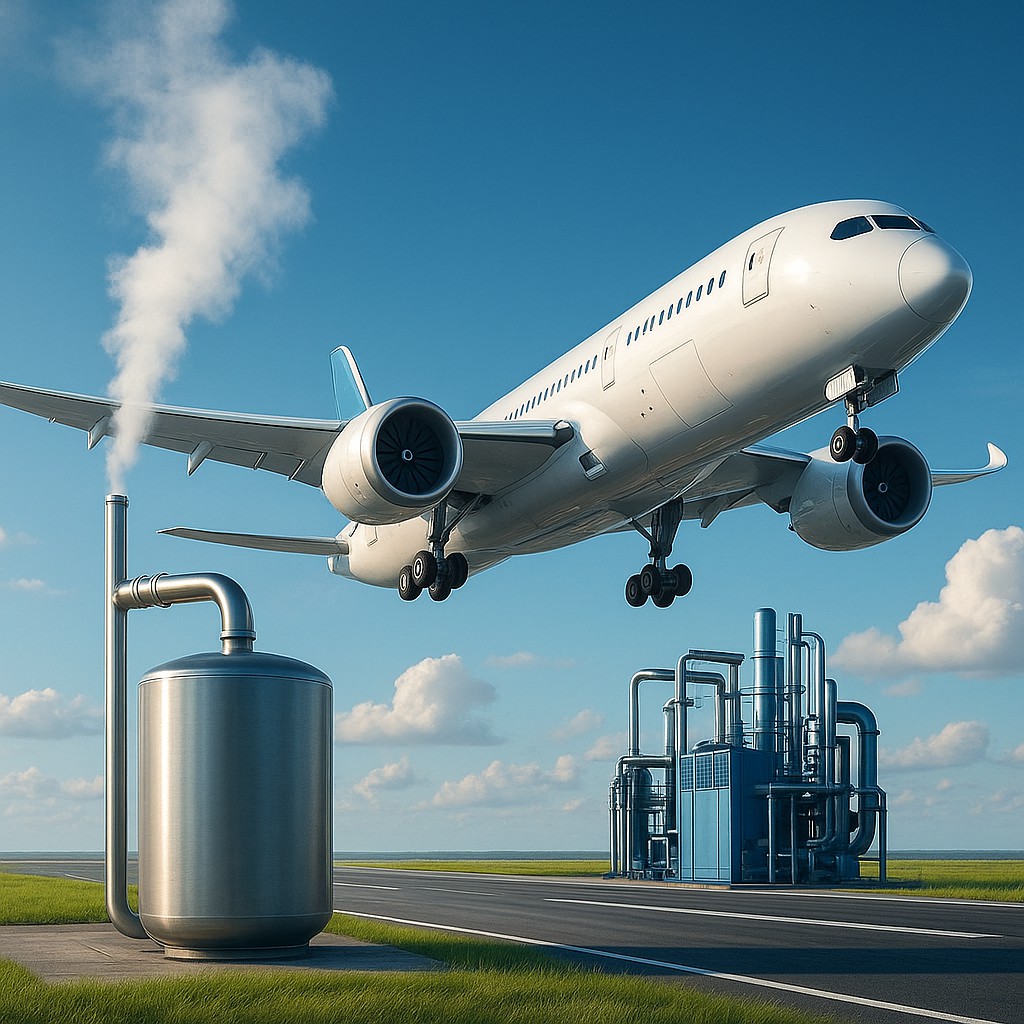
Imagine for a moment that you are standing on a windy runway, watching a massive Boeing 787 Dreamliner roar into the sky. It is a triumph of human engineering, carrying hundreds of people and tons of cargo across oceans at nearly the speed of sound. However, that triumph comes with a heavy, invisible cost. To keep that giant metal bird aloft, we currently have to burn thousands of gallons of ancient, liquefied sunlight known as petroleum. This process digs up carbon that has been buried underground for millions of years and tosses it into our atmosphere, where it acts like a thermal blanket we cannot seem to shake off.
The challenge of cleaning up aviation is uniquely difficult because airplanes are remarkably picky about their energy. While we can easily plug a car into a wall or power a house with solar panels, a long-distance flight requires an incredible amount of energy packed into a very small, very light space. Batteries, for all their modern brilliance, are simply too heavy. If we tried to power a jumbo jet with current battery technology, the plane would be so weighed down by its own power source that it would not have room for a single passenger. This brings us to a revolutionary concept that sounds like something out of a science fiction novel: creating fuel out of thin air using nothing but water, captured carbon, and a whole lot of renewable electricity.
The Weighty Problem with Electric Dreams
To understand why "Power-to-Liquid" technology is making such waves, we first have to appreciate the physics of flight. In the world of transportation, energy density is king. Liquid hydrocarbon fuels, the kind we currently use, are energy superstars. They pack about 43 megajoules of energy into every kilogram. To put that in perspective, the best lithium-ion batteries we have today manage only about 0.7 to 0.9 megajoules per kilogram. If you do the math, traditional jet fuel is roughly 50 times more energy-dense than our best batteries. For a short hop from London to Paris, an electric plane might work, but for a trans-Atlantic journey, the battery weight would be catastrophic.
This is why the aviation industry is looking for a "drop-in" solution. A drop-in fuel is something that behaves exactly like the kerosene-based fuel we use today. This means it can be pumped into the same tanks and burned in the same engines without needing to spend trillions of dollars redesigning every aircraft on Earth. The goal is to keep the energy density of liquid fuel while ditching the environmental baggage of fossil fuels. Power-to-Liquid (PtL) technology achieves this by essentially playing "LEGO" with molecules, using renewable energy to assemble a fuel that looks, smells, and burns just like the old stuff, but with a much cleaner history.
Building Fire From Water and Wind
The magic of Power-to-Liquid technology happens in a three-step dance of chemistry. It begins with something called electrolysis. Using excess electricity from wind turbines or solar farms, we zap water (H2O) to split it apart, releasing oxygen and keeping the hydrogen. This "green hydrogen" serves as the high-energy backbone of our future fuel. However, hydrogen on its own is a leaky gas that is incredibly hard to store on a plane, so we need to give it a more stable, liquid home.
The second step involves capturing carbon dioxide (CO2). This carbon can be sucked directly out of the sky using giant fans and chemical filters, a process known as Direct Air Capture, or it can be caught at the source from industrial plants. Once we have our carbon and our hydrogen, we use a clever chemical shortcut called the Reverse Water Gas Shift reaction to turn them into a "syngas" (synthesis gas). This gas is essentially a raw material that is ready to be molded into something useful.
Finally, we enter the Fischer-Tropsch phase, a process that has actually been around since the 1920s but is only now finding its true calling. In this stage, the syngas is passed over special catalysts, which are substances that speed up chemical reactions without being used up themselves. These catalysts persuade the carbon and hydrogen atoms to link up into long chains. By carefully controlling the temperature and pressure, engineers can ensure those chains are exactly the right length to create synthetic kerosene. The result is a clear, powerful liquid that is chemically identical to the fuel used by every commercial airline today.
Closing the Carbon Loophole
The most common question people ask about this technology is how it can possibly be sustainable if the plane is still spitting CO2 out of its exhaust pipes. The answer lies in the difference between a "closed loop" and an "open tap." When we burn fossil fuels, we are opening a tap that has been closed for millions of years, adding brand-new carbon to the atmosphere that was not there before. This increases the total amount of CO2, leading to the greenhouse effect that is warming our planet.
In a Power-to-Liquid system, we are simply borrowing carbon that is already in the atmosphere. We capture a molecule of CO2, turn it into fuel, and then the airplane releases that same molecule back into the sky when it flies. No new carbon is added to the overall system. It is like withdrawing twenty dollars from an ATM and then spending it at a local shop: the total amount of money in the neighborhood stays the same, it just moved around. This "carbon neutral" cycle allows us to enjoy the benefits of high-energy liquid fuels without the guilt of increasing the atmospheric carbon load.
Comparing High-Flying Energy Options
To help visualize how Power-to-Liquid stacks up against other potential green aviation solutions, consider the following comparisons based on current engineering trends.
| Feature |
Conventional Jet Fuel |
Electric Batteries |
Biofuels (HVO/HEFA) |
Power-to-Liquid (PtL) |
| Energy Density |
Extremely High |
Very Low |
High |
High |
| Infrastructure |
Ready to use |
Needs total redesign |
Ready to use |
Ready to use |
| Carbon Origin |
Underground (Ancient) |
N/A (Electricity) |
Plants / Organic Waste |
Atmospheric CO2 |
| Scalability |
High |
Low (Weight limits) |
Medium (Land use limits) |
High (Needs renewables) |
| Water Usage |
Low |
Low |
High (Irrigation) |
Moderate (Electrolysis) |
Overcoming the Economic Turbulence
While the science of Power-to-Liquid is sound, the economics are currently a bit of a bumpy ride. Because the process requires so many steps, from capturing carbon to splitting water, it is significantly more expensive than just pumping oil out of the ground. Currently, synthetic fuels can cost three to six times more than conventional jet fuel. This price gap is the primary reason why every airline is not switching over tomorrow morning. To make this work, we need "economies of scale," which means we need to build many of these plants so the cost of production starts to drop.
Governments and private investors are starting to step up to bridge this gap. Recent pilot programs involving major airlines and energy tech startups are currently testing how these fuels perform in real-world conditions. These pilots are not just about proving the fuel works (we already know it works); they are about refining the machinery to make it more efficient. As renewable energy becomes cheaper and carbon capture technology matures, the cost of PtL is expected to plummet. Some experts predict that by the mid-2030s, the price of synthetic "e-fuels" could become competitive with fossil fuels, especially if carbon taxes make polluting more expensive.
Clearing the Air on Common Misconceptions
One persistent myth is that synthetic fuels are lower quality than the real thing. In reality, the opposite is often true. Because Power-to-Liquid fuel is engineered in a lab rather than refined from crude oil, it is incredibly pure. Conventional jet fuel often contains impurities like sulfur or aromatics, which can lead to soot and contrails, the white streaks you see behind planes. Contrails are actually a significant contributor to global warming because they trap heat. Synthetic fuels can be designed to have fewer of these impurities, meaning they burn cleaner and create fewer contrails. This offers a double win for the environment that goes beyond just the carbon cycle.
Another misconception is that we should just wait for better batteries rather than investing in liquid fuels. While battery technology is improving, we are fighting the laws of physics. Even if we tripled the efficiency of batteries, they would still be vastly inferior to liquid fuels for long distances. By focusing on Power-to-Liquid technology, we are choosing a path that works with the physics we have, rather than waiting for a miracle that might never come. This allows us to start removing carbon from the hardest-to-reach parts of our economy right now, using the planes we already own.
A New Horizon for Global Travel
As we look toward the future, the sky does not have to be a place of environmental anxiety. The transition to Power-to-Liquid technology represents one of the most exciting frontiers in chemical engineering and environmental science. It turns the very problem we are facing, excess carbon dioxide, into the solution for our mobility. This shift enables us to maintain the global connections that define our modern world, such as the ability to visit family across the globe, conduct international business, and explore new cultures, all while respecting the planetary boundaries that keep our home habitable.
The journey from a laboratory experiment to a global fuel standard is long and requires immense cooperation between scientists, policymakers, and travelers alike. However, the flight path is clear. By harnessing the power of the sun and wind to rearrange the molecules of our atmosphere, we are learning to fly in harmony with the Earth rather than at its expense. The next time you see a jet streak across the blue, imagine a world where that trail represents a clever, circular triumph of human ingenuity. The technology is here, the pilots are ready, and the era of truly sustainable flight is finally cleared for takeoff.