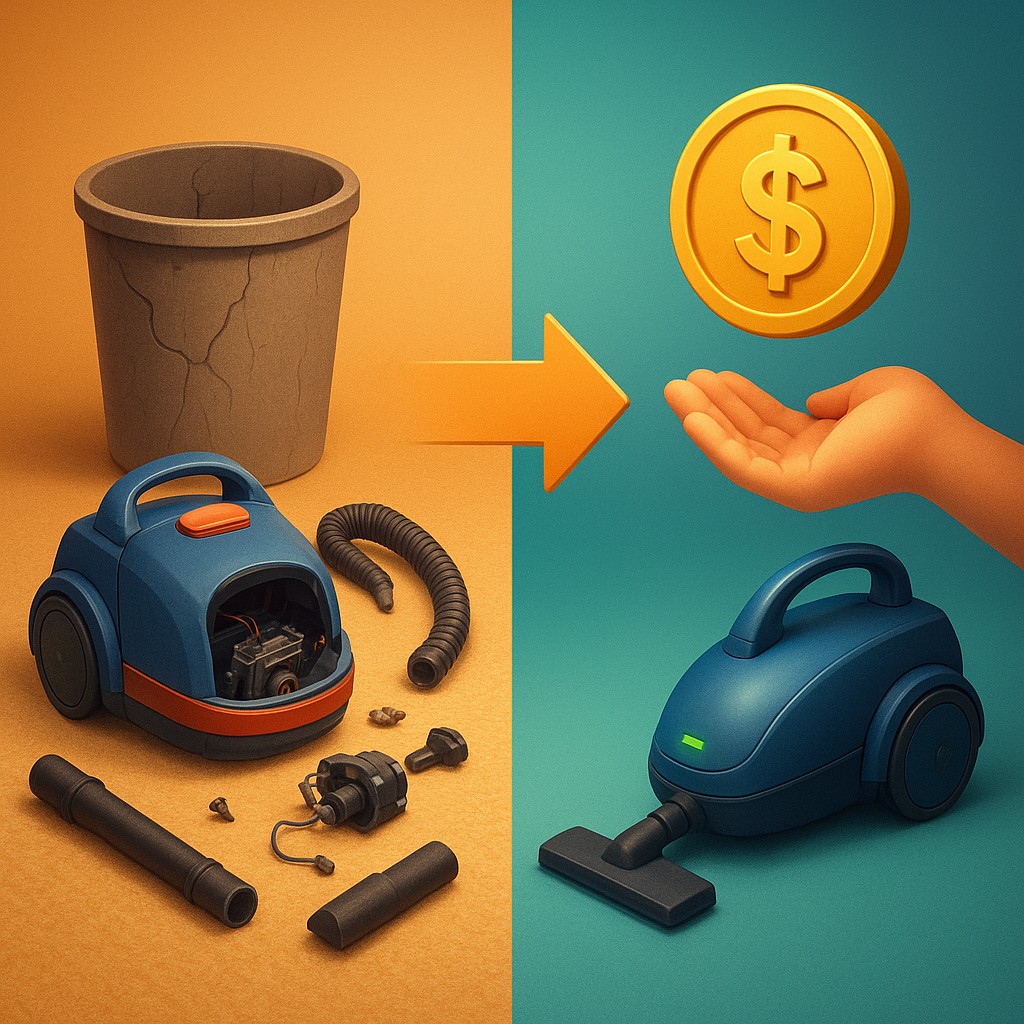
Imagine for a moment that your vacuum cleaner just gave up the ghost. In our current economy, this is a minor tragedy for your carpet but a quiet victory for the manufacturer. You will likely haul the plastic carcass to a landfill, head to a big-box store, and drop another two hundred dollars on a newer model. The manufacturer earns a profit when you buy the first one, and they cash in again the moment the old one breaks. This is the "Linear Economy," often described as "take-make-waste." It is a system where a company's financial success is actually tied to the eventual failure of the product they sold you.
Now, imagine a world where you don't actually own that vacuum. Instead, you pay a small monthly fee for the "service" of having clean floors. If the motor burns out, the company sends a replacement or repairs it for free within twenty-four hours. Suddenly, the entire financial incentive flips upside down. If that machine breaks, the company loses money on shipping, labor, and parts. If the machine is hard to take apart, their repair technicians waste expensive hours fumbling with glued-in batteries. In this "Product-as-a-Service" (PaaS) model, the company’s greatest asset is a product that never breaks, and their greatest liability is a product that ends up in a dumpster.
The Financial Alchemy of Shifting Incentives
The real magic of the circular economy is that it aligns the bottom line of capitalism with the survival needs of the planet. In a traditional sales model, "planned obsolescence" - building things to fail - is a dark but logical strategy. If a lightbulb lasts forever, the lightbulb company goes out of business. However, when we shift to a service model, durability becomes the primary driver of profit. When a company like Signify (formerly Philips Lighting) offers "Light as a Service," the customer pays for the illumination of their office building, while the company maintains the fixtures and pays the energy bill.
In this scenario, every watt of wasted electricity and every burnt-out LED represents a direct hit to the company’s profits. Because of this, they are motivated to design bulbs that last for decades and sensors that dim the lights when a room is empty. The product is no longer the end goal; it is a tool used by the company to deliver a result. By keeping ownership of the hardware, the manufacturer views the materials inside - like rare earth metals, copper, and high-grade plastics - as valuable inventory rather than "sold and forgotten" junk.
This shift creates a closed loop where the manufacturer acts as a caretaker of the material. When a piece of equipment eventually wears out, the company doesn't want it to vanish into a landfill because that would mean losing their raw materials. They design the product for "Reverse Logistics," which is a professional way of saying they make it easy to ship back, take apart, and put back onto the assembly line. It is a world where a broken component isn't "trash," but rather a "pre-processed raw material" that stays within the company's ecosystem.
Designing for an Inevitable Second Life
To make this model work, engineers have to unlearn everything they were taught about cheap manufacturing. In the linear world, glue is the king of the factory because it is fast and inexpensive. However, glue is the enemy of the circular economy. If a technician has to crack a plastic casing to replace a single small part, the labor cost often exceeds the value of the device. Therefore, service-driven design prioritizes modularity. We are seeing a return to screws, snaps, and plug-and-play components that allow for quick, precise repairs.
Consider the difference between a modern smartphone and a modular piece of industrial equipment. If your phone's charging port breaks, you might be told it’s cheaper to buy a new phone because the port is soldered directly to the main circuit board. In a service model, that charging port would be a separate, swappable module. The manufacturer would design the exterior to be "ruggedized" - toughened to prevent damage in the first place - but if damage does occur, the repair is as simple as swapping a Lego brick. This "Design for Disassembly" ensures that at the end of a five-year contract, the company can take the unit back, harvest the expensive sensors, and melt down the aluminum frame for the next generation of products.
This evolution also changes how software works with hardware. In a circular model, hardware is built to be "future-proofed." Instead of releasing a new physical model every year to convince you to upgrade, a service provider might send out software updates over the internet to improve the efficiency of the machine you already have. The goal is to maximize the "utilization rate," or how much work the object actually does. The longer that hunk of metal and silicon stays in the field earning service revenue, the more profitable it becomes for the manufacturer.
Comparing Global Economic Philosophies
To truly grasp how radical this shift is, it helps to see the two models side-by-side. The following table shows how basic business concepts change when we move from owning things to subscribing to their use.
| Feature |
Linear Economy (Ownership) |
Circular Economy (Service) |
| Primary Goal |
Selling the highest number of units. |
Delivering the best performance. |
| Product Failure |
A chance to sell a replacement. |
A financial loss due to repair costs. |
| Material Status |
Lost to the manufacturer after the sale. |
Kept as a long-term asset or inventory. |
| Customer Link |
Short and focused on the transaction. |
Long-term and based on a relationship. |
| Design Focus |
Low cost and looking good. |
Durability, easy repair, and recycling. |
| Waste Responsibility |
Falls on the consumer or the city. |
Stays with the manufacturer. |
The Psychological Leap from Ownership to Access
While the logic of the circular economy makes sense for engineering and the environment, the biggest hurdle isn't technology; it is psychology. Humans have a deep-seated desire to "own" things. Ownership provides a sense of security and status. We like to know that the car in the driveway is "ours," even if it sits unused for 95% of the day. To move to a service model, we have to adopt a mindset of "Access over Ownership."
This shift is already happening in the digital world. Most of us no longer "own" movies or music; we subscribe to Netflix or Spotify. We have traded the pride of a physical CD collection for the sheer convenience of having every song ever recorded in our pockets. The circular economy tries to bring this same "Spotify" approach to physical objects. Why own a lawnmower that you use twelve times a year when you could subscribe to a landscaping service that provides a high-end robot mower that the company maintains and upgrades for you?
This shift requires trust. To give up ownership, the consumer needs to be certain that the service will be seamless. If your "Mobility-as-a-Service" subscription (replacing a car) fails to provide a vehicle when you need to get to the hospital, the model collapses. Therefore, circular companies must be obsessed with reliability. They aren't just selling a machine; they are selling a promise that the machine will work. This creates a higher bar for customer service, turning traditional factories into service organizations.
Navigating the Challenges of a Subscription World
Of course, no system is perfect. One common concern with the service model is the "subscription fatigue" that many people already feel. If every appliance in your home, from the washing machine to the coffee maker, requires a monthly fee, managing those bills can become a headache. There is also the risk of "lock-in," where a consumer becomes so dependent on one company's system that switching to a competitor becomes nearly impossible.
From a privacy perspective, a service model often requires the product to be "smart" or connected to the internet. To maintain a machine before it breaks, the manufacturer needs to monitor how it is used. This raises questions about how much data the company is collecting about your daily habits. Are they just checking the health of the refrigerator's cooling motor, or are they tracking how many times you open the door for a midnight snack? For the circular economy to truly succeed, manufacturers must be honest about data and ensure that the benefits, like lower costs and zero maintenance, are worth the loss of privacy.
Finally, there is the question of cost and fairness. While a monthly fee might be lower than the upfront cost of a luxury appliance, over many years, the consumer might end up paying more than they would have for a cheap, disposable version. However, supporters argue that this is balanced out by the lack of repair bills and the higher quality of the service. Additionally, this model can make high-end, energy-efficient technology affordable for lower-income households who might not have the cash for a large purchase but can manage a small monthly fee.
The Dawn of the Resource Strategist
As we move further into the 21st century, the role of the "Manufacturer" is turning into that of the "Resource Strategist." In a world of shrinking raw materials and unpredictable climate change, the companies that thrive will be those that learn to do more with less. They will be the ones who treat a discarded laptop not as trash, but as a "mine" of gold and cobalt that just happens to be sitting in a customer’s living room. The circular economy isn't just a "green" project; it is a smart survival strategy for a planet with finite limits.
By embracing the Product-as-a-Service loop, we are essentially hiring the smartest engineers in the world to work for our long-term interests. When their profit depends on our satisfaction and the longevity of their creations, everyone wins. It transforms the act of buying stuff from a one-way street into a continuous, elegant cycle of materials and utility. As you look around your room at the objects you "own," ask yourself which ones you truly need to possess, and which ones you simply need to work. You might find that the freedom of not owning things is the most valuable service of all.