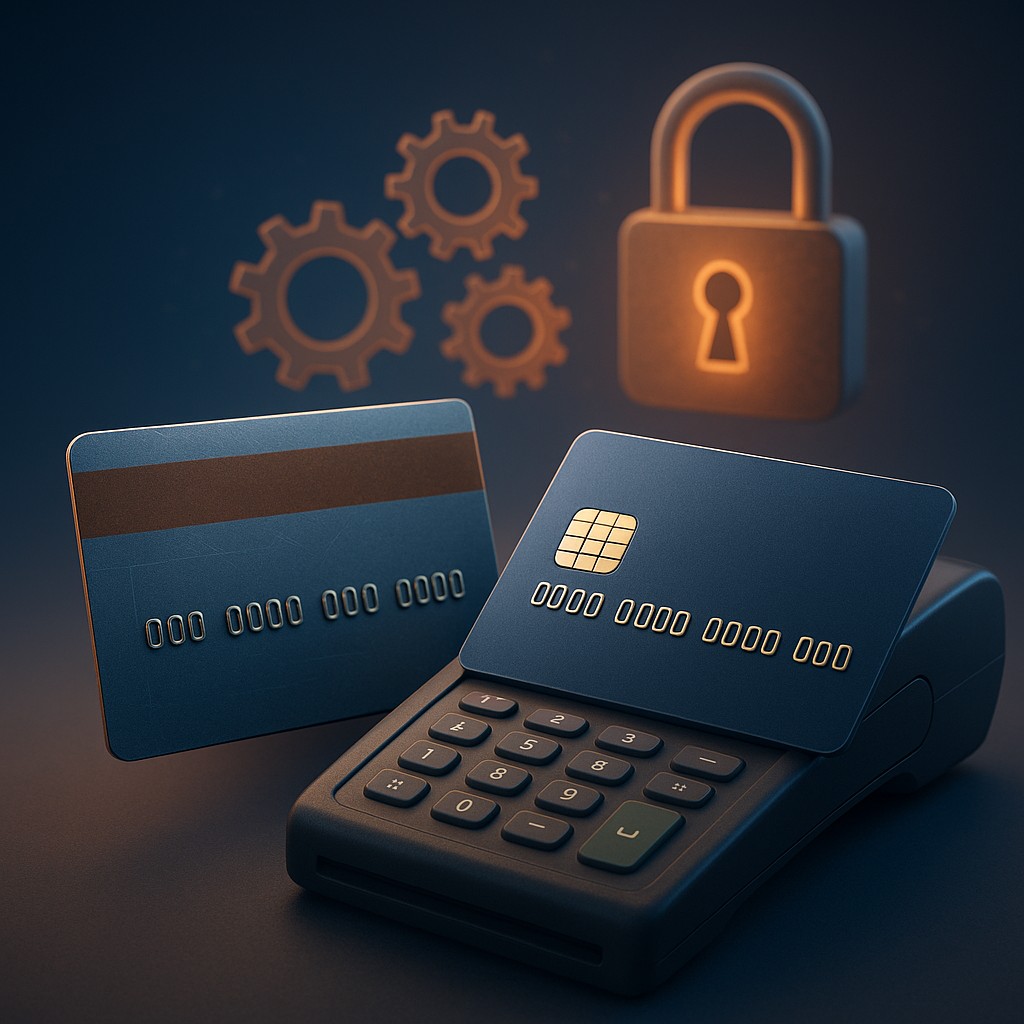
Imagine you are standing at a checkout counter, holding a small piece of plastic that serves as the gateway to your financial life. For decades, that plastic relied on a brown magnetic stripe, which was essentially a strip of cassette tape glued to the back of the card. It broadcast your private information to anyone with a reader, making it laughably easy for a thief to "skim" your data and clone your card onto a blank piece of plastic. Then came the "chip," that satisfying click of a card entering a terminal, and suddenly, cloning a card became nearly impossible.
The magic happens inside that tiny gold square. It is not just a memory chip; it is a miniaturized, armored computer. When you insert your card, it does not simply hand over your account number like a nervous informant. Instead, it enters into a high-stakes mathematical dance with the terminal. This process, known as Static Data Authentication or its more advanced variations, lets the terminal verify that your card is genuine without the card ever revealing the "private key," a secret code buried deep within its silicon core. By the time you pull your card out, a complex cryptographic conversation has taken place, proving the card is legitimate through math rather than blind trust.
The Fragility of the Magnetic Whisper
To understand why the chip is such a fortress, we first have to look at the spectacular insecurity of the magnetic stripe. A magnetic stripe works through "static data," meaning the information written on it never changes. It contains your name, card number, and expiration date in a format that is essentially plain text to any device with a magnetic head. When you swiped your card in the 1990s, the terminal simply read that text. If a criminal placed a "skimmer" over the card slot, they could record that exact same text, write it onto a cheap gift card, and walk away with a functional clone of your credit card.
This system relied entirely on physical possession as proof of authorization. It assumed that if you had the card, you were the owner. However, because the data was fixed and unencrypted, the "identity" of the card was separated from the plastic itself. A thief did not need your physical card; they just needed the patterns of magnetism stored on it. This led to a massive global industry of card skimming, where compromised ATMs and gas pumps acted as silent harvesters for millions of card numbers, all because the stripe was too "loud" and too simple.
The transition to chip technology, technically known as EMV (named after its creators Europay, Mastercard, and Visa), changed the fundamental logic of the transaction. Instead of the terminal reading the card, the terminal now talks to it. The chip is capable of processing logic, which means it can hold a secret that it never shares, using that secret only to sign off on specific requests. This shift from "reading" to "interacting" is what effectively killed the physical card cloning industry in regions that fully adopted the chip.
The Mathematical Handshake of Public and Private Keys
At the heart of the chip’s security is a concept called Asymmetric Cryptography, also known as Public Key Infrastructure (PKI). Imagine a mailbox with two different slots. One slot allows anyone to drop a letter in, but only the person with the special key can open the back and read it. In the world of credit card chips, the card possesses a "private key," a string of numbers burned into the hardware during manufacturing. This key is stored in a highly secure area of the chip that is physically shielded against tampering; if you try to cut into the chip to read the key, the delicate circuits are designed to break or erase themselves.
When you insert your card, the terminal sends a challenge to the chip. It might say, "Here is a random number and the details of this $50 transaction. Use your secret key to sign this." The chip then performs a complex calculation using its private key and the transaction data to produce a "digital signature." This signature is a unique string of numbers that could only have been generated by that specific card. The terminal receives this signature and uses a "public key" (which is common knowledge among banks and terminals) to verify it. If the math checks out, the terminal knows the card is genuine.
The brilliance of this system is that the private key never leaves the chip. The terminal never sees it, the internet never sees it, and the merchant’s server never sees it. Even if a hacker intercepted the entire conversation between the card and the terminal, they would only see the "digital signature" for that specific transaction. Because that signature is unique to that moment and that dollar amount, it is useless for any future purchase. A thief could steal the signature, but they could not use it to create a new one because they still lack the secret key hidden inside the silicon.
Comparing the Old Guard and the New Shield
It is helpful to see the technical differences laid out side by side to understand why the chip was such a massive leap forward. The primary difference lies in how the data is presented and how much "intelligence" the card possesses. While a magnetic stripe is a passive object, much like a printed barcode, the chip is an active participant in the security protocol.
| Feature |
Magnetic Stripe |
EMV Chip (SDA/DDA) |
| Data Type |
Static (never changes) |
Dynamic (unique signature per use) |
| Security Mechanism |
Physical possession is the only proof |
Cryptographic challenge-response |
| Vulnerability |
Easily skimmed and cloned |
Virtually impossible to physically clone |
| Intelligence |
None (passive magnetic strip) |
Microprocessor (active computer) |
| Data Transmission |
Broadcasts all info in plain text |
Keeps secret keys hidden in hardware |
| Verification |
Terminal simply reads the bits |
Terminal and card perform math together |
This table highlights why the logic of the "dip" is superior to the "swipe." In the swipe era, the terminal was the brain and the card was a dumb piece of paper. In the chip era, the card is the brain, and it treats the terminal with a healthy dose of skepticism until the mathematical proof is complete.
The "Card Not Present" Loophole
While the chip is a masterpiece of engineering for physical security, it is not a magic bullet for all types of fraud. You may have noticed that when you buy a pair of shoes online, you are not dipping your card into your laptop. You are simply typing in the numbers. This is known as a "Card-Not-Present" (CNP) transaction. In this environment, the sophisticated cryptographic hardware of the chip stays dormant in your wallet. The merchant essentially reverts to the old method of "blind trust," relying on the card number, expiration date, and that little three-digit CVV code on the back.
This is why, despite the massive drop in physical skimming, credit card fraud has not disappeared; it has simply migrated. Criminals who used to build skimmers for gas pumps now build "e-skimmers," or malicious scripts that infect the checkout pages of online retailers. When you type your numbers into a compromised website, that data is stolen in its "raw" form. Because the transaction happens online, there is no physical chip to provide a digital signature, and the security defaults back to the strength of the numbers themselves.
To combat this, banks have started introducing "3D Secure" protocols and virtual cards. When you use a virtual card, your browser or bank app generates a one-time-use number for that specific online purchase. This mimics the behavior of the chip by making the stolen data useless after the first use. However, until standard online shopping requires a physical hardware handshake, the numbers printed on your card remain the weakest link in your financial armor.
The Invisible Fortress in Your Wallet
It is a rare feat of engineering when a technology becomes so common and reliable that we forget how complex it actually is. Every time you buy a coffee with a dip or a tap, you are initiating a sequence of events that would have been considered high-level, military-grade encryption just a few decades ago. You are carrying a secure vault in your pocket, one that can prove its identity to a stranger without ever giving up its secrets.
This evolution from magnetic "shouting" to cryptographic "whispering" has fundamentally changed the landscape of global commerce. It has forced us to move from a world where we hoped nobody was looking to a world where it does not matter who is looking, because the math is unassailable. While the internet remains a bit of a Wild West for card data, the physical world has become significantly safer thanks to the silent, invisible work of the microprocessors living inside our plastic cards.
As you move through your day, take a moment to appreciate the tiny, golden computer in your wallet. It is a reminder that in the battle between thieves and engineers, the most powerful weapon is not a bigger lock or a thicker vault door. It is a well-designed mathematical puzzle that only the right key can solve. By understanding how this invisible handshake works, you can navigate the world of modern finance with more confidence, knowing that your secret keys are staying exactly where they belong: locked deep inside the silicon.