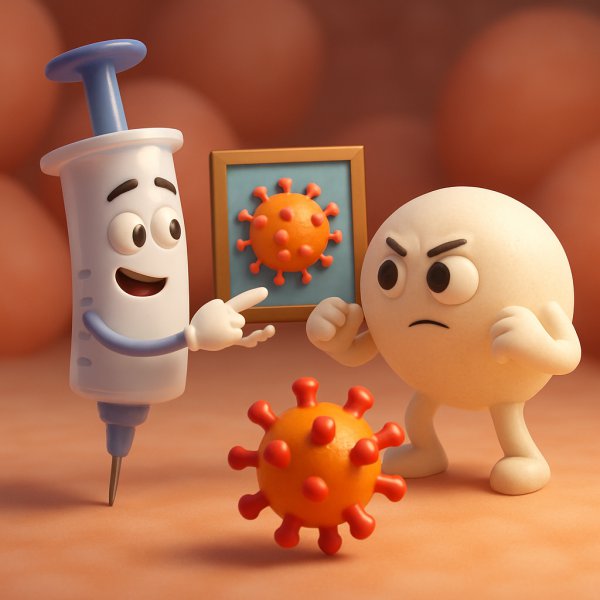
<h2>A tiny question with big consequences: What if your body could be coached to fight an enemy it has never met?</h2>
Imagine waking one morning to discover that your body has kept a small photographic memory of a dangerous intruder - not because it encountered the intruder, but because someone showed it a detailed, harmless portrait. Months or years later, when the real intruder appears, your body recognizes it instantly and neutralizes it before it can cause serious harm. That is the neat, almost miraculous promise of vaccines, and it is exactly what they do on a molecular level.
This article will take you on a guided walk through that microscopic coaching session. We will meet the immune system like a cast of characters, watch the step-by-step choreography that turns a vaccine into protection, correct common misunderstandings, and finish with practical tools you can use when deciding about vaccines for yourself or your family. Along the way there will be stories, analogies, and a few useful challenges to test your understanding.
<h2>A front-row seat to the microscopic drama: What a vaccine actually is</h2>
A vaccine is a biological preparation that teaches the immune system to recognize and respond to a specific pathogen - a virus or bacterium - without causing the disease that the pathogen normally produces. Think of a vaccine as a safe training exercise for your immune system: the danger is simulated, the lesson is learned, and your body gains memory so it can respond rapidly when the real thing appears.
Vaccines achieve this with a range of methods. Some use weakened live organisms that behave like the real pathogen but are too feeble to cause serious illness. Others use killed organisms, purified pieces of the pathogen such as proteins, or genetic instructions that tell your own cells to make a harmless piece of the invader. Each platform has advantages and trade-offs in terms of strength of immune response, safety, speed of development, and storage needs. The remarkable innovations of the past decade - notably mRNA vaccines - have added a powerful new tool to this toolkit.
<h3>Quick table of vaccine types and how they work</h3>
<table border="1" cellpadding="6" cellspacing="0">
<tr>
<th>Platform</th><th>What is delivered</th><th>How the immune system sees it</th><th>Examples</th>
</tr>
<tr>
<td>Live attenuated</td>
<td>Weakened whole virus or bacterium</td>
<td>Mimics natural infection, strong cellular and antibody responses</td>
<td>Measles, mumps, rubella, oral polio (some forms)</td>
</tr>
<tr>
<td>Inactivated</td>
<td>Killed whole pathogen</td>
<td>Safe, needs boosters to reinforce immunity</td>
<td>Inactivated polio, some influenza vaccines</td>
</tr>
<tr>
<td>Protein subunit / conjugate</td>
<td>Purified pieces of the pathogen, sometimes attached to carriers</td>
<td>Targets specific antibody responses, very safe</td>
<td>Hepatitis B, HPV, pneumococcal conjugate</td>
</tr>
<tr>
<td>Viral vector</td>
<td>A harmless virus delivering genetic code for an antigen</td>
<td>Cells produce antigen, stimulating immune response</td>
<td>Adenovirus-based COVID-19 vaccines</td>
</tr>
<tr>
<td>mRNA</td>
<td>Messenger RNA encoding a pathogen protein, in lipid nanoparticles</td>
<td>Cells translate mRNA and display the antigen, strong response</td>
<td>Some COVID-19 vaccines</td>
</tr>
<tr>
<td>Toxoid</td>
<td>Inactivated toxins</td>
<td>Neutralizing antibodies against toxin, not the bacteria itself</td>
<td>Tetanus, diphtheria</td>
</tr>
</table>
<h2>Meet your immune system: The heroes, the scouts, and the memory keepers</h2>
To understand how vaccines work, it helps to imagine your immune system as a well-organized city defense with rapid-response units, intelligence services, and a national archive of portraits and dossiers. The defense has two broad branches: the innate immune system, which reacts quickly and non-specifically like a general alarm, and the adaptive immune system, which learns, adapts, and remembers with exquisite specificity.
The innate system includes barriers like skin and mucous, patrol cells like macrophages and neutrophils, and molecules such as interferons and complement proteins. These provide immediate defense, limit early spread of pathogens, and send signals - chemical smoke signals - that recruit the adaptive forces. The adaptive system then takes center stage when specificity and memory are required. Its principal characters are B cells, which produce antibodies - specialized proteins that bind and neutralize foreign molecules - and T cells, which come in two main flavors: helper T cells that coordinate the response and cytotoxic T cells that kill infected cells.
Antigen-presenting cells, such as dendritic cells, are the scouts. They capture a piece of the invader, process it, and then travel to lymph nodes - the strategic command centers - to present the antigen to T cells. Once a T cell recognizes the presented antigen, a cascade of activation starts, resulting in clonal expansion where many copies of that specific B or T cell are produced. Some of these cells become effectors to fight the immediate threat, while others become memory cells that persist for years or decades, ready to respond much faster upon re-exposure.
<h2>From injection to immunity: The step-by-step choreography inside your body</h2>
The sequence that follows a vaccine is elegant and highly coordinated, and it unfolds over a time scale from minutes to months. The short version is: vaccine enters tissues, scouts pick up antigen, message gets carried to lymph nodes, B and T cells are activated, antibodies and killer cells are produced, and memory is formed. Now let us walk through the scenes in somewhat greater detail.
Within minutes to hours after injection, the innate immune system notices something unusual. Local inflammation - redness, warmth, sometimes mild pain - signals cells to gather at the site. Dendritic cells and macrophages engulf the vaccine material, break it into small pieces, and load those pieces onto molecular trays called major histocompatibility complex proteins, or MHC for short. These antigen-loaded scouts then travel to the nearest lymph node, where most of the adaptive response gets organized.
Over the next several days, dendritic cells present the antigen to helper T cells. If a specific helper T cell recognizes the antigen, it activates and multiplies, then helps B cells that recognize the same antigen to proliferate and differentiate into plasma cells. Plasma cells are antibody factories; they churn out large quantities of antibodies tailored to bind the antigen. Some B cells enter specialized structures called germinal centers where they undergo mutation and selection - a Darwinian-like refinement process called affinity maturation that improves the quality of the antibodies.
Over weeks to months, antibody levels rise, peak, and then contract to a stable level while memory B cells and long-lived plasma cells persist in bone marrow. Memory T cells also settle in various tissues. If the real pathogen later invades, memory cells recognize it and respond dramatically faster and more effectively than the initial response. What might have required days to ramp up in the first encounter now happens in hours, often preventing disease or making it much milder.
<h3>How different vaccine platforms achieve the same end result</h3>
<table border="1" cellpadding="6" cellspacing="0">
<tr><th>Platform</th><th>Pathway inside body</th><th>Typical immune outcome</th></tr>
<tr><td>mRNA</td><td>Lipid nanoparticle delivers mRNA to host cells, cells make antigen, display on MHC</td><td>Strong antibody and helper T cell response, some cytotoxic T cell response</td></tr>
<tr><td>Viral vector</td><td>Harmless vector infects cells, expresses antigen inside cells</td><td>Strong cellular and antibody responses, robust T cell activation</td></tr>
<tr><td>Protein subunit</td><td>Delivered antigen taken up by APCs, presented externally</td><td>Good antibody response, usually needs adjuvant for stronger effect</td></tr>
<tr><td>Live attenuated</td><td>Mimics infection, replicates weakly, broad antigen exposure</td><td>Very strong, long-lasting immunity; potent cellular and humoral responses</td></tr>
</table>
<h2>Why your neighbor's choice matters: Herd immunity and public health impact</h2>
Vaccines are not only personal protection - they are social tools. When a large fraction of a community is immune to a contagious disease, chains of transmission are interrupted and even people who cannot be vaccinated - infants, certain immunocompromised patients - are protected indirectly. This community-wide protection is called herd immunity.
How much coverage is needed depends on how contagious the disease is. Measles, which is extremely contagious, requires about 93 to 95 percent immunity in the population to stop spread, while diseases with lower contagiousness require lower thresholds. Herd immunity thresholds, vaccine effectiveness, and coverage interact to determine whether an outbreak can be sustained. Practical examples are instructive: smallpox was eradicated worldwide because of an effective vaccine and coordinated global campaigns. Polio is close to eradication in most regions thanks to massive vaccination efforts, and mass immunization with influenza or COVID-19 vaccines has substantially reduced severe disease and death during seasonal or pandemic waves.
<h2>Common myths, calmly disproven: Separating fact from fiction</h2>
Myth: Vaccines cause autism. Fact: This claim originated from a small 1998 paper that was later fully retracted because of fraudulent data and ethical violations. Extensive, large-scale studies involving millions of children have found no link between vaccines and autism. The original author lost his medical license, and public health agencies worldwide continue to endorse vaccination because the evidence for safety is powerful and consistent. When evaluating extraordinary claims, look for replication, large sample sizes, and independent confirmation.
Myth: Natural infection gives better immunity than vaccines. Fact: Sometimes natural infection produces robust immunity, but it carries a risk of severe illness, long-term complications, or death. Vaccines are designed to induce similar protective immunity without the uncontrolled risks of disease. For instance, measles infection can cause serious complications including pneumonia and encephalitis; measles vaccines give strong protection with a far safer profile.
Myth: Vaccines overload the immune system. Fact: Children encounter thousands of antigens every day through food, microbes, and the environment. The immunologic load from vaccines is tiny by comparison. Studies show that even multiple vaccines given together do not overwhelm the immune system, and modern vaccines are formulated to minimize unnecessary antigen exposure.
Myth: mRNA vaccines change your DNA. Fact: mRNA molecules operate in the cytoplasm and do not enter the cell nucleus where DNA resides. Human cells have no mechanism to reverse-transcribe ordinary mRNA into DNA and insert it into chromosomes. mRNA is transient; it is translated by ribosomes into protein and then degraded. The immune lesson is taught without any permanent change to your genome.
<h2>Side effects, explained: Why soreness and fever are often good news</h2>
After vaccination some people experience local pain, redness, fatigue, headache, mild fever, or muscle pain. These are signs of the innate immune system waking up and helping to build the adaptive response. These side effects, known as reactogenicity, are usually short-lived and self-limited. Severe allergic reactions are rare, and vaccine safety systems such as the Vaccine Adverse Event Reporting System collect information to monitor and investigate any unusual patterns.
It is helpful to separate common, expected effects from true adverse events. Expected effects are a sign that the immune system is responding; they are usually manageable with rest, fluids, and over-the-counter pain relief if needed. True adverse events are uncommon and function as signals for thorough investigation. If you have a history of severe allergic reactions, discuss this with a healthcare provider before vaccination so appropriate precautions can be taken. Reporting adverse events helps public health agencies maintain safety and trust.
<h2>Practical steps: Making wise vaccine choices for yourself and your family</h2>
When deciding about vaccines, use a simple framework: assess the disease risk, check the vaccine evidence, consider personal health conditions, and consult trusted professionals. Start with official schedules from trusted authorities such as the Centers for Disease Control and Prevention or the World Health Organization, which base recommendations on robust evidence of benefit and safety. Keep a vaccination card or digital record, especially when travelling or planning pregnancy.
A few practical tips: plan vaccinations ahead of travel to allow enough time for immunity to develop, update tetanus boosters every ten years or after certain injuries, and ensure influenza vaccination annually for most people. For babies and young children, follow the recommended schedule - the timing is based on how the immune system develops and when protection is most needed. If someone in your household is immunocompromised, ensure that household contacts are up to date with vaccines to reduce risk of transmission.
Reflective question: If you had to explain to an anxious friend why they should get a vaccine, how would you describe the benefit in one or two sentences that are personal, not technical? Try it now - it clarifies your thinking and helps you communicate persuasively.
Small challenge: Look up one vaccine you have received in the past, check whether a booster is recommended, and schedule it if needed. This tiny action can make a real difference.
<h2>A story to remember: From cowpox to cutting-edge mRNA</h2>
It is worth closing with a story because stories lodge in the mind more stubbornly than facts alone. In 1796, Edward Jenner noticed that milkmaids who had recovered from cowpox did not get smallpox. He deliberately infected a boy named James Phipps with cowpox material and later showed that the boy was protected from smallpox. This crude but effective experiment catalyzed vaccination - the word comes from vaccinia, the virus used - and launched a public health revolution. Smallpox caused massive death and disfigurement for centuries; its eradication in 1980 showed that organized vaccination campaigns could eliminate a disease forever.
Now fast forward to the 21st century when scientists read genetic blueprints and made mRNA vaccines within months after a new virus emerged. The principle is the same as Jenner’s - teach the immune system with harmless pieces - but the tools are vastly more precise. This arc from cowpox to mRNA is a human achievement of observation, curiosity, and relentless refinement. It is also a reminder: the science of vaccines marries humility - an acknowledgment of nature’s power - with audacity - the will to bend that power to prevent suffering.
<h3>Where to read more, and who to trust</h3>
- Centers for Disease Control and Prevention (CDC) - vaccine schedules and safety data
- World Health Organization (WHO) - global guidance and disease eradication history
- Peer-reviewed journals such as Nature Reviews Immunology or The New England Journal of Medicine for deep dives and recent research
- Trusted public health agencies and your local healthcare provider for personal recommendations
Quote to remember:
"Vaccines are one of the great achievements of public health - quiet, ordinary, and yet heroic in their cumulative effect." - paraphrase, distilled for our conversation
<h2>Parting thought: A small action with outsized returns</h2>
Vaccination is one of those rare inventions that is both scientifically elegant and morally generous. It protects the individual and reduces harm for others. Understanding the how and the why helps replace fear with curiosity, and suspicion with informed choice. You have now seen the cast of cellular characters, watched the choreography from injection to memory formation, and learned how to weigh decisions in everyday life. The final invitation is simple: use this knowledge, ask thoughtful questions at your next healthcare visit, and if you can, help others access the same protections. It is the small, informed actions of many that keep communities healthier and kinder places to live.