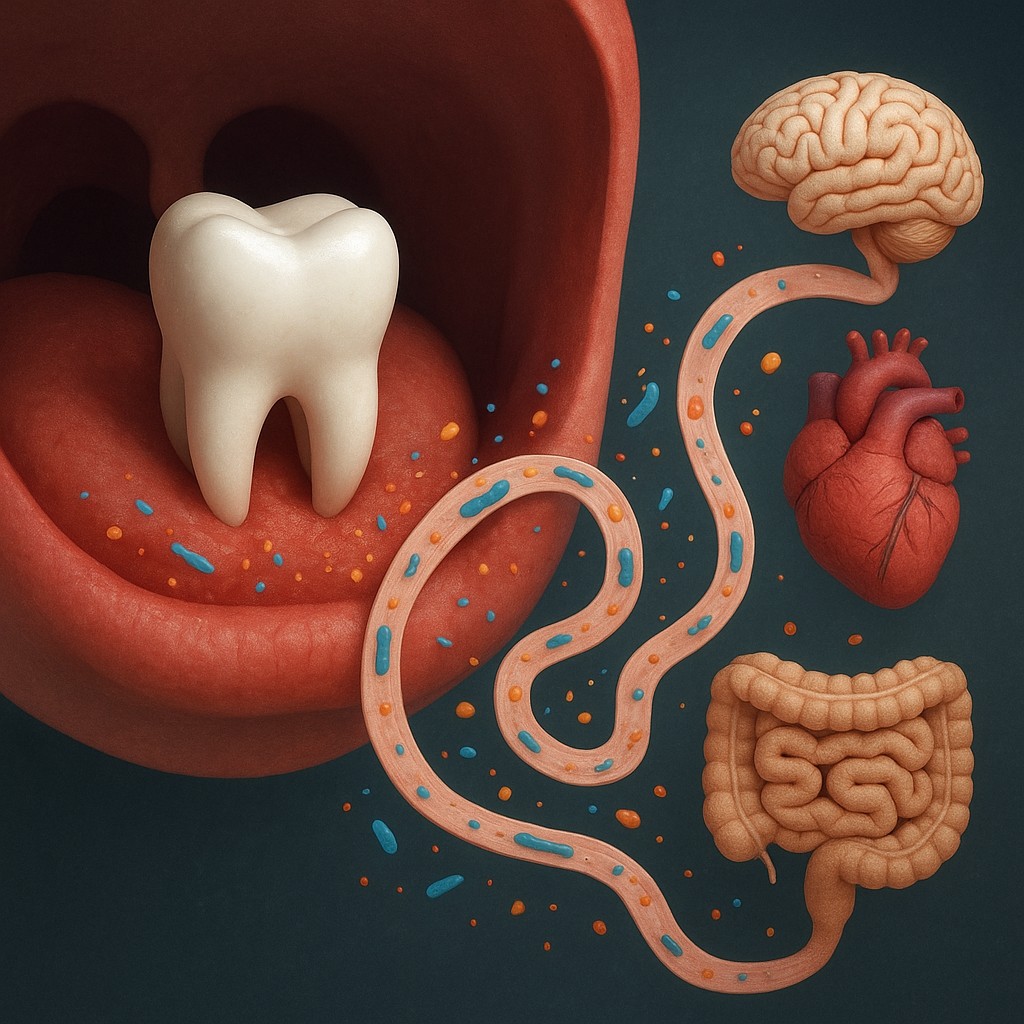
Most of us think of the mouth as a self-contained island, a biological neighborhood whose only residents are teeth, a tongue, and the occasional piece of spinach. We brush because we want to avoid the dentist’s drill or because we don't want our breath to clear out a crowded elevator. However, the reality is far more interconnected. Your mouth is actually the grand foyer of a massive, winding mansion, and the front door is rarely locked. What happens in your gums does not stay in your gums; it is the starting point for a complex biological highway known as the gums-to-gut axis. This pathway allows tiny hitchhikers to travel from your smile to your vital organs.
Every time you chew, brush, or even talk, you interact with a bustling metropolis of billions of bacteria. In a healthy mouth, these microbes live in a delicate, cooperative balance. But when gum disease takes hold, the tissue becomes inflamed and leaky, essentially turning a solid wall into a sieve. This creates a golden opportunity for harmful bacteria to slip into the bloodstream. Once they have hitched a ride on your red blood cells, these microscopic travelers can set up shop in distant places like the heart, the lungs, or even the brain. There, they trigger inflammatory responses that can subtly reshape your long-term health.
The Secret Life of Your Oral Neighborhood
To understand how a toothache can influence your heart, we first have to appreciate the sheer complexity of the oral microbiome, the community of microorganisms living in your mouth. Your mouth is home to over 700 species of bacteria; some are helpful guardians, while others are constant troublemakers. These microbes live in biofilms, which are sophisticated, sticky communities better known to us as plaque. When these biofilms are managed through good hygiene, they are harmless. However, when left undisturbed, they transform. The population shifts from mostly "good" oxygen-loving bacteria to "bad" anaerobic bacteria that thrive without air in the deep, dark pockets between your teeth and gums.
This shift marks the beginning of dysbiosis, a state where the microbial community is out of balance. As the bad actors take over, they produce toxins that irritate the delicate gum tissue. Your immune system, ever the vigilant protector, rushes to the scene, causing the redness and swelling we recognize as gingivitis. This inflammation is meant to kill the invaders, but it has a side effect: it breaks down the physical barriers of the gum tissue. Think of it like a riot in a city where the fences are knocked down. Suddenly, the residents of one neighborhood can spill out into the main highways, which, in your body, are the blood vessels.
Bloodstream Hitchhikers and the Inflammatory Tax
Once the strength of the gums is compromised, even a simple act like eating a crunchy apple can push oral bacteria into the circulatory system. This is a process called transient bacteremia, or bacteria temporarily entering the blood. Usually, a healthy immune system mops up these strays in a matter of minutes. However, if your gums are chronically inflamed, this "leak" becomes a steady drip. Pathogens like Porphyromonas gingivalis, a particularly nasty character in the dental world, are experts at surviving the journey. They don't just float passively; they actively trick the immune system to avoid detection, allowing them to travel to distant sites.
When these bacteria arrive at a new destination, they don't necessarily cause a traditional infection like a fever or an abscess. Instead, they act as chronic irritants. For example, if they settle in the arteries, they can contribute to the formation of fatty plaques, a process known as atherosclerosis or hardening of the arteries. The body recognizes these bacteria as foreign and mounts a low-grade inflammatory response to deal with them. Over years or decades, this "inflammatory tax" adds up. It's not that the bacteria are the sole cause of heart disease or stroke, but they act like a persistent set of bellows, fanning the flames of existing inflammation and making the body's job much harder.
Connecting the Dots Across the Body
The reach of the gums-to-gut axis is surprisingly long, touching nearly every major system in the body. Research has increasingly shown that oral health is systemic, meaning it affects the whole organism rather than just one part. This connection is especially clear in metabolic health. There is a "two-way street" between gum disease and diabetes: high blood sugar makes gum disease worse, and severe gum disease makes it harder for the body to regulate blood sugar. It is a frustrating cycle where the mouth and the pancreas are constantly bickering, leading to worse outcomes for both.
Furthermore, the "gut" part of the axis is just as critical. We swallow about a liter of saliva every day, which is packed with oral microbes. While stomach acid is designed to be a biological incinerator, some hardy oral pathogens can survive the acid bath and reach the intestines. Once there, they can disrupt the local gut microbiome, leading to increased intestinal permeability, often called "leaky gut." This further increases the total amount of inflammation the body has to process, creating a loop where the mouth destabilizes the gut, and the gut destabilizes the rest of the system.
| Body System |
Potential Impact of Oral Pathogens |
Mechanism of Action |
| Cardiovascular |
Arterial plaque and heart disease |
Bacteria trigger inflammation in vessel walls, speeding up clogging. |
| Metabolic |
Insulin resistance and Diabetes |
Chronic inflammation disrupts the body's ability to process glucose. |
| Neurological |
Cognitive decline and Alzheimer's |
Pathogens or inflammatory markers cross the blood-brain barrier. |
| Respiratory |
Pneumonia and COPD flare-ups |
Bacteria from the mouth are inhaled into the lungs, causing irritation. |
| Prenatal |
Low birth weight or preterm birth |
Systemic inflammation can affect the environment of the womb. |
Protecting the Brain from Dental Invaders
One of the most fascinating and unsettling areas of current research is the link between oral health and the brain. For a long time, we believed the blood-brain barrier was an impenetrable fortress, keeping the brain safe from the chaos of the rest of the body. We now know that this barrier can be weakened by age and chronic inflammation. Once the door is ajar, oral bacteria or the inflammatory chemicals they trigger can find their way into the central nervous system. Some studies have even found the DNA of gum-disease bacteria inside the brains of people who suffered from Alzheimer’s disease.
The theory is that once these pathogens reach the brain, they may trigger the production of amyloid-beta, the protein that forms the "plaques" associated with memory loss. In this context, the amyloid may actually be the brain's attempt to trap and kill these invading microbes. While we are still figuring out whether the bacteria cause the disease or simply show up because the brain is already vulnerable, the consensus is clear: a "quiet" mouth leads to a quieter immune system, which is generally better for brain health. By reducing the total bacterial load in your mouth, you are effectively lowering the background noise your brain has to filter out.
Navigating Myths and Measuring Risk
Because the gums-to-gut axis is such a compelling concept, it is easy to oversimplify. A common myth is that if you have a cavity, you are instantly at risk for a heart attack. This is not the case. The human body is remarkably resilient, and overall health is the result of a thousand different variables, including genetics, diet, exercise, and sleep. Oral health is a major contributor, but it is rarely the only "smoking gun." Instead, think of it as a significant risk modifier. Having healthy gums is like having a lower insurance premium for your heart; it doesn't guarantee you'll never have an accident, but it significantly tips the odds in your favor.
Another misconception is that "strong" brushing is the best way to keep this axis clean. In reality, aggressive brushing can actually push bacteria into the bloodstream more easily by causing tiny tears in the gums. The goal is not to scrub your teeth like you're cleaning a garage floor, but to gently break up the biofilm. Modern dentistry is moving toward an ecological approach, focusing on maintaining a balanced microbiome rather than trying to sterilize the mouth entirely. You don't want a "sterile" mouth, as many of those microbes are your first line of defense against viruses and fungi; you simply want a peaceful, diverse community where no single germ becomes a tyrant.
Practical Strategies for a Balanced Axis
The beauty of understanding the gums-to-gut axis is that the "treatment" is incredibly easy to access. It starts with the basics: brushing for two minutes twice a day and flossing daily. Flossing is particularly important because it reaches the spaces between teeth where the most dangerous bacteria love to hide. These are the areas where the gum tissue is most likely to become thin and leaky. By keeping these hidden corners clean, you are literally patching the holes in your body's perimeter fence.
Beyond the brush, your diet plays a massive role in the health of your oral neighborhood. Sugar is the primary fuel for the bacteria that cause both decay and gum disease. When you eat sugar, you are essentially throwing a party for the germs, allowing them to multiply and produce acid. On the other hand, a diet rich in fibrous vegetables and fermented foods can help support a healthy microbiome from the top down. Regular professional cleanings are also vital because, once plaque hardens into tartar, it can only be removed by a dentist. This "deep clean" resets the clock on bacterial growth and gives your immune system a much-needed break from the constant battle.
Embracing the connection between your smile and your internal health is one of the most empowering shifts you can make in your wellness journey. When you pick up your toothbrush, you aren't just performing a cosmetic chore; you are acting as the guardian of your own internal ecosystem. Every small action you take to soothe your gums and balance your oral microbiome ripples throughout your body, easing the burden on your heart, supporting your brain, and helping your metabolic systems run smoothly. By treating your mouth with the respect it deserves, you are investing in a future where your whole body can thrive, proving that a healthy life really does begin from the inside out.