Imagine standing on a city sidewalk on a bright, sunny afternoon. You step into the shadow of a skyscraper, and while the temperature might drop a few degrees, you can still see everything perfectly. You can make out the texture of the pavement, the color of your shoes, and even a coin dropped a few feet away. This is because we live at the bottom of a massive, glowing ocean of gas. Earth’s atmosphere acts like a giant blender for light particles, or photons, bouncing sunlight off nitrogen and oxygen molecules until it scatters into every nook and cranny. On Earth, shadows are merely "less light" - a gentle softening of the sun’s glare that still allows for a comfortable stroll.
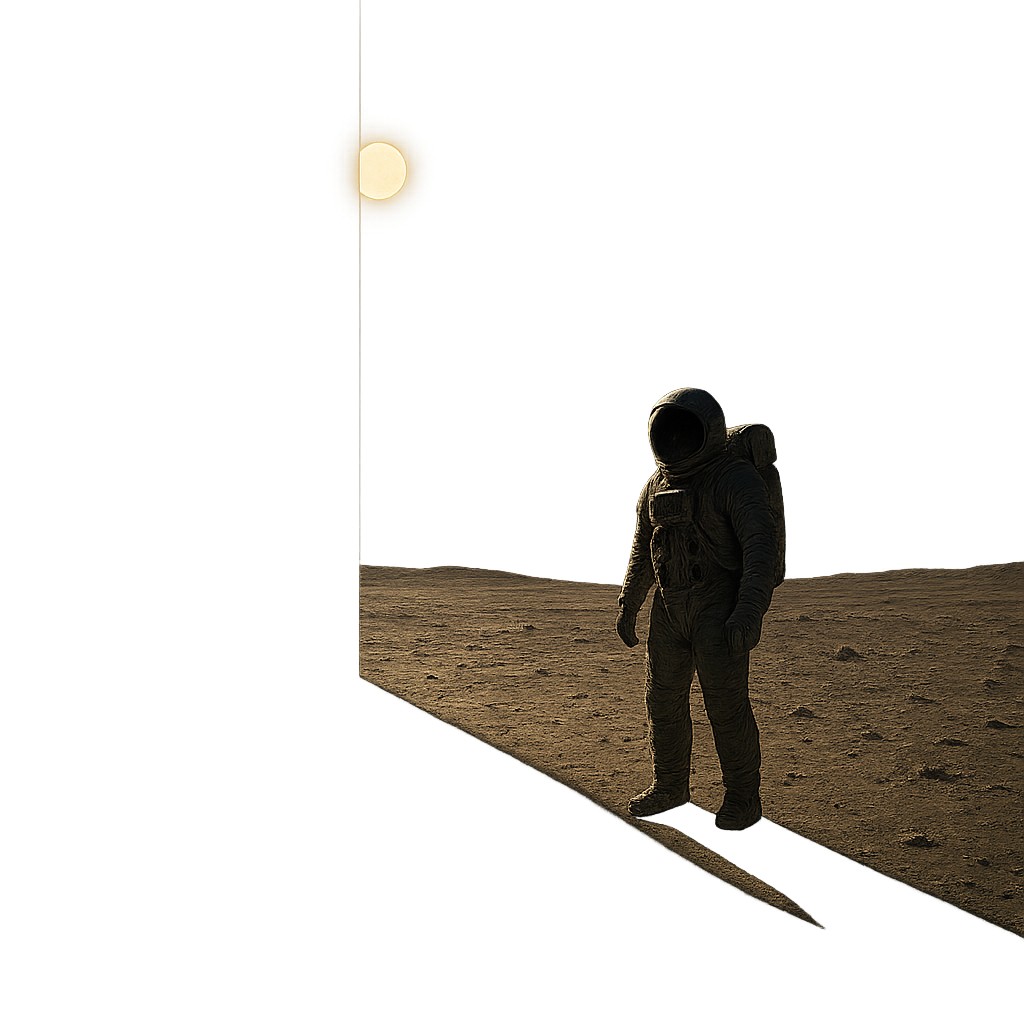
Now, imagine you are on the surface of the Moon or in the empty void of deep space. That "ocean of gas" has vanished, replaced by a vacuum so clean it makes a high-tech laboratory look like a dumpster. Without air or dust to catch and redirect the sun’s rays, light follows a brutal, straight-line logic. It travels in a direct path until it hits something; where it doesn't hit, it simply doesn't exist. In space, a shadow isn't just a darker patch of ground; it is a hole in reality. This lack of scattered light creates an environment so alien that it challenges our most basic instincts about how to move and survive in the cosmos.
The Missing Atmosphere and the Death of Ambient Light
To understand why space shadows are so terrifyingly dark, we first have to look at a process called Rayleigh scattering. On Earth, when sunlight hits our atmosphere, shorter blue light waves scatter in every direction, which is why the sky looks blue. This scattered light acts like a massive, 360-degree "softbox" light in a photography studio. It fills in the shadows, ensuring that even if you are shielded from the direct sun, you are still being hit by "second-hand" light from every other part of the sky. This is why you don't need a flashlight to see inside your garage during the day, even if the sun isn't shining directly into it.
In the vacuum of space, this fill-light is completely gone. There is no blue sky, only a pitch-black abyss, even when the sun is at its brightest. If you held your hand out while standing on the Moon, the side facing the sun would be painfully bright - enough to make you squint. The side of your hand facing away from the sun, however, would be in total, ink-black darkness. Because there is no air to bounce light back toward your palm, your own hand would seem to partially vanish from your sight. This creates a "binary" world where everything is either a "one" (blindingly bright) or a "zero" (total darkness), with almost no middle ground.
This high-contrast environment is more than just a visual quirk; it is a physical rule that dictates how everything in space must be built. On Earth, we rely on the subtle shift between light and shadow to judge the depth, shape, and distance of objects. Our brains are wired to see "soft" shadows as a sign of three-dimensional form. When those shadows become "sharp" and "hard," our internal navigation begins to fail. For an astronaut, a small rock could look like a massive boulder, or a deep, lethal crater might look like a flat patch of dark soil until they are literally stepping over the edge.
The Optical Illusions of a Binary World
The human eye is an incredible piece of biology, but it was designed for the hazy, filtered light of a forest, not the harsh vacuum of a lunar plain. One of the most dangerous side effects of "perfect" shadows is the loss of landscape detail. On Earth, we can see the "bottom" of a shadow because light leaks in from the surrounding air. In space, if an object casting a shadow is large enough, the area behind it is essentially a sensory void. Astronauts during the Apollo missions frequently reported that it was nearly impossible to tell how deep a trench was or how steep a slope might be because the shadows were "monolithic" - solid blocks of black.
Consider the challenge of docking two spacecraft. If a protruding part of the ship casts a shadow over a docking port, that port doesn't just look dim; it becomes invisible. It turns into a black hole on the side of the ship. This caused serious worry during early spacewalks. If an astronaut needed to repair a bolt that happened to be in the shadow of a solar panel, they might as well be working in a cave at midnight, even though the sun is hitting their back with enough heat to cook a steak. This is why space agencies spend millions of dollars developing light systems that mimic the scattering effect of an atmosphere.
This binary lighting also changes how we perceive distance. On Earth, an "atmospheric haze" makes distant mountains look blue and faint, but in space, everything stays sharp and clear. When you combine this "infinite sharpness" with shadows that erase parts of the landscape, you get a recipe for losing your sense of space. During the Apollo 14 mission, astronauts Alan Shepard and Edgar Mitchell tried to hike to the rim of "Cone Crater." They eventually gave up because the lack of air cues and the confusing shadows made it impossible to judge how far they had traveled. They were actually just a few dozen yards from the edge when they turned back, defeated by the visual tricks of the vacuum.
| Feature |
Earth (Atmosphere) |
Space (Vacuum) |
| Shadow Edge |
Fuzzy/Blurred |
Razor-Sharp |
| Shadow Depth |
Dark Gray/Visible Detail |
Ink Black/Zero Detail |
| Sky Color |
Blue (Scattered Light) |
Black (No Scattering) |
| Contrast |
Low to Moderate |
Extreme/Harsh |
| Depth Perception |
Helped by Haze and Gradients |
Confused by Sharpness |
Engineering the Sun Out of the Darkness
Because the environment won't provide the light we need, engineers have to bring the "atmosphere" with them using specialized technology. Modern spacesuits, like those being built for the Artemis missions to the Moon’s South Pole, come with high-intensity LED headlamps. These aren't just for seeing at night; they are used in broad daylight. If an astronaut steps into the shadow of their lunar lander, they must switch on their lights to "fill in" the darkness - essentially creating a personal, portable atmosphere of light so they don't trip over their own feet.
Another clever solution involves the materials used on spacecraft. Engineers often use highly reflective thermal blankets (the gold or silver crinkly foil seen on satellites). While these are mainly for temperature control, they also act as "passive reflectors." By making parts of the ship shiny, light can bounce off the hull and "leak" into shadowed areas. This provides just enough light to see tools or handles. In a sense, the spacecraft itself replaces the air, bouncing light around corners so humans can work.
Space cameras also have to be very different from the ones we use for vacation photos. High Dynamic Range (HDR) technology is a luxury on Earth, but a necessity in space. A standard camera would either turn sunlit areas into a featureless white blob or leave shadowed areas as a black void. Space-grade sensors must be able to process extreme differences in brightness at the same time. This is why images from Mars rovers or the International Space Station often look "flat" or strangely edited; they are processed to squeeze that intense contrast into something the human brain can actually understand.
The Psychological Weight of the Absolute Void
Beyond the technical dangers, there is a heavy psychological impact to these "sharp" shadows. Humans have an evolutionary fear of the dark, but "Earthly dark" is rarely absolute. We expect that if our eyes adjust, we will eventually see something. In the vacuum of space, your eyes can wait forever, but they will never "adjust" to a shadow that contains zero light. This creates a sense of isolation that is hard to describe. When an astronaut moves from sunlight into a shadow, it isn't a gradual change; it feels like an eclipse of the self.
Scientists have noted that this high-contrast environment can lead to "lunar hay fever" of the mind, where the brain gets exhausted trying to make sense of a broken visual field. We take for granted the "visual noise" of Earth - the dust in the air, the hazy horizon, and the way light wraps around a tree trunk. In space, that noise is silenced. The resulting "perceptual silence" is eerie and can lead to mistakes. If you cannot see the ground you are walking on simply because the sun is behind a rock, the environment feels hostile in a way that goes beyond the lack of oxygen.
This is why mission planners are obsessed with "lighting geometry." They don't just care about when they land; they care about the angle of the sun compared to the hills. If the sun is too low, shadows become long, black daggers that hide landing spots. If the sun is directly overhead, the lack of shadows might make the ground look perfectly flat, hiding dangerous slopes. Navigating space is the art of managing the relationship between a single, blinding light and the absolute nothingness it leaves behind.
Reimagining Our Place in the Light
Learning about the brutal clarity of space shadows changes how we look at our own blue sky. We often think of the atmosphere as a barrier - something that clouds our view of the stars. But in reality, our air is a master artist, softening the world and making it easy to navigate. It turns the sun from a deadly spotlight into a warm, all-encompassing glow. Without this scattering, our world would be a jagged, terrifying landscape of blinding light and invisible pits, a place where depth is a guess and the dark is a solid wall.
As we move toward living on other planets, understanding how light works in a vacuum is as vital as understanding rocket fuel. We are learning to live in a binary world, developing the tools and the mental strength to bridge the gap between sun and shade. The next time you see your shadow on the ground, take a moment to notice the soft, fuzzy edges and the way you can still see the grass inside the shape. You are witnessing the protective power of our atmosphere, a gentle light that makes Earth one of the most visually forgiving places in the universe. Space may be the final frontier, but it is a place where we must bring our own light, because the universe refuses to scatter a single photon for us.