If you take a stroll through any major city, you are effectively walking through a forest of artificial stone. Concrete is the second most consumed substance on Earth, surpassed only by water. It provides the literal foundation of modern civilization, from the basement of your home to the soaring pillars of a highway overpass. However, this convenience comes with a staggering environmental bill. For every ton of ordinary cement produced, roughly one ton of carbon dioxide is released into the atmosphere, making the cement industry responsible for about 8% of global CO2 emissions. If the cement industry were a country, it would be the third largest emitter in the world, trailing only China and the United States.
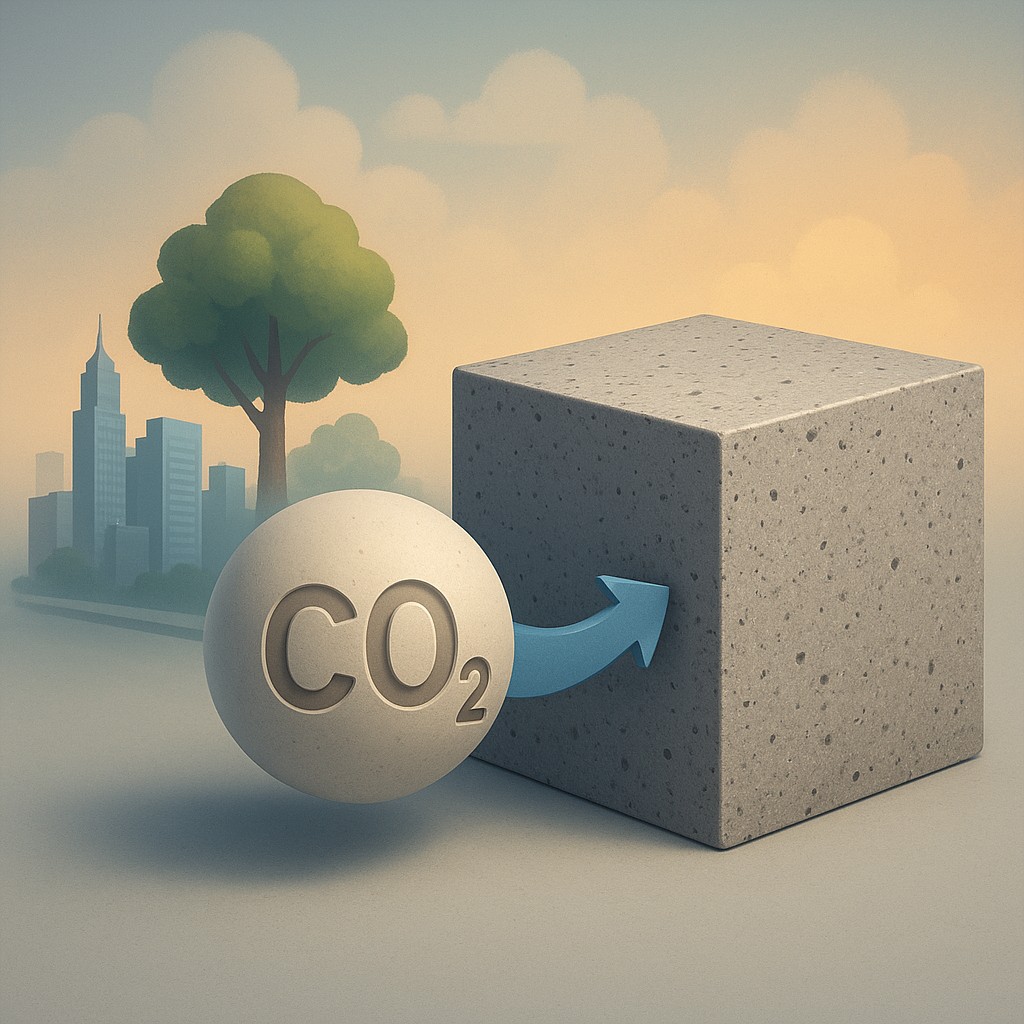
What if we could flip the script on this gray, everywhere material? Instead of viewing concrete as a climate villain, imagine if we treated every sidewalk and skyscraper as a permanent storage locker for greenhouse gases. This is the promise of carbon mineralization. It is a process where we stop treating CO2 as a pollutant and start treating it as a functional building ingredient. By injecting captured industrial emissions directly into concrete while it is still wet, we can trigger a chemical transformation that locks carbon away in a solid mineral state for centuries. It turns out that the very substance that helped create our climate crisis might actually be one of our most effective tools for solving it.
The Chemistry of Turning Gas into Stone
To understand how we can trap carbon in a sidewalk, we first need to look at what happens inside a concrete mixer. Traditional concrete is a blend of water, aggregates like sand and gravel, and portland cement, which acts as the glue. When water hits the cement, a chemical reaction called hydration begins, forming a crystalline structure that binds everything together. However, if we introduce purified CO2 gas into this wet mix, a second, rather magical reaction occurs. The CO2 reacts with calcium ions from the cement to create tiny particles of calcium carbonate. This is essentially the same material that makes up limestone and sea shells, but created in a matter of seconds inside a rotating drum.
This process is known as mineralization, and it is fundamentally different from capturing carbon and burying it in underground wells. When CO2 is pumped into an old oil field, there is always a lingering fear that it might leak back out if the earth shifts. In carbon-captured concrete, the CO2 is no longer a gas. It has undergone a permanent chemical change. Once that carbon becomes calcium carbonate, it is chemically stable. Even if you demolish the building 50 years from now and grind the concrete into dust, the carbon stays trapped in the mineral. It is a one-way trip from the atmosphere into the bedrock of our cities.
Strength Through Chemistry: Using Less to Do More
In the world of construction, there is usually a trade-off between sustainability and performance. If you want something to be "green," you often have to accept that it might be weaker or more expensive. Carbon-infused concrete breaks this rule. The calcium carbonate particles created during mineralization actually act as a reinforcing agent at a microscopic level. These tiny minerals fill in microscopic gaps within the concrete paste and provide more surface area for the cement to bond with. The result is concrete that often boasts higher compressive strength (the ability to withstand heavy loads) than the standard version.
This increased strength creates a "virtuous cycle" for engineers. Because the carbon-treated concrete is stronger, builders can actually reduce the amount of cement in their recipe without compromising the structural integrity of the building. Since cement is the most carbon-heavy and expensive part of the mix, using less of it provides a double win. You are taking CO2 out of the air and putting it into the building, and you are avoiding further emissions by lowering your cement consumption. It is a rare case where the environmentally friendly option can actually save money on a construction site.
Navigating the Supply Chain of Captured Carbon
While the chemistry of carbon-injected concrete is rock solid, the logistics are a bit more complicated. For this process to work on a global scale, we need a steady, local supply of pure CO2. Currently, most of the carbon used in these projects is captured from industrial exhaust at places like ethanol plants or fertilizer factories. This gas is purified, turned into liquid, and then trucked to the concrete plant. This creates a geographic hurdle. If the nearest source of CO2 is hundreds of miles away, the emissions from the truck driving to the plant might cancel out the carbon saved during the mixing process.
Researchers and startups are currently working to bridge this gap by developing decentralized carbon capture technology. Some are even looking at "Direct Air Capture," which pulls CO2 straight out of the surrounding air at the concrete plant itself. While this is currently more expensive than sourcing CO2 from industrial waste, the prices are dropping as the technology improves. The goal is to create a "plug-and-play" system where any concrete producer, whether in a bustling city or a rural town, can generate or receive their own supply of carbon "seasoning" to add to their daily batches safely and affordably.
Comparing Traditional and Carbon-Captured Concrete
To see why this shift is so significant, it helps to compare the life cycle and traits of standard concrete versus the new mineralized versions. The differences extend from the chemical level all the way to the long-term environmental footprint.
| Feature |
Traditional Concrete |
Carbon-Captured (Mineralized) Concrete |
| Carbon Footprint |
Extremely high (approx. 1 ton CO2 per ton of cement) |
Significantly lower through storage and cement reduction |
| Chemical State of Carbon |
Released into the atmosphere as a gas |
Chemically bonded as solid calcium carbonate |
| Material Strength |
Standard structural capacity |
Often 10-15% higher compressive strength |
| Permanence |
N/A (Emitted gas stays in atmosphere) |
Permanent mineralization; no risk of leakage |
| Primary Limitation |
Non-renewable and high emission |
Requires a local source of purified CO2 |
| Cost Dynamics |
Cheap material, high environmental cost |
Higher upfront tech cost, offset by using less cement |
Debunking the Myths of the Carbon Sink
When people hear about "injecting gas" into buildings, they often worry about safety. A common misconception is that carbon-captured concrete might be porous or "fizzy" like a soda, making it likely to crack or weather poorly. In reality, the CO2 is not stored as bubbles or gas pockets. Because it has transformed into a solid mineral, it does not change the texture or look of the finished concrete. It looks, feels, and pours exactly like the material we have been using for a century. In fact, because the minerals fill in tiny pores, the concrete can actually be more resistant to water damage than traditional mixes.
Another myth is that this process is just a form of "greenwashing" that allows the cement industry to keep polluting. While mineralization alone cannot cancel out every gram of CO2 from cement manufacturing, it is a critical piece of the puzzle. When combined with other strategies, such as switching to renewable energy to power factory kilns, carbon mineralization helps the industry move toward a "Net Zero" reality. It is not a magic wand that deletes the footprint of construction, but it is a powerful tool that turns an unavoidable byproduct into a structural asset.
A New Vision for the Concrete Jungle
As we look toward a future where we must house billions more people while simultaneously cooling the planet, we cannot afford to stop building. Urbanization is an unstoppable force, particularly in developing nations. Since we cannot quit our concrete habit cold turkey, our best path forward is to reinvent the material from the inside out. By adopting carbon mineralization, we transition from a "take-make-waste" model of construction to one where our buildings act as artificial lungs for the planet. We are essentially learning how to mimic the way nature builds coral reefs, using chemistry to turn dissolved carbon into lasting, beautiful structures.
The next time you walk past a construction site and see a spinning mixer, don't just see a noisy machine making a gray slurry. Imagine a high-tech reactor that is busy locking away the ghosts of our industrial past. Every cubic yard of mineralized concrete represents a small victory in the fight against climate change. By rethinking the foundations of our world, we can build a future that is not just physically strong, but environmentally resilient. The transformation of our cities from carbon sources into carbon sinks is not just a scientific possibility; it is a necessity that is already being poured into the ground beneath our feet.