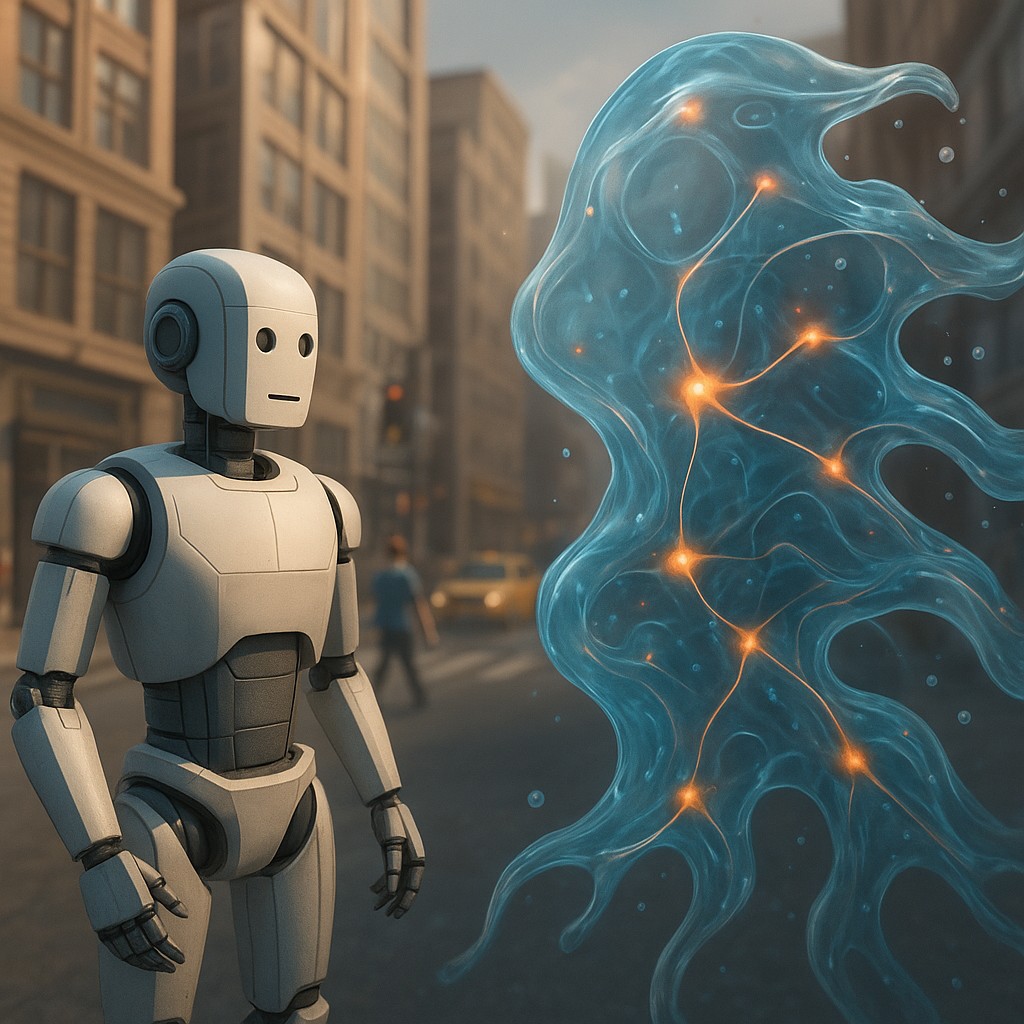
Imagine you are teaching a traditional robot how to walk down a busy city street. You spend months showing it thousands of hours of video, helping it memorize every possible scenario-from a stray cat darting across the road to a sudden summer thunderstorm. By the end of its training, the robot is a master of the data it has seen. However, the moment you set it loose, something unexpected happens. A patch of fog rolls in, or a construction crew puts up a new type of neon orange barrier the robot never encountered in its training. In that moment, the traditional robot often freezes or makes a dangerous mistake.
This happens because most modern Artificial Intelligence is essentially a "fossilized" brain. Once the training phase ends, the mathematical values that govern its decisions are locked in place. This leaves the model unable to adjust its logic to the fluid, messy reality of the physical world.
This rigidity is a "hidden wall" that researchers have been hitting for years. We have models that can write poetry or create art, but when it comes to critical, real-time tasks-like landing a drone in high winds or monitoring a patient’s shifting vital signs-our digital brains are often too brittle. This is where the concept of "liquid" neural networks comes in. Inspired by the surprisingly complex nervous systems of tiny creatures like the C. elegans worm, these networks do not stop learning once they leave the laboratory. Instead of being a static set of rules, they function more like a living organism that changes its own internal "chemistry" based on its surroundings. They represent a shift from AI as a library of facts to AI as an active, flowing process. Understanding how they work requires us to rethink what a computer program actually is.
Escaping the Frozen Logic of Standard AI
To understand the liquid revolution, we first have to look at the "solid" state of current machine learning. Most neural networks today are based on a series of snapshots. If you are training a model to recognize a video of a person walking, the computer treats that video like a deck of cards, looking at each frame individually to find patterns. The "synapses," or connections between these digital neurons, are represented by numbers. During training, these numbers are tweaked until the model gets the right answer.
But the second the training is finished, those numbers are "bolted" to the floor. If the video speed changes or the lighting shifts, the model cannot adjust its internal math to compensate for the flow of time. It is effectively trying to understand a movie by looking at it as a million separate photographs.
Liquid neural networks, primarily developed by researchers at MIT’s Computer Science and Artificial Intelligence Laboratory (CSAIL), take a radically different approach. Instead of using fixed values, they use "differential equations"-a type of math used to describe constant change-to define how a neuron behaves. For those who aren't mathematicians, think of a differential equation as a recipe that describes how things change over time rather than just what they are at one specific moment.
Because the underlying math of a liquid network is built to handle change, the connections between neurons can shift based on the information they receive. If the data starts coming in faster, or if the signals become fuzzy, the network’s own equations adapt in real time. It doesn't just process the data; it shifts its very structure to match the "rhythm" of the information flowing through it.
The Secret Architecture of a Tiny Worm
You might assume that creating a more adaptable AI would require making it much larger, perhaps with billions of parts like the models behind ChatGPT. Surprisingly, the inspiration for liquid networks came from going smaller. Researchers looked at C. elegans, a microscopic soil-living worm that has only 302 neurons. Despite this tiny "processor," the worm is capable of complex behaviors like searching for food, avoiding predators, and reacting to temperature changes. It doesn't have a giant brain, but the neurons it does have are incredibly efficient. Each connection in the worm's nervous system isn't just an "on or off" switch; it is a dynamic chemical exchange that constantly shifts.
By mimicking this biological efficiency, liquid neural networks can be incredibly small. While a traditional AI model might require thousands of neurons to learn how to steer a car, a liquid network can often get the same or better results with fewer than twenty. This "compactness" is a game-changer for hardware. Because the model is small, it can run on a tiny chip inside a drone or a medical wearable rather than requiring a giant, energy-hungry server farm. This mimics the elegance of the worm: high intelligence achieved with minimal resources because the system is designed for the specific task of navigating a changing world.
Why Fluidity Beats Brute Force
The primary advantage of a liquid system is its mastery over "time-series data." This refers to any information where the order and timing of the data points matter just as much as the numbers themselves. In a self-driving car, for example, knowing that a pedestrian is at a certain spot is useful, but knowing the speed and direction of that pedestrian over the last three seconds is vital. Standard AI often struggles with this because it treats time as just another variable. A liquid network, however, treats time as a core part of its design.
The table below shows how these two philosophies differ in practice.
| Feature |
Traditional Neural Networks |
Liquid Neural Networks |
| State after training |
Static and frozen; internal values stay the same. |
Dynamic; equations adapt to incoming data. |
| Model Size |
Often massive, requiring significant memory. |
Extremely compact and efficient. |
| Handling Noise |
Struggles with "unseen" weather or lighting. |
Highly resilient; filters out noise naturally. |
| Computing Cost |
High; needs powerful processors to run. |
Low; can run on small, portable devices. |
| Primary Strength |
Recognizing patterns in still images or text. |
Real-time adaptation to moving info. |
This adaptability makes liquid networks significantly more "robust." In the world of AI, robustness refers to a model's ability to keep its cool when things get weird. If you train a standard AI to drive on a sunny day in California and then move it to a snowy day in Boston, it may fail because the visual "look" of the road has changed. A liquid network is better at identifying the core essence of the task. It figures out that "driving" is about the relationship between the road, the car's speed, and the obstacles, regardless of whether the images coming in are bright yellow or dull gray. It is essentially translating the "physics" of the situation rather than just memorizing the scenery.
The Logic of the "Closed-Form" Breakthrough
One of the biggest hurdles in developing liquid networks was the sheer amount of math required to keep them running. Initially, these networks were slow because they had to solve complex equations constantly. Imagine trying to catch a ball, but before you move your hand, you have to solve a page of calculus to predict where the ball will be. Even if you are very smart, you might be too slow to actually catch the ball. For a long time, this was the bottleneck for liquid AI. It was smarter and more adaptable, but it was mathematically "heavy," making it difficult to use for high-speed tasks like flight.
The breakthrough came with the development of "closed-form" models. This is a bit like replacing a complex recipe that requires constant measuring with a simplified shortcut formula that gives you the same result instantly. Researchers found a way to simplify those complex "liquid" equations into a mathematical structure that can be solved in a single step. This allowed the networks to stay fluid and adaptable without the digital lag. Suddenly, these models weren't just adaptable; they were faster than the traditional models they were designed to replace. This leap moved liquid AI from a laboratory curiosity to a practical tool for the real world.
Navigating the Physical World with Digital Water
The applications for this technology are particularly exciting in fields where the environment is unpredictable. Take drone delivery, for example. A drone flying through a city has to deal with sudden gusts of wind between buildings and moving obstacles like birds. A liquid neural network allows the drone’s flight controller to adjust its settings in milliseconds, essentially "feeling" the wind and changing its reaction speed on the fly. It doesn't need a map of every possible wind gust; it just needs the ability to adapt its underlying equations to the pressure it feels in the moment.
Similarly, in medicine, liquid networks are being tested for patient monitoring. Human bodies are not static; our heart rates, blood pressure, and oxygen levels are constantly shifting in response to medication, sleep, or stress. A standard AI monitor might trigger a false alarm if a patient’s heart rate spikes slightly during a nightmare because it doesn't understand the context of the change over time. A liquid network can "smooth out" the noise, recognizing the difference between a dangerous heart rhythm and a natural, temporary fluctuation. By understanding the flow of a patient's health, these models can provide more accurate warnings and reduce the "alarm fatigue" that exhausts hospital staff.
Understanding the "Explainability" Factor
One of the most persistent problems with "black box" AI like GPT-4 is that we often don't know why it makes the decisions it does. When a model has billions of parts, tracing its logic is nearly impossible. Liquid networks offer a refreshing alternative because they are so small. Because a liquid model might only use 20 "neurons" for a specific task, researchers can actually map out the decision-making process. They can see exactly which equations are shifting and which inputs are triggering those changes.
This transparency is vital for safety. If a self-driving car makes an unexpected turn, engineers need to know if it was because of a glare on the camera or a deeper logic error. With a liquid network, they can look at the state of the neurons at that exact moment and see how the model was weighing its options. This creates a level of accountability that is often missing from larger models. It allows us to build systems that aren't just intelligent, but also predictable and auditable-a key requirement for any AI we entrust with human lives.
Adapting to the Future of Intelligent Systems
The development of liquid neural networks reminds us that the best solutions often mimic the elegance of nature rather than the sheer power of industrial machinery. We are moving away from an era of "big AI," where success was measured by how many billions of dollars were spent on electricity, toward an era of "smart AI," where success is measured by efficiency and adaptability. The shift from "solid" to "liquid" represents a transition into a world where our technology feels less like a rigid tool and more like an extension of the natural world, capable of breathing and shifting along with us.
As you look toward the future, imagine a world where your devices don't just process your requests, but truly understand the context of your life. Your smart home wouldn't just turn on the lights at a set time; it would sense the natural rhythm of your evening and adjust the atmosphere based on the fading sunlight and your own activity. This is the promise of liquid logic: a digital world that is as responsive and resilient as the biological world that inspired it. By embracing the fluidity of change, we aren't just making better computers; we are building a more intuitive bridge between human need and machine capability - one that doesn't break when the wind starts to blow.