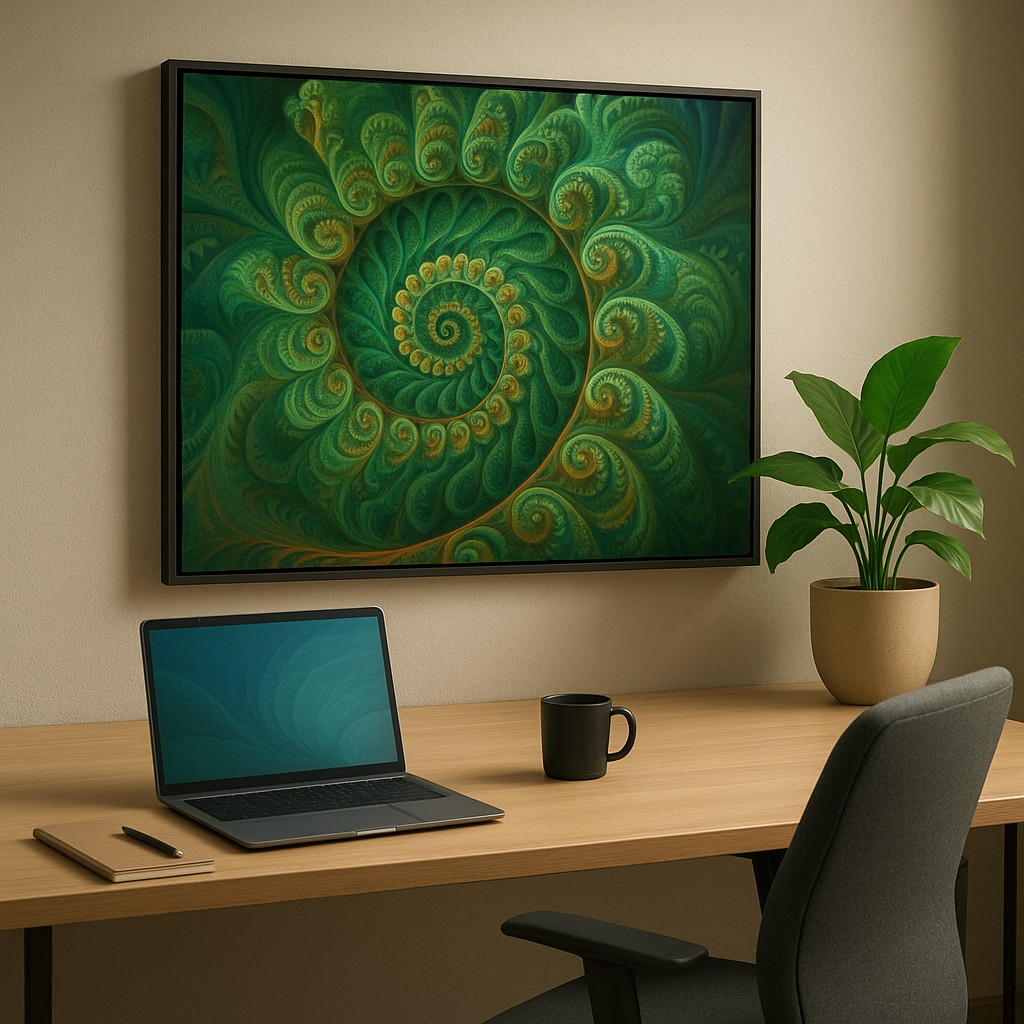
Imagine walking into a modern high-rise office at ten in the morning. The air is perfectly chilled, the lights are a crisp, sterile white, and the walls are painted a soothing shade of "corporate oatmeal." On paper, this is a peak productivity hub. Yet within an hour, your brain feels like a browser with fifty tabs open, and your shoulders are creeping up toward your ears. We often blame our emails or a caffeine crash for this looming fatigue, but the real culprit might be the room's geometry. Our eyes constantly scan our surroundings; when they find nothing but smooth, flat surfaces and perfect right angles, our brains work surprisingly hard to navigate a world that looks nothing like the one we evolved to live in.
For millions of years, the human visual system developed in the wild, messy, and complex theater of nature. In a forest, there are no perfectly straight lines or featureless planes. Instead, the world is made of "organized chaos," a specific geometry that balances complexity with order. When we trade a view of a swaying canopy for a drywall partition, we lose more than just a nice view; we deprive our brains of the visual "software" they were programmed to run. Recent breakthroughs in biophilic design - the practice of connecting buildings to nature - suggest that the secret to a stress-free office isn't just a lonely potted palm in the corner. Instead, it lies in a mathematical concept called fractals: repeating patterns that serve as the blueprint for everything from clouds to blood vessels.
The Secret Geometry of the Natural World
To understand why some environments exhaust us, we first have to understand what a fractal actually is. Simply put, a fractal is a pattern that repeats itself at different scales. If you look at a fern leaf, you will notice that the overall shape is made of smaller branches that look almost exactly like the whole leaf. If you zoom in on one of those branches, you will see even smaller leaflets that mirror that same structure again. This property is called "self-similarity." Nature loves this design because it is an efficient way to pack a lot of surface area into a small space - perfect for absorbing sunlight or moving nutrients.
Humans have been looking at these patterns since the dawn of our species. Because fractals are the "language" of nature, our brains are world-class experts at processing them. Scientists call this "fractal fluency." When we look at a fractal, our visual system recognizes the pattern almost instantly, which allows our minds to relax. It is the visual equivalent of listening to a song with a steady, predictable beat rather than listening to static noise. In a world of fractals, the brain doesn't struggle to see where one object ends and another begins; the rhythm of the pattern tells the story for us.
In contrast, modern architecture is often "non-fractal." Cubicles, flat ceilings, and rectangular windows are mentally demanding because they are unnatural. The brain searches for familiar, nested patterns and, finding none, stays on high alert. This constant, subconscious searching contributes to the "brain fog" we feel in sterile spaces. By bringing fractals back into our rooms, we aren't just decorating; we are speaking to the deepest, most ancient parts of our neurology in a language they finally understand.
How Your Brain Relaxes Without You Noticing
The magic of fractals isn't just a psychological trick; it is a physical response that can be measured. When people look at "mid-range" fractals - patterns that aren't too simple but aren't overwhelming - their bodies undergo a rapid reset. Research using an EEG to monitor brain waves shows that these specific patterns trigger an increase in alpha waves. These waves are linked to "relaxed wakefulness," a state where you are calm but deeply focused.
At the same time, physical stress markers begin to drop. Studies show that heart rates slow down and skin conductance - a measure of nervous system excitement - decreases significantly when fractal patterns are present. Even more impressively, levels of cortisol, the "fight or flight" stress hormone, begin to dip. This happens because the brain sees a fractal environment as "safe" and "resource-rich." In the wild, a fractal-rich area usually means there is life, water, and shelter nearby. A flat, barren environment, on the other hand, signals a desert or a void, which keeps the primitive brain on edge.
Interestingly, this effect is separate from the physical presence of plants. While having a vine on your desk is wonderful, the stress-reduction benefits of fractals can come from wallpaper, carpets, or even the shadows cast by perforated window screens. It is the mathematical rhythm of the shapes, rather than the biological life of the plant, that does the heavy lifting. This opens up incredible possibilities for design in places where live plants are hard to keep, such as hospitals, high-security offices, or submarines.
Measuring the Rhythm of Nature
Not all fractals are created equal. In physics, the complexity of a fractal is measured by a "Fractal Dimension," or "D." This number describes how much space a pattern fills. A perfectly straight line has a dimension of 1.0, while a solid, filled-in square has a dimension of 2.0. Nature usually stays in the "sweet spot" between 1.3 and 1.5. This mid-range complexity is what we find in clouds, the silhouettes of trees, and the movement of ocean waves.
Comparing Visual Environments and Mentally Demanding Tasks
| Environment Type |
Typical Fractal Dimension (D) |
Brain Response |
Common Examples |
| Low Complexity |
1.1 - 1.2 |
Boredom, lack of interest |
Bare white walls, flat glass fronts |
| The Sweet Spot |
1.3 - 1.5 |
High relaxation, low stress |
Trees, clouds, specialized carpets |
| High Complexity |
1.6 - 1.9 |
Overstimulation, anxiety |
Tangled briars, chaotic city signs |
| Artificial Rigid |
Not Applicable |
Mental fatigue, high cortisol |
Standard grid-based office layouts |
As the table shows, there is a "Goldilocks zone" for fractal design. If a pattern is too simple, we find it boring. If it is too dense and chaotic, like a tangled thicket of thorns, it can make us feel anxious because our brains can't find the repeating logic. But when designers hit that middle ground, the brain enters a state of effortless processing. The visual information "fits" perfectly into our neural slots, requiring almost no energy to decode. This "easy processing" is what allows the mind to recover from the fatigue of complex tasks like writing reports or analyzing data.
Bringing the Wild Indoors Through Design
Applying fractal theory to interior design is more than just hanging a photo of a forest. While nature photography helps, the most effective designs build these patterns into the building itself. This is visible in the work of innovative carpet makers who use "random" patterns that follow fractal rules. Instead of a repeating tile pattern that the eye quickly gets tired of, these carpets look like a forest floor. Each square is slightly different, yet they all share a common mathematical DNA, allowing the eye to wander without getting stuck on a rigid grid.
Architects are also using fractals to change how light enters a room. By using laser-cut window screens inspired by natural shapes, they can create shadows that dance across the floor in fractal patterns. As the sun moves, the shadows shift, mimicking the dappled sunlight seen under an oak tree. This movement is vital because nature is never static. The subtle change in these shadows provides a "micro-restorative" experience, giving the brain a tiny vacation every time you look up from your screen.
Even furniture and wall textures are getting a fractal makeover. Designers are experimenting with 3D-printed acoustic panels that have fractal ridges. Not only do these panels look beautiful, but their high surface area makes them incredibly effective at absorbing sound. This creates a multi-sensory experience where the room looks calm and sounds quiet. When we surround ourselves with these nested shapes, we are creating a "technological forest" - a space that serves modern needs while respecting our ancient biological requirements.
Debunking Myths of Nature-Inspired Spaces
Whenever a concept like biophilic design gains popularity, a few misconceptions follow. One of the most common myths is that it is just a fancy word for "add more plants." While plants are a great source of fractals, they are only one tool. You can have a biophilic room with zero living organisms if the geometry, light, and textures are handled correctly. This is vital for "clean rooms" or intensive care units where soil and standing water might be a health risk. Fractal-patterned glass or flooring can provide the same neurological "hug" without the maintenance of a garden.
Another mistake is thinking that any "busy" pattern counts as a fractal. People often confuse simple repetition or "clutter" with fractal geometry. A checkerboard repeats, but it isn't fractal because it doesn't change scale. A Jackson Pollock painting, however, has been scientifically proven to be fractal, which is why many find his chaotic drips strangely soothing. The key is "self-similarity" at different sizes. If you can zoom in and find the same pattern again, you are in the fractal zone; if you just see the same square over and over, you are in the "boring" zone.
Finally, some skeptics believe the benefits are just a "placebo" effect based on personal taste. However, the data suggests otherwise. Even when people say they prefer modern, minimalist styles, their physical markers - like heart rate and brain waves - still show a preference for fractals. Our bodies are often smarter than our conscious "style" choices. We might think we want a sleek, ultra-smooth glass office, but our nervous systems are quietly screaming for a bit of jagged, leafy complexity.
Building a Future That Feels Like Home
As we spend more of our lives indoors, the design of our rooms becomes a matter of public health rather than just decoration. We are beginning to realize that "efficiency" in architecture should not just be measured by square footage or energy costs, but by how much mental energy a space drains from the people inside. By putting fractal geometry into our homes, schools, and workplaces, we are "hacking" our own evolution to create a world that feels less like a cage and more like a habitat. We are moving from building spaces that just house our bodies to building spaces that actually nourish our minds.
The next time you feel drained while sitting in a windowless room, take a moment to look at the patterns around you. If you see nothing but flat surfaces and harsh angles, you are looking at a visual desert. The remedy might be as simple as changing your desktop wallpaper to a high-resolution image of a fern, or choosing a rug with the organized complexity of a mountain range. As we bridge the gap between math, art, and biology, we are rediscovering a simple truth: we don't just look at the world; we are built to resonate with it. When we bring the rhythms of nature into our halls and offices, we aren't just decorating; we are coming home.