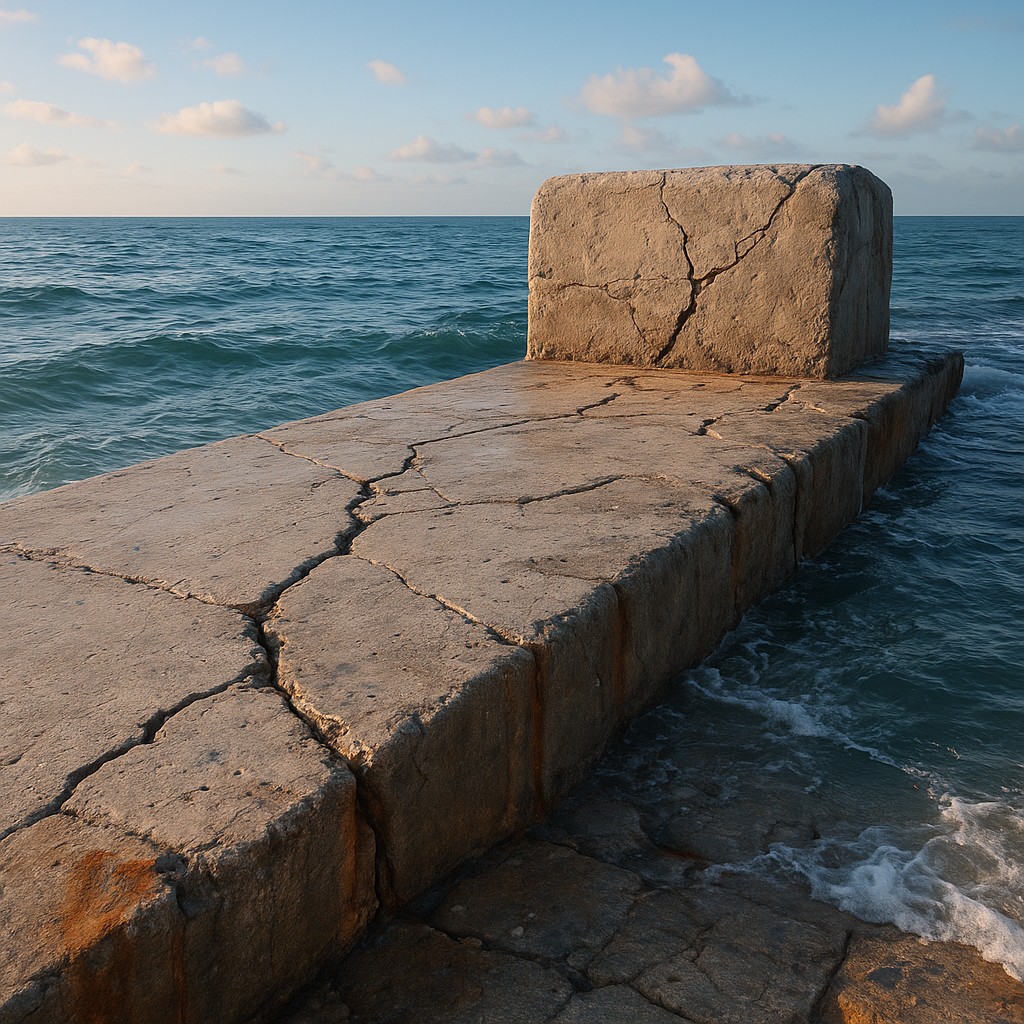
If you stand on a modern pier, you might notice the telltale signs of a losing battle against the ocean. Rust stains seep through the gray surface, deep fissures spider across the walkways, and chunks of concrete occasionally crumble into the surf. We often view our architectural prowess as the pinnacle of human history, yet we are constantly outshined by builders who have been dead for two millennia. If you visit the Bay of Naples or common Roman archaeological sites, you will find harbor walls and breakwaters that have survived two thousand years of relentless salt-flogged punishment. These structures have not just survived the Mediterranean tides; they have actually become more robust while sitting in them.
For centuries, engineers assumed the longevity of Roman concrete was simply a fluke of luck or perhaps a trade secret lost to the dark ages. We looked at our modern Portland cement, reinforced with high-strength steel, and wondered why it surrendered to the elements after only fifty or sixty years while the Roman Portus Cosanus still sits proudly in the water. The answer is not just about what the Romans put into their mix, but how that mix interacts with the world around it. While modern concrete is a static material that effectively dies the moment it cures, Roman concrete is a living, reactive chemical system that uses the destructive power of seawater to perform its own maintenance and dental work.
The Chemistry of Ancient Resilience
To understand why ancient structures refuse to fall, we have to look at the fundamental recipe used by the Romans. Unlike modern concrete, which relies on a mixture of Portland cement, water, sand, and gravel, the Romans used a specific combination of volcanic ash and lime. This mixture, documented by the architect Vitruvius, was known as pozzolana. When this volcanic ash was mixed with maritime seawater and lime, it created a chemical soup that behaved very differently from anything we use today. In modern construction, we try to make concrete as "inert" as possible, meaning we want it to stay exactly the way it is forever. The Romans, perhaps accidentally or through brilliant observation, created something that remained chemically active for centuries.
The magic happens at a microscopic level. In modern concrete, seawater is the ultimate villain. It seeps into tiny cracks and corrodes the internal steel reinforcements, causing them to expand and shatter the concrete from the inside out. In Roman concrete, the seawater acts as a catalyst rather than a corrosive force. When the salt water permeates the pozzolanic material, it dissolves parts of the volcanic ash and releases minerals. These minerals then precipitate back out into new forms, specifically a rare mineral called aluminous tobermorite. This mineral forms long, plate-like crystals that grow within the gaps and pores of the concrete. Instead of the salt water creating a hole, it triggers the growth of a structural bridge.
Turning the Environment into an Architect
One of the most profound differences between ancient and modern building philosophy is how each handles the concept of equilibrium. Modern engineering seeks to create a structure that is in balance at the moment of completion, hoping it stays that way. Roman maritime concrete, however, is a material that exists in a state of constant, slow-motion evolution. As the ocean waves beat against a Roman pier, they force mineral-rich water into the structure. This water interacts with "lime clasts," which are small, undissolved pebbles of lime that were once thought to be a sign of poor mixing. We now know these clasts are actually "smart" reservoirs of self-healing material.
When a microscopic crack forms in the concrete due to stress or weathering, it inevitably encounters one of these lime clasts. As water enters the crack and hits the lime, it creates a calcium-rich solution. This solution quickly recrystallizes, filling the crack and effectively "gluing" the structure back together before the damage can spread. This means that for the Romans, the harshness of the sea was a feature, not a bug. The salt and the moisture were the fuel required for the building to repair itself. This creates a fascinating paradox where a structure becomes physically more integrated and chemically stable the longer it sits in the water.
Comparing the Two Giants of Construction
| Feature |
Modern Portland Cement |
Ancient Roman Concrete |
| Primary Binder |
Portland Cement (limestone/clay) |
Volcanic Ash and Lime |
| Reaction Type |
Hydration (stops after curing) |
Pozzolanic (continues for centuries) |
| Structural Support |
Steel Reinforcement (Rebar) |
Massive stone and mineral growth |
| Life Expectancy |
50 to 100 years |
2,000+ years |
| Environmental Role |
Seawater causes corrosion and failure |
Seawater triggers mineral crystallization |
| Repair Mechanism |
External patching and maintenance |
Internal self-healing via lime clasts |
The Secret of the Hot Mix
Recent breakthroughs in materials science have added another layer to this ancient mystery by focusing on the temperature at which the Romans prepared their batches. For a long time, historians believed the Romans carefully slaked their lime (mixing it with water before adding other ingredients). However, new analysis of the lime clasts suggests that the Romans used a method called "hot mixing." By adding quicklime directly to the volcanic ash and water, they generated immense heat throughout the mixing process. This high-temperature environment prevented the lime from dissolving completely, leaving those little white pebbles scattered throughout the finished product.
This hot-mixing technique is a masterclass in unintentional, or perhaps highly intentional, nanotechnology. The heat creates a chemical environment that allows for unique crystalline structures to form more easily than they would at room temperature. These lime clasts are not just accidental lumps; they are reactive, on-demand healing agents. Because they were formed at high heat, they have a porous, brittle structure that is particularly sensitive to water. As soon as a crack opens, the clast is the first thing to break, releasing its chemical treasure exactly where it is needed most. It is a biological-style response in a purely mineral object.
Engineering a Carbon-Neutral Future
The study of Roman concrete is not merely an exercise in nostalgia; it is a vital frontier for sustainable engineering. Modern cement production is a climate disaster, accounting for approximately 8 percent of global carbon dioxide emissions. This is largely because the process requires heating limestone to incredibly high temperatures, releasing CO2 from both the fuel used and the chemical reaction of the stone itself. If we can move away from Portland cement and toward a pozzolanic model based on the Roman method, we could drastically reduce the carbon footprint of the construction industry. The Roman method uses less lime and fires it at lower temperatures, which is a win for the atmosphere.
Furthermore, the longevity of Roman-inspired materials would solve the "throwaway" culture of modern infrastructure. Imagine a bridge or a highway that does not need to be torn down and rebuilt every two generations. By creating materials that heal themselves, we reduce the need for constant maintenance and the massive resource consumption that comes with it. Scientists are currently experimenting with adding bio-fillers and volcanic analogs to modern mixes to see if we can replicate the tobermorite growth. We are essentially trying to learn how to build things that do not just resist the world around them, but actually thrive and grow stronger within it.
The Wisdom of the Long View
Perhaps the most important lesson the Romans left us is a shift in perspective regarding time and durability. We have become accustomed to a world where "new" is synonymous with "better," but the crumbling ruins of the mid-20th century suggest otherwise. The Roman builders were not looking at a five-year fiscal cycle or even a fifty-year lifespan; they were building for the eternity of the Empire. By choosing materials that worked in harmony with the environment, they created a legacy that outlasted their language, their government, and their gods. They did not fight the ocean; they invited it in to help with the masonry.
As you look at the world around you, consider the materials that make up your environment. Most of what we see is designed to be static, but the most resilient systems in nature-and in ancient history-are those that can adapt and repair. The secret of Roman concrete reminds us that true strength does not always come from being the hardest or the most rigid object in the room. Sometimes, the greatest durability comes from having the right internal ingredients to turn your greatest challenges into the very things that hold you together. By looking back at the volcanic dust of the past, we might just find the blueprint for a future that actually lasts.