Fifty years sounds like a long time. It is long enough for a newborn to become a grandparent, for coastlines to redraw themselves, and for technologies that once felt like science fiction to become everyday appliances. But it is also short enough that many choices shaping that future are being made right now, by people alive today, using institutions built for a slower, simpler world.
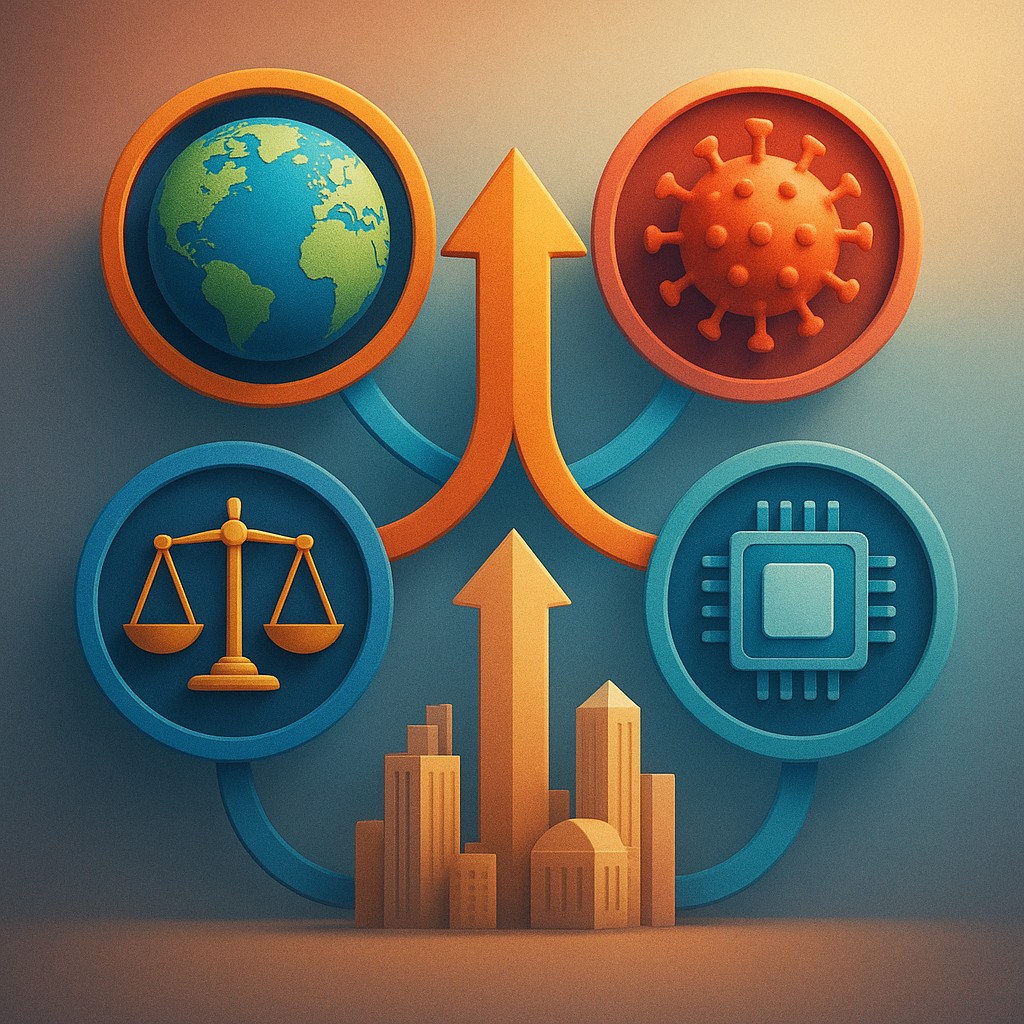
When people ask, "What is the greatest challenge humanity will face in the next 50 years?" they usually expect a single villain: climate change, AI, pandemics, nuclear war, inequality. The uncomfortable truth is that the biggest problem is not one monster under the bed. It is that many powerful risks are tangled together, and our ability to coordinate and steer them has not kept up with our ability to create them.
So the greatest challenge is this: building global resilience and coordination fast enough to manage compounding, interconnected risks. Plainly put, our tools are getting stronger, our planet is under more stress, and our social systems are growing more polarized. The question is whether we can learn to act like a species with a shared destiny, not a set of rival groups arguing on a burning group chat.
The real “boss level” is compounded risk, not a single catastrophe
It is tempting to rank threats like a top-10 list. That makes for great headlines and bad planning. The next half-century will likely be shaped less by one isolated crisis and more by cascades, where one disruption makes others more likely, worse, and harder to fix.
Imagine a long heat wave that ruins crops. Food prices spike, governments panic, and social unrest follows. That unrest weakens public trust, which makes it harder to run vaccination campaigns during the next outbreak, or pass sensible energy policies, or stop misinformation. None of those outcomes is certain, but the chain reaction is the point: modern societies are tightly linked, like a machine with many gears. When one gear slips, the stress spreads.
This is what compounding risk looks like in everyday terms:
- Climate stress worsens water shortages, migration pressures, and the chance of conflict.
- Pandemics disrupt supply chains and economies, amplifying political extremism.
- Economic inequality eats away at trust, making collective action harder.
- Powerful technologies can solve problems, but they also lower the cost of causing harm.
- Biodiversity loss makes ecosystems less stable, making food and disease patterns harder to predict.
The biggest challenge is not predicting which gear will slip. It is building systems that can bend without breaking, and doing it among people who disagree about what "bending" should look like.
Climate change is the multiplier that makes everything harder
If one risk reliably turns a manageable problem into a major crisis, it is climate change. Not because it flips a single doomsday switch one Tuesday. Because it adds background stress to almost everything: farming, roads and bridges, health, insurance, migration, geopolitics, and ecosystems.
A common mistake is thinking climate change is only about melting ice and polar bears. Those are real, but the most immediate human impacts come through boring-sounding measures like wet-bulb temperature (a heat and humidity measure), wider swings in crop yields, and "100-year" floods arriving every decade. Heat makes it harder to work, learn, and sleep. Floods and fires destroy homes and drain budgets. And because these impacts hit unevenly, they deepen inequality within and between countries, which then fuels political instability.
Another myth is that climate action is mainly about personal virtue, like using metal straws. Individual choices matter, but the heavy lifting happens in systems: power grids, building codes, transport networks, industry, and land use. You cannot recycle your way out of a physics problem, but you can modernize energy, redesign cities, and protect ecosystems with smart policy and investment.
What makes the next 50 years tricky is that we must do two big things at once:
- Mitigation: cut greenhouse gas emissions fast enough to limit future warming.
- Adaptation: upgrade infrastructure and institutions to live with the warming already locked in.
Doing one without the other is like buying a fire extinguisher and refusing to fix the faulty wiring.
The coordination crisis: when humans can’t agree, even on shared reality
Why do we struggle to respond to problems we can measure with satellites, thermometers, and hospital records? Often the limiting factor is not science, it is coordination. Coordination means aligning incentives, sharing burdens, and making credible commitments over time. It is hard to decide as a family where to eat. It is far harder across 200 countries, millions of companies, and billions of people with different interests and histories.
A modern twist is that coordination now competes with a polluted information environment. We live in an era where attention is bought and sold and outrage pays. Misleading stories can spread faster than corrections, and social media can turn complex trade-offs into simple moral battles. The result is a society that is both over-informed and under-oriented, drowning in facts but starving for a shared understanding.
A common misconception is that if people just learned "the facts," we would solve big problems. Facts matter, but the real barriers are usually:
- Trust: Do people believe institutions are competent and fair?
- Identity: Does a policy feel like surrender to an enemy tribe?
- Time horizons: Democracies and markets often focus on the short term, while climate and infrastructure require a long view.
- Unequal costs and benefits: Some groups pay first, others benefit later, and resentment fills the gap.
In the next 50 years, humanity’s biggest test may be whether we can build institutions that earn trust and coordinate action across borders while protecting democracy, human rights, and dignity. That is a tall order, but so was landing a rover on Mars, and we did that with math and teamwork.
Powerful technologies: salvation, sabotage, and the “who controls it” question
Technological progress will shape the next 50 years as much as climate. The tricky part is that technology is not moral. It is a power amplifier. It can help us decarbonize energy, detect disease early, speed up supply chains, and personalize education. It can also enable mass surveillance, automate misinformation, and make cyberattacks or engineered pathogens easier.
Artificial intelligence is the headline example. Many picture AI risk as evil robots gaining consciousness and plotting revenge on the people who yelled at chatbots. A more realistic and scarier worry is mundane: systems that are extremely capable but not reliably aligned with human goals, rolled out at scale by actors chasing profit, power, or advantage. Even without science fiction, AI can destabilize economies through labor shifts, accelerate propaganda, or intensify military competition.
Biotechnology is another double-edged sword. The same tools that speed vaccine development can, in the wrong hands, enable dangerous experiments. The risk is not just a lone "bad genius in a basement." It also includes accidents, weak oversight, and competitive pressures that reward speed over caution.
Here is a simple way to remember the challenge: capability is rising faster than governance. We are handing teenagers race cars and hoping etiquette will replace seatbelts. What we need are seatbelts: safety standards, monitoring, international norms, and accountability that match the power of our tools.
A quick map of major risks and what “resilience” looks like
The word "resilience" can sound like a motivational poster, but in practice it means: can a system absorb a shock, recover, and learn without collapsing? Different risks need different kinds of resilience, and seeing them side by side shows how hard coordination will be.
| Major risk area |
What makes it dangerous |
What resilience looks like in practice |
| Climate change |
Chronic stress plus extreme events, uneven impacts |
Clean energy, resilient infrastructure, climate-smart farming, disaster preparedness |
| Pandemics and biosecurity |
Fast spread, economic disruption, trust erosion |
Early detection, rapid vaccine platforms, strong public health systems, clear communication |
| AI and cyber risks |
Speed, scale, low cost of misuse |
Safety testing, secure infrastructure, independent audits, international norms for deployment |
| Geopolitical conflict |
Arms races, miscalculation, resource pressure |
Diplomacy, crisis hotlines, arms control, diversified supply chains |
| Inequality and social fragmentation |
Eroded trust, polarization, instability |
Fair economic policy, access to education, social safety nets, inclusive institutions |
| Ecosystem and biodiversity loss |
Less stable food and disease systems |
Habitat protection, sustainable fisheries and farming, restoration, better land management |
Notice the pattern: none of these solutions is a single gadget you can buy. Most are steady investments in capacity, trust, and maintenance. Civilization runs on spreadsheets and plumbing more than speeches, even if speeches are more fun.
Misconceptions that quietly sabotage our future
Some bad ideas are dangerous not because they are dramatic, but because they make people give up or aim at the wrong target. Here are a few myths to retire.
“We have to choose between human progress and protecting the planet”
This sets up a false trade-off: sacrifice versus comfort. In reality, unchecked climate change and ecosystem collapse are anti-progress. They destroy wealth, health, and stability. A smarter frame is: we can do planned modernization now, or chaotic damage control later. Later is always more expensive.
“Technology will automatically save us”
Technology can help, but it does not automatically spread fairly or safely. Clean energy is cheaper than ever, but grids, storage, permits, and politics decide whether that becomes real decarbonization. Tools are not plans, and innovation is not governance.
“One country can solve it alone”
A single nation can lead, invent, and cut its own emissions, and that matters. But climate, pandemics, cyber threats, and AI competition do not respect borders. If the world is a shared apartment building, you cannot declare your unit "fire-safe" while the hallway fills with smoke.
“It’s too late”
This is the laziest myth, because it sounds profound while excusing inaction. The future is not an on-off switch. Every fraction of a degree avoided, every ecosystem saved, every safety standard adopted, and every institution strengthened changes outcomes. Hope is not naive optimism, it is a strategy for staying engaged.
What we can actually do: the resilience playbook in human terms
Big challenges feel paralyzing when they are abstract. They become manageable when turned into repeatable habits for societies, not just individuals. Over the next 50 years, humanity will need to get good at a few core moves.
Build cleaner systems without turning it into a culture war every week
Decarbonization is mainly an infrastructure project: power generation, electrification, buildings, industry, and transport. The fastest path usually mixes renewables, upgraded grids, storage, efficiency, and in many places nuclear or other low-carbon firm power. The political trick is to make the benefits visible: cleaner air, stable energy prices, good jobs, and less dependence on volatile fuel markets. People cooperate more when they can picture the payoff.
Treat public health like national security, because it is
Pandemics are not rare black swans. They are recurring biological realities in a connected world. Resilience means surveillance systems that spot outbreaks early, hospitals that can surge, and public communication that treats citizens like adults. It also means investing in vaccine platforms and manufacturing so responses take weeks, not years. And yes, it means practicing, because nothing exposes institutional weakness like an exam you never studied for.
Create “rules of the road” for powerful tech
For AI, biotech, and cyber systems, resilience requires standards and oversight that keep pace with capability. That includes safety checks before deployment, ways to audit high-impact systems, and international agreements that reduce the incentive to cut corners. Perfect safety is impossible, but predictable accountability is not. When the rules are clear, responsible actors can compete without gambling with everyone else’s future.
Strengthen the social glue
Coordination depends on trust, and trust depends on fairness and competence. Societies that leave large groups behind or tolerate corruption struggle to mobilize for long-term goals. Education, transparent institutions, and policies that reduce extreme insecurity are not just nice to have, they stabilize societies. A community that can argue without breaking is better prepared for shocks than one that treats every debate like a final battle.
Learn to think in systems, not slogans
The skill of the century is systems thinking: seeing feedback loops, trade-offs, and second-order effects. It helps you avoid solutionism (expecting a single fix to solve everything) and doomism (treating complexity as proof nothing can be done). Systems thinking is also practical. It shows how small changes in leverage points, like incentives and information quality, can reshape large outcomes.
The story we are writing, whether we admit it or not
In the next 50 years, humanity will not be judged by whether it avoided every crisis. That is unrealistic. We will be judged by whether we learned fast enough, cooperated widely enough, and built institutions sturdy enough to handle a world where risks stack and interact.
The greatest challenge is therefore not just surviving specific threats. It is growing up as a global civilization, upgrading our coordination the way we upgraded our technology. We need to become the kind of species that can manage planet-scale responsibilities without waiting for catastrophe to force cooperation.
A hopeful ending does not require pretending everything will be fine. It requires noticing something true and powerful: humans are remarkably good at solving problems when we treat them as shared, solvable, and urgent. The next 50 years will reward clear thinkers, bridge builders, and practical dreamers. If we choose resilience over rivalry and wisdom over reflex, the future will not just happen to us. It will be something we deliberately create.