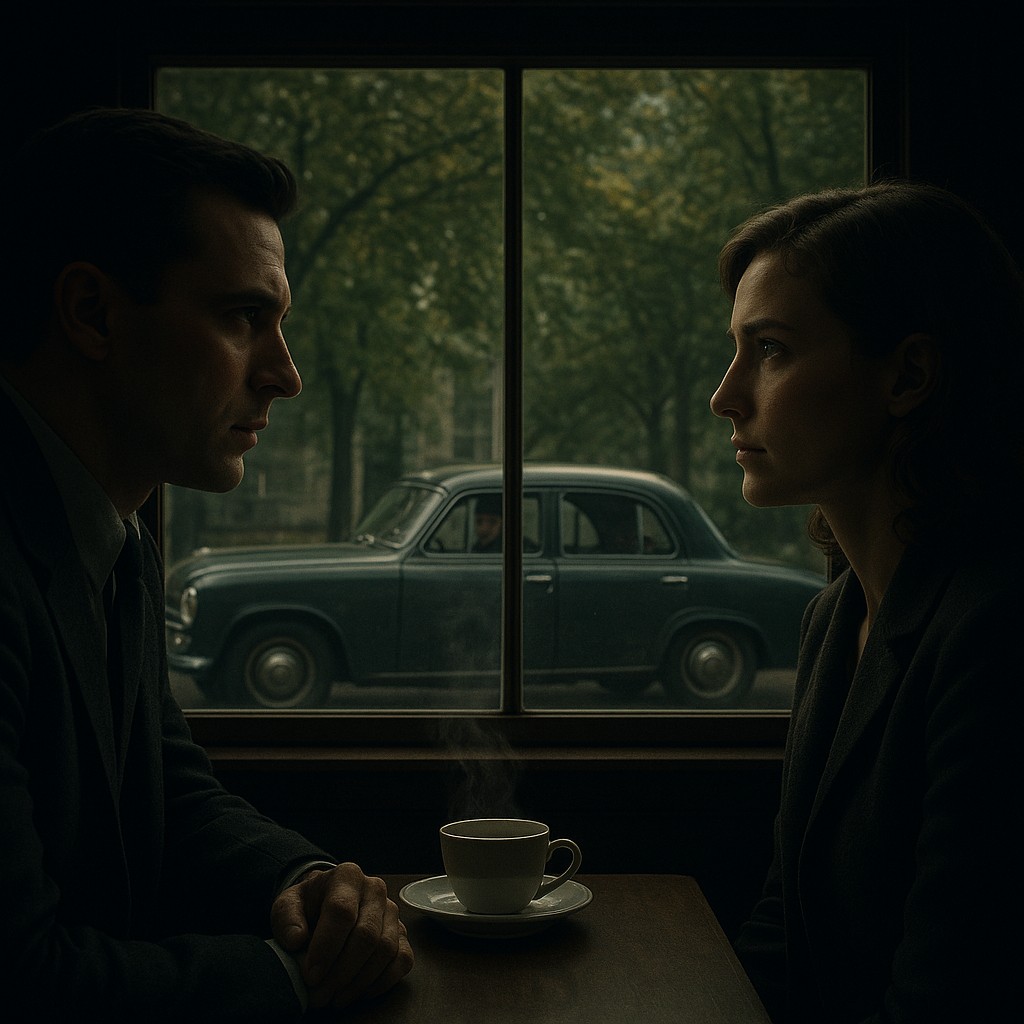
Imagine you are sitting in a darkened movie theater, watching a tense conversation between two characters. Behind them, through a window in the distant background, you can see a car pulling up to the curb. In most modern films, that car would be a soft, blurry smudge of color - a visual whisper that someone is arriving without distracting you from the actors' faces. This happens because the director is "curating" your vision. Most filmmakers use a shallow depth of field to tell you exactly where to look, effectively doing the mental work of prioritizing information for you. It is a comfortable way to watch a story, but it is also a bit like being led through a museum by a guide who keeps pointing a flashlight at specific paintings while leaving the rest of the room in total darkness.
Now, imagine the same scene, but this time, every single leaf on the tree outside the window is as sharp as the teardrop on the lead actress’s cheek. You can see the driver’s expression in the car as clearly as you can see the steam rising from a cup of tea in the foreground. This is the magic of deep focus. Rather than shrinking your world down to a single point of interest, deep focus expands the canvas. It presents a dense, bustling reality where the foreground, middle ground, and background all demand your attention at once. This technique shifts the power from the director to the viewer, inviting you to explore the frame like a detective looking for clues rather than a passive observer being told a secret.
The Technical Wizardry Behind the Sharpness
To understand how a camera can keep a coffee cup two feet away and a mountain five miles away equally sharp, we have to look at the physics of light. In photography and filmmaking, this is governed by "depth of field." This term refers to the distance between the nearest and farthest objects that stay sharp in a single shot. Achieving deep focus requires a specific combination of tools and settings that often go against modern "cinematic" trends. The most important factor is the aperture, which is the adjustable opening in the lens that lets light through. While many photographers love a wide aperture to get that creamy, blurry background, deep focus requires a tiny opening, often called a high f-stop.
The catch is that a tiny aperture lets in very little light. If you have ever tried to take a photo in a dim room with a small opening, you know that the result is usually a pitch-black image. To make up for this, cinematographers using deep focus must drench their sets in an incredible amount of light. During the filming of classics like Citizen Kane, the sets were often blindingly bright to allow the camera to capture that signature crispness. Additionally, filmmakers use wide-angle lenses, which naturally provide a deeper area of focus than zoomed-in lenses. These lenses also have the side effect of exaggerating distances, making rooms look larger and deeper than they actually are, which adds an epic scale to the storytelling.
Giving Information to the Active Audience
One of the most profound effects of deep focus is how it changes the relationship between the movie and the person watching it. When a director uses "selective focus," they are essentially making the editorial decision for you. They decide which character’s reaction matters most and which background details are irrelevant. Deep focus, however, treats the audience with a degree of intellectual respect. By keeping everything sharp, the filmmaker provides a wealth of information and trusts you to decide what is important. It mimics the way we experience the real world, where our eyes are constantly scanning our surroundings to find meaning and context.
This technique creates a sense of "democratic" viewing. In a single shot, you might have a husband and wife arguing in the foreground while their child plays innocently in the background, unaware of the tension. Because both layers are sharp, you can watch the parents' faces and then flick your eyes to the child to see the irony of the situation. This allows for complex, multi-layered storytelling without the need for constant cutting back and forth between different angles. It makes the world of the film feel like a continuous, living space rather than a series of isolated moments. This approach often results in a more immersive experience, as the brain feels it is participating in the scene rather than just watching it.
| Feature |
Shallow Focus (Standard) |
Deep Focus (Expansive) |
| Aperture Size |
Large (low f-stop numbers) |
Small (high f-stop numbers) |
| Viewer Role |
Guided and passive |
Active and exploratory |
| Lighting Needs |
Normal or low light |
Extremely high light levels |
| Lens Choice |
Telephoto or long lenses |
Wide-angle lenses |
| Narrative Feel |
Intimate and focused |
Realistic and grand |
Balancing the Visual Layers of the Frame
While deep focus sounds like a "more is better" approach, it presents significant challenges for the people designing the look of the film. When everything is in focus, the mess of a set can become overwhelming. A stray cable on the floor or a poorly painted prop that would usually be hidden by a blurry background suddenly becomes a glaring distraction. This means that production designers and set decorators have to work twice as hard. Every inch of the set must be perfect, as the camera will see into every corner. It requires a meticulous level of detail that "shallow" films can sometimes skip.
Furthermore, there is a risk of the image looking "flat." If everything is equally sharp and the lighting is uniform, the screen can start to look like a flat painting rather than a three-dimensional space. To fix this, cinematographers use light and shadow to create depth. They might light the foreground brightly, leave the middle ground in shadow, and then hit the background with a "rim light" - a light from behind that makes the edges of objects pop. This creates a 3D effect without the need for special glasses. By using light to guide the eye through the deep-focus frame, the director can still suggest a path for the viewer’s gaze without forcing it, maintaining that delicate balance between guidance and freedom.
Correcting the Myth of the Blurry Background
There is a common misconception in modern digital photography that a blurry background (often called "bokeh") is the hallmark of a professional or cinematic look. You see this everywhere, from smartphone "Portrait Mode" to high-end wedding videos. While shallow focus is a beautiful and effective tool, assuming it is the only way to make a movie look expensive is a mistake. In fact, many of the greatest achievements in cinema history were celebrated precisely because they rejected the easy shortcut of a blurry background.
Using deep focus is often much harder and more expensive than using shallow focus. It requires more lights, better lenses, more detailed sets, and a director who is a master of staging. When you see a film that successfully employs deep focus, you are seeing a production that has mastered the art of "mise-en-scene." This is a fancy French term for "putting into the scene," and it refers to how everything is arranged within the frame. Deep focus highlights the movement of the actors and the thoughtfulness of the environment, proving that clarity can be just as artistic, if not more so, than a hazy, unfocused background.
The Emotional Impact of Visual Scope
Beyond the technical hurdles and the mental exercise of scanning the frame, deep focus carries a heavy emotional weight. It often conveys a sense of destiny or the pressure of the environment on an individual. When a character is shown in a vast, sharply focused room, they often look smaller and more vulnerable. We see the world they inhabit pressing in on them from all sides. Conversely, it can show the connection between things. By keeping a foreground object (like a ticking clock) and a background action (like a man waiting for a phone call) in focus, the filmmaker establishes a thematic link. The clock isn't just a prop; it becomes the heartbeat of the scene.
This technique also works well with "long takes," where the camera doesn't cut for several minutes. Because the entire space is in focus, actors can move from the back of the room to the front without the camera operator having to frantically adjust the focus ring. This creates a seamless flow of action that feels like a stage play. The audience becomes grounded in the layout of the room. We know where the door is, we know where the window is, and we know exactly how far the characters are from one another. This spatial awareness builds a unique kind of tension that is hard to replicate with quick cuts and shallow, blurry shots.
Mastering the Art of Seeing Everything
As you continue to explore the world of visual storytelling, keep an eye out for those moments where the background is just as clear as the person speaking. Notice how your eyes move across the screen. Do you find yourself looking at the books on the shelf behind the hero? Do you notice the expression of the waiter in the distance? This is the director giving you the keys to the kingdom. Deep focus is an invitation to be more than just a consumer of stories; it is an invitation to be an explorer of worlds.
The next time you pick up a camera or even your phone, try to experiment with this concept. Instead of always reaching for that "Portrait Mode" that blurs the world away, try to capture a scene where the foreground and background tell two different parts of the same story. It takes more work to light, more care to compose, and a sharper eye to pull off, but the result is a rich, immersive image that rewards anyone who takes the time to look closely. Movies are often described as windows into other worlds. With deep focus, that window is cleaned until it’s crystal clear, allowing us to see every detail of the life unfolding on the other side.