If you have ever stood in a swimming pool and tried to run across the shallow end, you have felt the stubborn, invisible wall of fluid dynamics. For every bit of effort you spend pushing forward, the water seems to push back with even more spite. It feels as though the harder you try, the more the water thickens into a heavy, gel-like barrier. This is the basic frustration of moving through water: unlike air, which we slice through without thinking, water is nearly 800 times denser. In this environment, brute force is a losing game where the harder you work, the less you get in return.
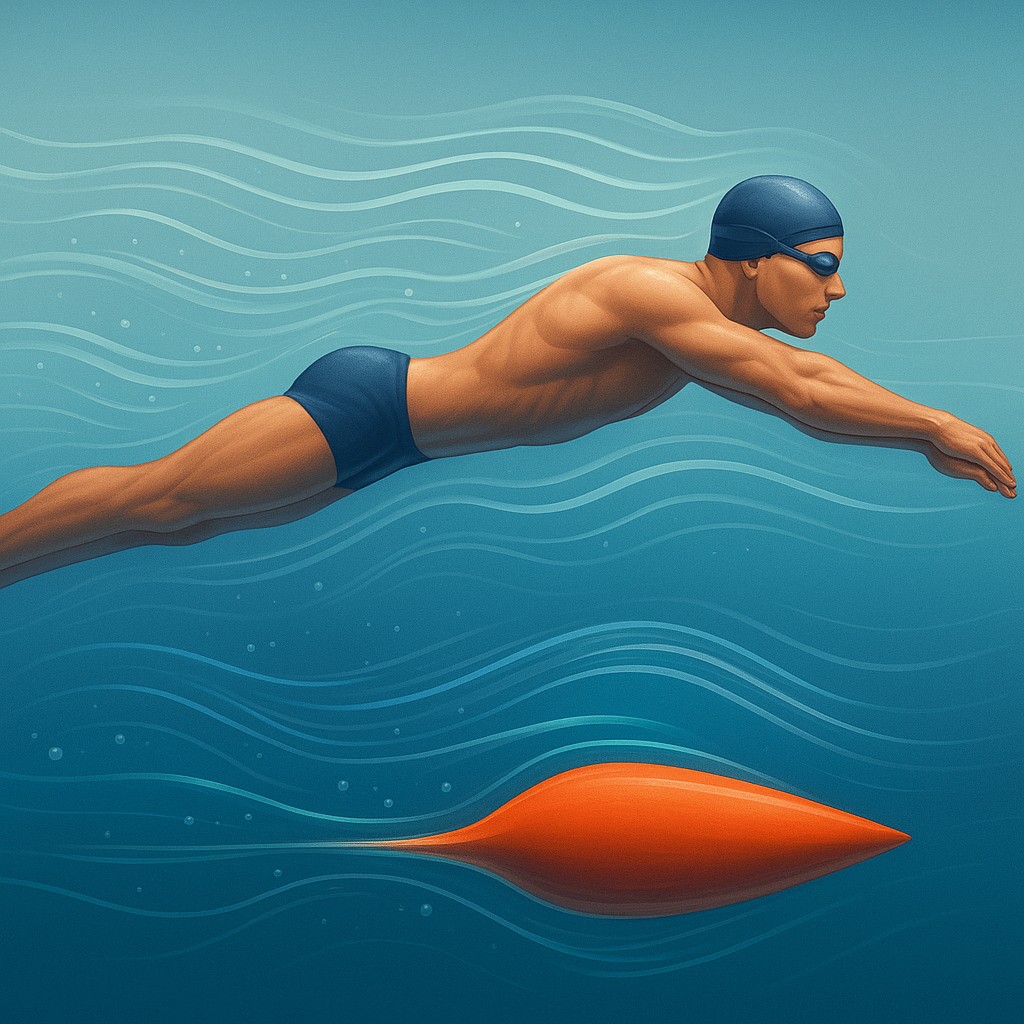
Elite swimmers know a secret that most casual lap-swimmers and gym-goers miss. While the amateur looks at the pool and sees a test of arm strength and lung capacity, the professional sees a puzzle of geometry and friction. To move truly fast, you do not simply try to overpower the pool; you try to disappear from it. By mastering the "narrow profile," a swimmer can reach speeds that would be physically impossible through muscle alone. This change from a struggling human to a sleek, aquatic projectile is less like being a motorboat and more like becoming a needle.
The Paradox of the Square-Law Resistance
To understand why kicking harder usually leads to exhaustion rather than excellence, we have to look at the physics of drag. In any fluid, whether air or water, the resistance an object faces does not climb at a steady, predictable rate. Instead, drag increases by the square of the speed. This means that if you want to double your swimming speed, you do not just need twice the power; you actually face four times the resistance. This "Square Law" is the main reason why even the strongest Olympic athletes hit a physical ceiling where more muscle results in almost no extra speed. They are effectively hitting a liquid wall.
When a swimmer moves through the water, three specific types of drag work together to slow them down. The first is friction drag, caused by water molecules rubbing against the skin. The second is wave drag, which is the energy lost to creating the ripples and splashes that look great in photos but act like a literal anchor. The third, and the one the athlete can control most, is form drag. Form drag is decided by the shape of the body as it cuts through the water. A body that is tilted, even slightly, creates a larger "shadow" in the water. This forces more molecules out of the way and creates a massive wake of swirling, turbulent energy behind the feet that pulls the swimmer backward.
The Horizontal Architecture of Speed
The most common mistake beginners make is "sinking hip" syndrome. Because our bodies are naturally denser in the lower half - thanks to heavy leg bones and muscle - our hips and legs want to drift toward the bottom. When this happens, the swimmer's body stops being a horizontal line and becomes a diagonal plow. Instead of cutting through the water like a knife, the chest and thighs act like a parachute, catching the water and creating immense pressure. By simply lifting the hips a few inches to create a perfectly flat, horizontal line, a swimmer can reduce the surface area hitting the water by over 50 percent without gaining any muscle.
Finding this horizontal "sweet spot" is not about leg strength, but core tension. Elite swimmers use their stomach and lower back muscles to create a bridge, locking the ribcage and the pelvis into a single, stiff unit. This is often called "swimming tall." By pressing the chest down slightly into the water - a technique known as "pressing the T" - the swimmer uses the natural buoyancy of their lungs as a pivot point, which naturally lifts the hips. It is a delicate game of see-saw where the goal is to stay perfectly level with the surface, taking up as little vertical space as possible.
Managing the Fluid Footprint
| Type of Drag |
Main Cause |
Professional Solution |
| Form Drag |
Large surface area hitting the water (like dropped hips). |
Keeping a stiff, horizontal "vessel" shape through core tension. |
| Skin Friction |
Texture and surface area of the skin or swimsuit. |
Wearing technical compression suits and cutting out shaky movements. |
| Wave Drag |
Energy lost to surface splashing and ripples. |
Taking deep, smooth strokes while keeping the head still. |
| Turbulent Wake |
Water swirling behind the feet, creating a vacuum. |
Keeping the kick narrow and tucked behind the body's path. |
Beyond the alignment of the torso, elite athletes focus on what coaches call the "body tube." Imagine a hollow pipe stretching through the water; the goal is to keep every part of the arms and legs within that narrow diameter. Beginners often kick with a wide, thrashing motion, thinking that more splash means more speed. In reality, a wide kick ruins hydrodynamics because it breaks the sleek profile and creates massive turbulence. A professional’s kick is compact and works like a whip, starting from the hips rather than the knees. It is designed to provide just enough lift to keep the body horizontal, creating forward drive without adding extra drag.
The Micro-Physics of Water Flow
Once a swimmer masters their general posture, they move on to tiny adjustments. One of the most important factors is head position. The human head is surprisingly heavy, and its position controls the alignment of the entire spine. If a swimmer looks forward to see where they are going, their hips will inevitably drop, much like the back of a boat sinks when the bow rises. Professionals keep their eyes focused on the black line at the bottom of the pool. They keep the neck long so the waterline cuts right at the top of the head. This ensures the smallest possible wake is created by the front of the body.
There is also the matter of laminar versus turbulent flow. Air and water prefer to flow in smooth, predictable layers called laminar flow. As soon as a swimmer makes a sudden, jerky movement or reaches too far across the center of their body, they break those layers. This creates "eddies" - little whirlpools of chaos that suck energy out of the system. This is why elite swimmers look so smooth, almost as if they are moving in slow motion despite their speed. They are carefully managing the water’s path around their body, making sure the fluid closes back up behind them with as little disturbance as possible. This "closing of the wake" is the mark of a truly efficient athlete.
Efficiency as the Ultimate Competitive Advantage
The final piece of the puzzle is energy efficiency. Because drag grows so fast as speed increases, a swimmer with poor form has to burn a huge amount of oxygen just to keep a decent pace. By reducing drag, a swimmer can travel the same distance using only a fraction of the energy. This is why the person who wins the race is often not the one with the biggest muscles, but the one who stays most efficient until the end. While the "power swimmer" is gasping for air because they have been fighting the water, the "streamlined swimmer" still has an oxygen reserve left for the final sprint.
Understanding these principles changes the way we look at any high-level goal. It teaches us that pushing harder is rarely the only solution. Often, the most effective way to move forward is to find and remove the things holding us back. Whether you are in the pool or handling a complex project at work, the lesson remains the same: look for the friction, flatten your profile, and let physics do the heavy lifting. When you stop fighting your environment and start working with it, you find that the water is not a wall, but a path that can carry you faster than you ever imagined.