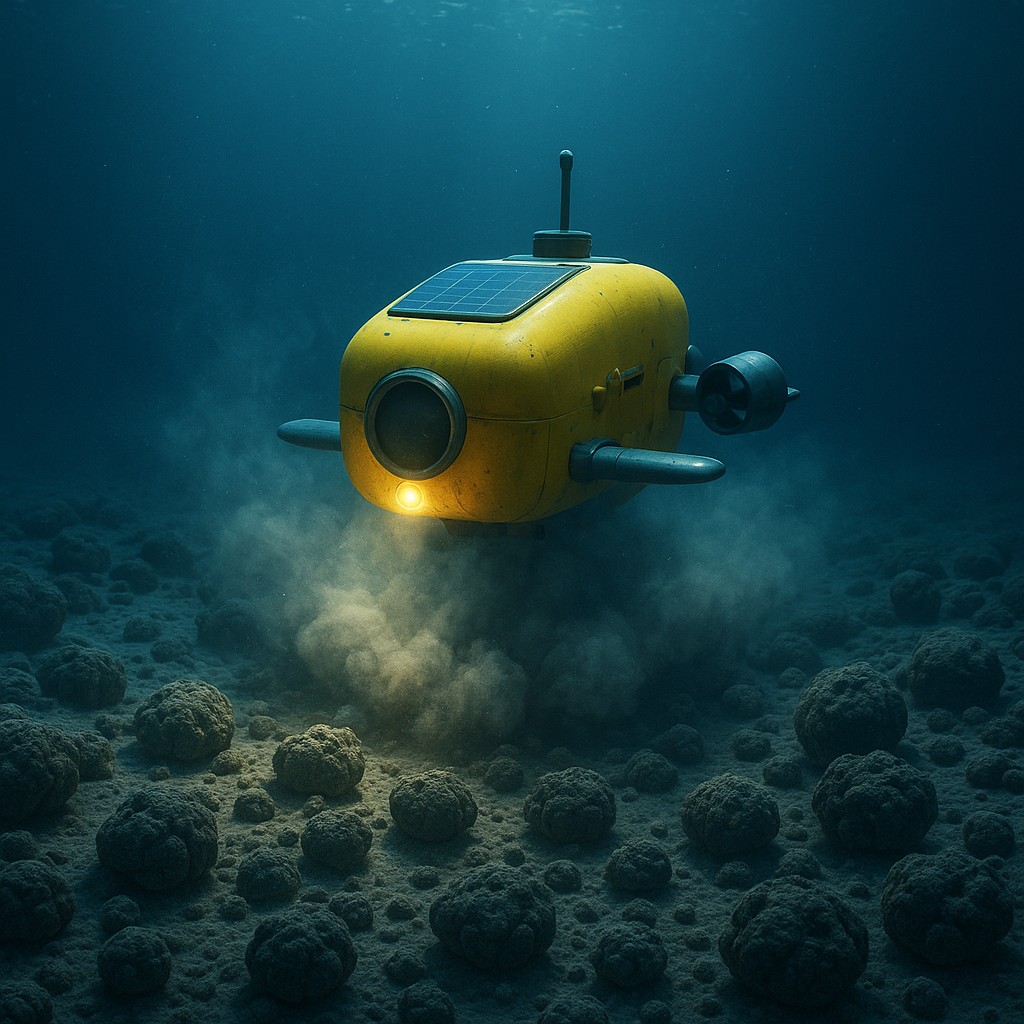
Imagine standing on a vast, pitch-black plain where the water pressure is strong enough to crush a heavy truck into the size of a soda can. Deep at the bottom of the Pacific Ocean, in a region called the Clarion-Clipperton Zone, the ground is covered with billions of potato-sized rocks known as polymetallic nodules. These plain-looking lumps contain cobalt, nickel, and manganese - the exact ingredients needed to make high-capacity batteries for electric cars and renewable energy storage. For decades, the main challenge in retrieving these treasures was purely mechanical: how do we pull heavy minerals up from five kilometers below the surface? But as we enter this new industrial era, the question has changed from "can we do it" to "how gently can we do it?"
The deep ocean floor is not a barren desert. It is a delicate, slow-motion world where the mud is as fine as powdered sugar and has settled over millions of years. Traditional underwater vehicles use high-powered thrusters, which are large propellers that spin fast to push the machine forward. in the abyss, those thrusters act like leaf blowers in a flour factory. They kick up massive, billowing clouds of silt called sediment plumes. These clouds can drift for miles, burying fragile creatures that filter their food from the water or clogging the delicate breathing systems of deep-sea animals. To solve this, engineers are moving away from the loud engines of the 20th century and toward the silent, elegant physics of buoyancy. If a robot can move simply by changing how much it weighs compared to the water around it, it can collect the tools for our green revolution without destroying the very environment it aims to protect.
The Problem with High-Power Propulsion in the Abyss
To understand why buoyancy is the future, we first have to understand why propellers are a problem in the deep. On the surface, if a boat’s wake stirs up some sand, the tides and currents wash it away in hours. But at the bottom of the ocean, the water is incredibly still. The sediment consists of microscopic particles that are so light they can take weeks or even months to settle back to the seafloor once disturbed. When a traditional ROV (Remotely Operated Vehicle) uses its thrusters to stay steady or move across the bed, it creates a "turbidity current." This isn't just a local dusty patch; it is a cloud of floating dirt that can travel sideways with slow deep-sea currents, effectively suffocating life-forms that have lived in crystal-clear water for thousands of years.
Furthermore, many deep-sea animals are bioluminescent, meaning they use tiny pulses of light to communicate, hunt, or find mates. A massive cloud of silt acts like a thick fog, blinding these creatures and disrupting their entire life cycle. From an engineering perspective, thrusters also waste a lot of power. Deep-sea robots are often limited by battery life or the thickness of the power cable connecting them to a ship. Propellers need constant energy to stay in one spot or move at a steady pace. If you stop the propeller, the robot stops moving. This creates a high-vibration, high-energy machine that clashes with the stillness of the deep. Switching to a passive movement system isn't just an eco-friendly choice; it is a more efficient way to operate in a high-pressure world.
Master of Displacement and the Physics of the Bladder
The secret behind these new mining robots is Archimedes' principle. This rule states that any object in a fluid is pushed up by a force equal to the weight of the fluid the object moves out of the way. Most underwater vehicles are designed to be "neutrally buoyant," meaning they neither sink nor float. However, the new generation of eco-friendly robots uses "variable buoyancy." They act less like a car and more like a human lung. Inside the robot is a strong system of pumps and flexible bladders filled with oil or water. To sink, the robot pumps oil from an outside flexible bag into a solid internal tank. This shrinks the robot's total volume (displacement) without changing its weight much, making it denser than the surrounding seawater.
When the robot needs to rise or move forward, it reverses the process, pumping oil back into the outside bag. This increases the total size of the machine, making it "lighter" compared to the water it displaces. By pairing this up-and-down movement with short wings or a sleek body shape, the robot can turn a vertical "sink" or "rise" into a forward glide. This is the exact same method used by "Seagliders," autonomous underwater vehicles (AUVs) that can travel thousands of miles across oceans using almost zero battery power. In a mining context, this means the robot can "hop" or "glide" from one patch of rocks to the next. Instead of a continuous blast of water from a propeller, there is only a slow, silent change in volume.
Comparing Propulsion Systems: Thrusters vs. Buoyancy
| Feature |
Conventional Thruster Robots |
Buoyancy-Driven Robots |
| Primary Movement |
Propellers / Water jets |
Changing volume (Bladders) |
| Sediment Disturbance |
High (creates large mud clouds) |
Minimal (passive gliding) |
| Energy Consumption |
High (constant power for thrust) |
Low (power only used for pumps) |
| Stealth / Noise |
Significant mechanical noise |
Near-silent operation |
| Speed and Control |
High speed, instant turning |
Slower, heavy-feeling movement |
| Ecological Impact |
Disrupts filter-feeders and light |
Keeps water clear and saves habitats |
Mimicking the Giants of the Deep
This shift toward buoyancy isn't just a clever engineering trick; it is a way of copying nature. If we look at the most successful residents of the deep, such as the sperm whale or various types of jellyfish, they rarely use aggressive mechanical force to move through the water. Sperm whales, for instance, are thought to use a special organ in their heads as a buoyancy regulator. By changing the blood flow to the organ, they can cool or warm the waxy substances inside. This changes the density of the wax to help them dive deep or rise to the surface with very little effort. They are literally changing their physical state to navigate the different pressures of the ocean.
By designing robots that "inhale" and "exhale" to change their density, engineers are creating machines that fit into the natural rhythm of the ocean. These robots don't fight the water; they cooperate with it. This "passive" approach allows the machines to work for much longer. A mining robot that spends 80 percent of its time gliding on currents can stay on the seafloor for weeks longer than one that is constantly fighting gravity with high-speed motors. Furthermore, by removing the heavy, complex gears and motor parts needed for propellers, the robots can be made simpler and tougher against the extreme salt and pressure of the deep.
Overcoming the Slowness of the Glide
While buoyancy-driven movement sounds perfect, it does have one big design challenge: momentum. In a traditional robot, if you see an obstacle, you reverse the thrusters and stop immediately. A buoyancy-driven robot is more like a massive hot-air balloon or a glider; it doesn't stop on a dime. It needs smart computer programs to plan its path. The robot’s "brain" must calculate its route minutes in advance, adjusting its internal density well before it reaches its goal. Engineers are currently developing advanced AI flight controllers that can map the seafloor in real-time and use deep-sea currents to "sail" the robot toward mineral zones.
This leads to a fascinating mix of robotics and the study of how water moves. Because these machines move slowly, they don't create the messy turbulence that usually makes it hard to see underwater. Their movement is "laminar," meaning the water flows smoothly around them. This predictability actually makes it easier for sensors to keep a clear image of the surroundings. When you aren't stirring up mud, your cameras and sonar work much better. By accepting a slower pace, the robot actually becomes more efficient at "seeing." It proves the old saying that "slow is smooth, and smooth is fast." In the deep sea, "fast" was never the goal; accuracy and protection are what matter.
Scaling the Technology for a Sustainable Future
Developing a single prototype that glides is one thing, but making a whole fleet of mining robots is where the real innovation happens. Future deep-sea mining might look less like a single giant excavator and more like a "swarm" of gliding robots. These swarms could work together, with some bots scouting for rocks and others gently lifting them using small, controlled buoyancy changes. By spreading the work across many smaller, passive machines, the total impact on the environment is much lower. If one robot fails, the rest keep going. If a cloud of mud is detected, the robots can simply adjust their density to rise above it and wait for it to settle.
This "environment-first" design represents a major turning point in the history of robotics. For the first hundred years of the field, we built machines to conquer nature - to crush rocks, fly fast, and move heavy loads no matter what. But as we move into a more eco-friendly era, we are learning that a robot is only as successful as the environment it leaves behind. The deep-sea mining robots of tomorrow prove that the most advanced technology doesn't have to be the loudest or the fastest. Sometimes, the most sophisticated way to move through a world is to simply change your heart's volume and let the physics of the ocean carry you.
The move from propeller power to buoyancy gliding marks a big realization: we cannot solve problems on land by creating new ones in the deep ocean. By making our engineering work with the laws of the abyss, we are discovering that efficiency and conservation are often the same thing. As you look at the gadgets in your life - your phone, your laptop, the car in your driveway - remember that the minerals inside them might one day be gathered by silent, gliding guards thousands of feet below the waves. This approach teaches us that when we face a hard challenge, the best solution isn't always to push harder; sometimes, the best way forward is simply to find a better way to float.