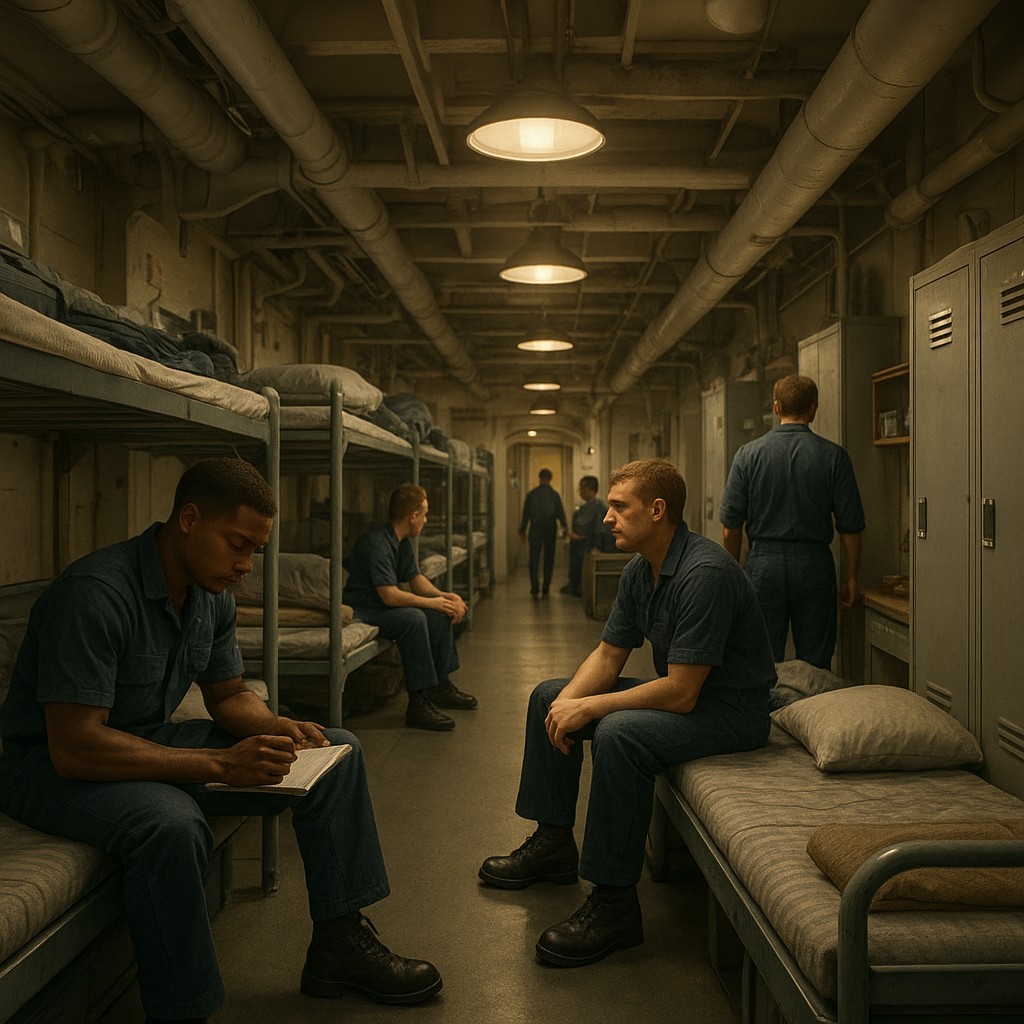
Imagine waking up in a room shared with forty other people. The ceiling is only a few inches from your nose, and the floor thrums with the low vibration of nuclear reactors. You aren't in a colony on Mars; you are in a floating city in the middle of the ocean, one as long as the Empire State Building is tall. An aircraft carrier is a masterpiece of engineering - a four-and-a-half-acre piece of sovereign territory with its own airport, power plant, and a population of five thousand. In this world, the sun rarely touches your skin unless your job is on the roof, and the smells of jet fuel and fresh-baked bread often drift together through the vents.
Living on a carrier is a lesson in extreme adaptation. It is a place of total contradictions. You are surrounded by billions of gallons of salt water, yet you must save every drop during a shower. You are part of a massive team, yet your private world is shrunk down to a single metal locker and a bunk often called a "coffin." To understand life on these grey giants, you have to look past the steel to see how a society functions when it is cut off from the rest of the world for months. It is a high-stakes, fast-paced environment where the routine is strict, the noise never stops, and the mission comes first.
The Architecture of a Floating City
To grasp the scale of a carrier, stop thinking of it as a boat and start seeing it as a vertical city. The ship is divided into deck levels. The flight deck is "Level 0," and every floor above or below is numbered accordingly. Because space is the most valuable thing on the ship, every inch is put to use. Hallways, called passageways, are narrow and filled with "knee knockers" - raised doorframes you have to step over to move between rooms. These keep the ship watertight if the hull is ever breached, but for a new sailor, they are mostly a source of bruised shins and torn pants.
The layout is a maze of ladders and hatches that can take weeks to learn. Most sailors spend their time in three places: their workspace, their sleeping quarters (berthing), or the dining halls (mess decks). Because the ship is so large, it has small comforts tucked into every corner, like mini post offices, barbershops, and gyms. There is even a television station and a daily newspaper produced on board to keep everyone informed about what is happening on the ship and back home. It is a self-contained world that makes its own electricity, drinks its own desalinated water, and manages its own trash.
The ship is never truly silent. There is the constant roar of the ventilation system, the rhythmic thud of waves against the side, and the heavy "thump-crunch" of planes landing on the deck above. Depending on where you sleep, you might hear the screech of the metal wires that catch returning jets. This noise becomes a background hum over time - a type of white noise that sailors eventually find they cannot sleep without once they return to the quiet of a house on land.
Sleeping in the Coffin: Life in the Berthing Area
Personal space is a luxury that simply does not exist here. Junior sailors live in "berthing areas," which are large rooms filled with dozens of "rack" beds stacked three high. Each rack is about six and a half feet long and thirty inches wide. The bottom of the bed above you serves as your ceiling, and the space is so tight you cannot sit up straight. This is why many call them "coffins," though they feel surprisingly cozy once you get used to the dark. Under the mattress is a shallow metal tray where you store everything you own, from uniforms to laptops and snacks.
Privacy comes from a small blue curtain that slides across the side of the bed. When that curtain is closed, it is the only private territory a sailor has. An unwritten rule says you never disturb someone behind their curtain unless there is an emergency. Because the ship runs 24 hours a day, someone is always sleeping while someone else is working. You have to learn to sleep through the sound of heavy boots on metal floors and the clanging of lockers.
The "head," or bathroom, is a shared facility for the whole sleeping area. Dealing with plumbing is a group effort. Because the vacuum-flush toilets are delicate, one person flushing something they shouldn't can break the system for fifty people. This shared hardship builds a unique bond. You aren't just roommates; you are survivors. You learn the intimate details of your shipmates' lives - from who snores the loudest to who has the best stash of hidden candy.
Cooking for Five Thousand at Full Speed
Feeding 5,000 people four times a day is a logistical miracle. The mess decks are the heart of the ship’s social life. Most carriers serve breakfast, lunch, dinner, and "midrats" - meaning midnight rations for the night shift. The amount of food is staggering. On a normal day, the kitchen might use 800 gallons of milk, 15,000 eggs, and 500 pounds of coffee. The cooks are some of the hardest-working people on the ship, starting long before sunrise to make sure the line is moving by 6:00 a.m.
The quality of the food is a major factor in morale. While old movies joke about "Navy food," modern dining is surprisingly good. You might find a taco bar, pasta station, or "Burger Day" on Wednesdays, which is usually the best part of the week. Every department has its own specific table, creating a high-school cafeteria vibe where pilots sit with pilots and engineers sit with engineers. It is a rare moment of rest where rank matters a little less than a hot meal.
| Category |
Daily Amount |
Fun Fact |
| Eggs |
~15,000 |
Enough to fill a small swimming pool in a week. |
| Coffee |
~500-800 Pounds |
Called "Navy Wine," it fuels the night shift. |
| Vegetables |
~1,000-2,000 Pounds |
Fresh produce is the first thing to run out at sea. |
| Drinking Water |
~400,000 Gallons |
Made by the ship using heat from the reactors. |
| Laundry |
~5,000 Pounds |
The laundry runs 24/7 to keep thousands of uniforms clean. |
Even with the best planning, life at sea changes how you look at food. Fresh fruit and vegetables, known as "freshies," are highly prized. During the first week after leaving a port, the salad bar is full. By week four, the apples look sad. By week six, the menu relies heavily on canned goods and frozen meat. This is why the arrival of a supply ship - where pallets of food are transferred across cables while both ships are moving - is a cause for celebration.
The Dance on the Flight Deck
If the inside of the ship is a city, the flight deck is the world’s most dangerous stage. This is "the roof," a place of extreme wind, deafening noise, and the smell of jet fuel. To a visitor, it looks like chaos, but it is actually one of the most organized environments on earth. Everyone wears a colored jersey to show their job, since you cannot hear anyone speak over the roar of the engines.
Yellow shirts are the directors who guide the planes. Blue shirts move aircraft with tractors. Red shirts handle bombs and ammo, and green shirts run the catapults that launch the planes. This color system ensures that everyone knows exactly who is responsible for what in a split second. When jets are launching, the whole ship vibrates. The steam catapults hit with such force that you can feel the jolt in your teeth three floors down.
When no planes are flying, the flight deck becomes the ship's backyard. The crew might hold a "Steel Beach Picnic," opening the giant hangar doors to the sea and bringing out grills. Sailors get to spend a few hours in the sun, playing basketball or just staring at the horizon. This break is vital because a workday on a carrier is often 12 to 16 hours long. The line between work and home doesn't exist; you live where you work, and you work where you live.
Staying Sane in a World of Grey
How do you stay mentally healthy while trapped in a steel box for six to nine months? The answer is routine and small comforts. Modern carriers have limited internet and email so sailors can talk to their families. However, the connection is often slow, and the ship may go into "River City" - a total communications blackout - during certain operations. During these times, the crew goes "old school" for fun, using gym workouts, books, video games, or board game tournaments.
The ship also has a medical department like a small hospital, with doctors, dentists, and even a psychologist. Mental health is a major focus because being isolated at sea can be difficult. Sailors create their own "tribes" within their units. These friendships are very intense. When you spend every hour with the same people, they become your family. They are the ones who celebrate your birthday with a "cake" made of snack bars and help you get through a 20-hour repair job.
Traditions also help. Crossing the equator for the first time involves a big ceremony where "pollywogs" (those who haven't crossed) become "shellbacks." These rituals link modern sailors to centuries of history, giving them a sense of purpose. Even watching the sunset from a high gallery on the ship's tower becomes a spiritual moment, a brief bit of beauty that reminds the crew why they are there.
Returning to the Silent World
As a mission ends, a feeling called "channel fever" sets in. The crew becomes focused on going home, but they also feel anxious about leaving the ship's rigid structure. For months, they haven't had to drive, choose what to wear, or decide what to eat. Everything has been decided by a schedule on the wall. Returning to civilian life, with its endless choices and lack of a 24-hour mission, can be shocking.
When a carrier finally pulls into port, it is a massive event. Thousands of families line the docks for the homecoming. But the crew carries the ship with them long after they leave. They will always be the people who can sleep through a storm, fix a machine with duct tape and willpower, and recognize the specific, salty smell of the ocean at three in the morning in the middle of the Pacific.
Life on a carrier isn't for everyone. It is a life of "hurry up and wait," hard labor, and missing big moments back home. But for those who serve, it shows what humans are capable of. It proves that thousands of people can work together to run the most complex machine ever built, finding humor in small spaces and pride in the constant hard work. It is a grueling, exhausting, and magnificent way to see the world.