What if five minutes could change your day: a surprising doorway into calm
Imagine this: you are in the middle of a chaotic workday, email pings, your to-do list grows, and your heart feels like it is running a small marathon. Now imagine sitting down for five minutes and finding enough mental space to notice, breathe, and choose what to do next. That is the everyday power of meditation, and the good news is it is not reserved for monks or gurus. Science and ordinary people agree that even brief, regular practice reshapes how we relate to stress, focus, and other people.
Meditation is not magic, and it is not an instant fix. It is a skill you learn with simple steps and repeated practice, just like learning to ride a bike or play a musical phrase. The practice trains attention, cultivates awareness, and changes patterns of reaction. If you are curious, skeptical, or both, this guide will show you what meditation really is, how to do it in practical ways, what benefits reliable research has found, and how to make it stick in daily life without guilt.
What meditation actually means, in plain language
At its heart, meditation is intentional attention. You sit, stand, lie down, or walk, and you deliberately bring awareness to an experience - the breath, bodily sensations, sounds, or thoughts - then gently return to that focus when the mind wanders. Different traditions and techniques emphasize different qualities - concentration, open awareness, compassion - but they share the same basic engine: practice in noticing and choosing where attention goes.
There are several common categories to know because they guide different outcomes. Focused-attention meditation trains the mind to stay on one object, like the breath. Open-monitoring meditation cultivates nonjudgmental awareness of whatever arises, thought or sensation. Loving-kindness or compassion practices deliberately evoke warmth toward yourself and others. Body-scan practices tune you into physical sensations. Knowing these categories helps you pick a practice for your goal, whether it is stress relief, improving attention, or developing empathy.
A gentle, step-by-step practice you can try right now
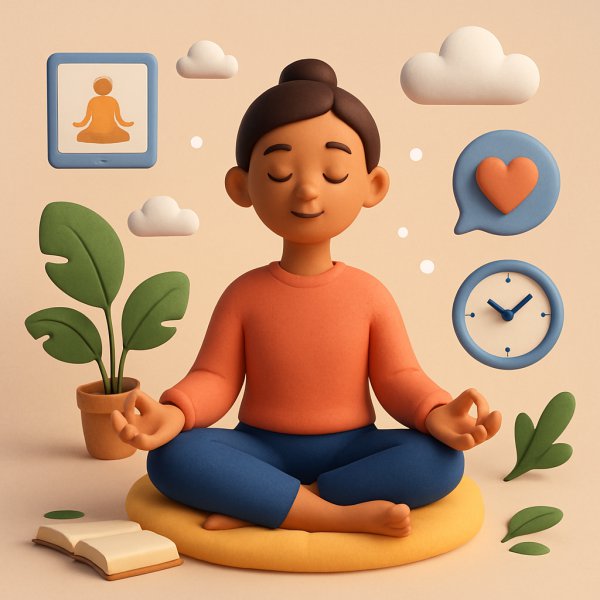
Find a quiet spot where you will not be interrupted for five to ten minutes. Sit on a chair or cushion with your back comfortably upright, or lie down if sitting hurts. Place your hands where they feel natural, relax your shoulders, and lower your gaze or close your eyes if that feels safe. If you prefer movement, a slow three-minute walking practice works just as well to begin.
Start by taking three slow, intentional breaths. Notice the inhale moving in, the brief pause, and the exhale moving out. Allow the breath to become a gentle anchor - not forced, not controlled - simply noticed. When your mind wanders, and it will, notice the thought with curiosity - label it if you like, for example "planning" or "worry" - then guide your attention back to the breath. Repeat this noticing-and-returning cycle; this is the practice. Even when you notice you are already late or wondering what to make for dinner, each return to the breath is a training session for your attention and composure.
Try this short exercise as your first mini-challenge: set a timer for five minutes, sit, and follow the steps above. Afterward, write one sentence about what changed - maybe your shoulders feel softer, or your mood is less sharp. That tiny note will help build a habit of learning from practice.
A simple guided 10-minute script you can follow
Begin by settling into comfortable posture, taking three full breaths and feeling the body sit or touch the floor. Bring your attention to the sensations of breathing - the rise at the chest or belly, or the coolness at the nostrils. For the next minute, count each in-breath and out-breath up to five, then start again at one. Notice when the mind drifts and gently return to counting. In minutes three to six, shift from counting to simply noticing the quality of each breath - long or short, deep or shallow - without changing it. In minutes seven to nine, widen your attention to include sounds and bodily sensations, observing them as if watching weather in the mind. In the final minute, rest in whatever is present, and set a gentle intention to carry that awareness into the next part of your day.
If standing up, use the same structure while walking: notice heel touch, leg movement, breath, and the environment. If lying down and sleepiness arrives, notice that and consider a shorter seated practice next time.
Common obstacles and straightforward fixes that actually work
A major misconception is that meditation means stopping thoughts or emptying the mind. This is false and unhelpful. The mind thinks; meditation teaches you to notice thinking without getting pulled into it. When you expect a thought-free mind, frustration grows and practice becomes unpleasant. Instead, expect wandering and treat it like a teacher that shows where your attention needs training.
Another common problem is feeling too restless, too busy, or too tired to meditate. Restlessness often means your nervous system needs movement first; do a brief stretch or take a short walk for two minutes, then sit. If sedation or sleepiness regularly appears, try a standing or walking practice, open your eyes slightly, or reduce the practice length and do it twice a day. Painful sensations can be a sign to adjust posture, add supportive cushions, or choose a body-scan with curiosity rather than judgment. Finally, the belief that you must meditate perfectly or for long periods can lead to all-or-nothing thinking. Short, consistent practice beats sporadic marathon sessions.
List of quick troubleshooting moves:
- Mind keeps wandering: use a shorter timer and count breaths to anchor attention.
- Restless body: do 1-2 minutes of movement before sitting.
- Sleepiness: practice upright, or switch to walking meditation.
- Pain or discomfort: modify posture, use props, or try guided body-scan with soft attention.
- Guilt about missing sessions: drop self-punishment, restart immediately, and log small wins.
Benefits that show up in daily life, supported by evidence
Meditation produces a range of benefits that researchers have documented across thousands of studies. Regular mindfulness practice is associated with reduced symptoms of anxiety and depression, improved attentional control and working memory, lower perceived stress, and better emotion regulation. A 2014 meta-analysis in a leading medical journal summarized that mindfulness meditation programs show moderate evidence for improving anxiety and depression symptoms, comparable to what many expect from psychotherapy. Neuroimaging research shows changes in brain regions involved in attention, empathy, and self-regulation after sustained practice.
Physically, meditation links to lower blood pressure, improved sleep quality in some people, and reduced chronic pain symptoms when combined with other treatments. Importantly, effects are often proportional to consistency and type of practice; loving-kindness practices tend to boost social connectedness and positive emotions, while focused-attention practices reliably improve concentration.
Below is a concise table summarizing common benefits and the kinds of evidence behind them:
| Benefit |
Practical example |
Evidence snapshot |
| Reduced anxiety and depression |
Feeling less overwhelmed during stressful weeks |
Multiple meta-analyses show moderate effect sizes |
| Improved attention and focus |
Completing tasks with fewer interruptions |
Studies show better sustained attention after training |
| Better emotion regulation |
Pausing before reacting in conflicts |
Neuroimaging links to prefrontal control changes |
| Decreased perceived stress |
Lower subjective stress scores after programs |
Randomized trials of 8-week programs show reductions |
| Greater compassion and social connection |
More patience with family or coworkers |
Loving-kindness studies show increases in positive affect |
Keep in mind that meditation is not a cure-all. Effects vary by person, practice type, and how regularly you practice. It is best used as one tool among many for mental and physical health.
How to make meditation part of your life - with less willpower, more design
Habits are formed by pairing new behaviors with existing cues and rewards. Use "habit stacking" - attach meditation to a regular cue, such as right after brushing your teeth in the morning, or just before your lunch break. Start tiny - even one or two minutes daily is powerful when kept consistent. Build up by doubling time slowly, for instance, add one minute every five days. Make the environment easy: keep a cushion by the chair, set a timer app with a pleasant chime, or create a calming corner with a plant or lamp.
Social accountability multiplies success. Join a weekly class, sign up for a local meetup, or commit to a friend to meditate together online. Track your practice in a simple calendar or habit app and celebrate streaks. Avoid perfectionism: if you miss a day, restart immediately without guilt. Use reminders that are curiosity-based rather than punitive, for example, "I wonder what five minutes today will reveal." This keeps the practice playful and sustainable.
Try this 30-day micro-plan: Week 1 - meditate 3 minutes daily, Week 2 - 5 minutes daily, Week 3 - 10 minutes daily, Week 4 - mix 10-minute sits with two 5-minute practices. After each session, note one change you experienced. By the end of the month, review the notes and adjust goals based on what worked.
Real people, real shifts: short stories that make the benefits concrete
Case 1 - The stressed manager: Priya, a midlevel manager, used to react loudly in meetings when stress peaked. She began a 10-minute daily focused-breathing practice and enrolled in an 8-week mindfulness course at work. After six weeks, she noticed she could pause before replying. Her emails became clearer, and her team reported fewer tense exchanges. The combination of daily mini-practices and group learning helped her convert insight into habit.
Case 2 - The athlete who turned nerves into focus: Marcus, an amateur marathoner, learned breath-counting and a brief visualization before races. He used these practices to steady pre-race panic, and he noticed improved pacing because he could stay present rather than obsess over splits. The practice did not make him faster overnight, but it reduced anxiety and improved his consistency.
Case 3 - The parent finding patience: Elena, a mother of two, practiced loving-kindness meditations for 5 minutes each evening, silently wishing safety and ease for herself, her children, and people she found difficult. Over months she reported small but cumulative shifts - less snapping during bedtime routines and more warmth when her child tested limits. The practice complemented her parenting toolkit by increasing emotional reserves.
These stories show that change is often gradual, practical, and linked to specific goals - stress management, performance, or relationships.
Practical tools, apps, books, and a few favorite shortcuts
There are many accessible resources to support practice. Apps can provide structure and guided sessions; books offer depth and frameworks; community classes bring support.
Table of recommended resources with quick pros and cons:
| Resource |
Good for |
Quick note |
| Insight Timer (app) |
Variety of free guided meditations |
Huge library, variable teacher quality |
| Headspace or Calm (apps) |
Structured courses for beginners |
Paid, with polished guidance |
| "Full Catastrophe Living" by Jon Kabat-Zinn |
In-depth MBSR framework |
Classic text for clinical-style training |
| Local meditation group or sangha |
Community and accountability |
Look for secular groups if you prefer nonreligious approach |
| Timer apps (e.g., Medito, simple phone timer) |
Silent practice with bells |
Minimalist and distraction-free |
Practical shortcuts: use breath awareness before meetings, do a 2-minute body check while waiting for the kettle to boil, or practice a compassion phrase like "May I be well, may I be calm" during a commute. These micro-practices are not lesser; they are the currency of lasting change.
Quote to remember:
"You do not need to be good at meditation. You only need to be willing to show up." - a reminder that effort, not perfection, matters.
Final encouragement, a tiny challenge, and reflection prompts
Meditation is a skill you grow by returning to the practice again and again with curiosity, not judgment. It reshapes how you relate to stress, focuses your attention, and increases emotional flexibility. The smallest consistent practice often creates the most durable change, so resist the urge to overcomplicate early on.
Tiny challenge: for the next seven days, do a 3-minute sit each morning and a 1-minute compassionate breath in the evening. After each session, write one short sentence about what you noticed. At the end of the week, read your notes. Ask yourself: What changed in my body, attention, or reactions? When did I resist practice, and what helped me return? What is one small adjustment to make the upcoming week easier?
If you leave this piece with one practical insight, let it be this: meditation is not about stopping life, it is about learning to live with more choice, clarity, and kindness. Try it, be curious, and give yourself permission to be imperfect.