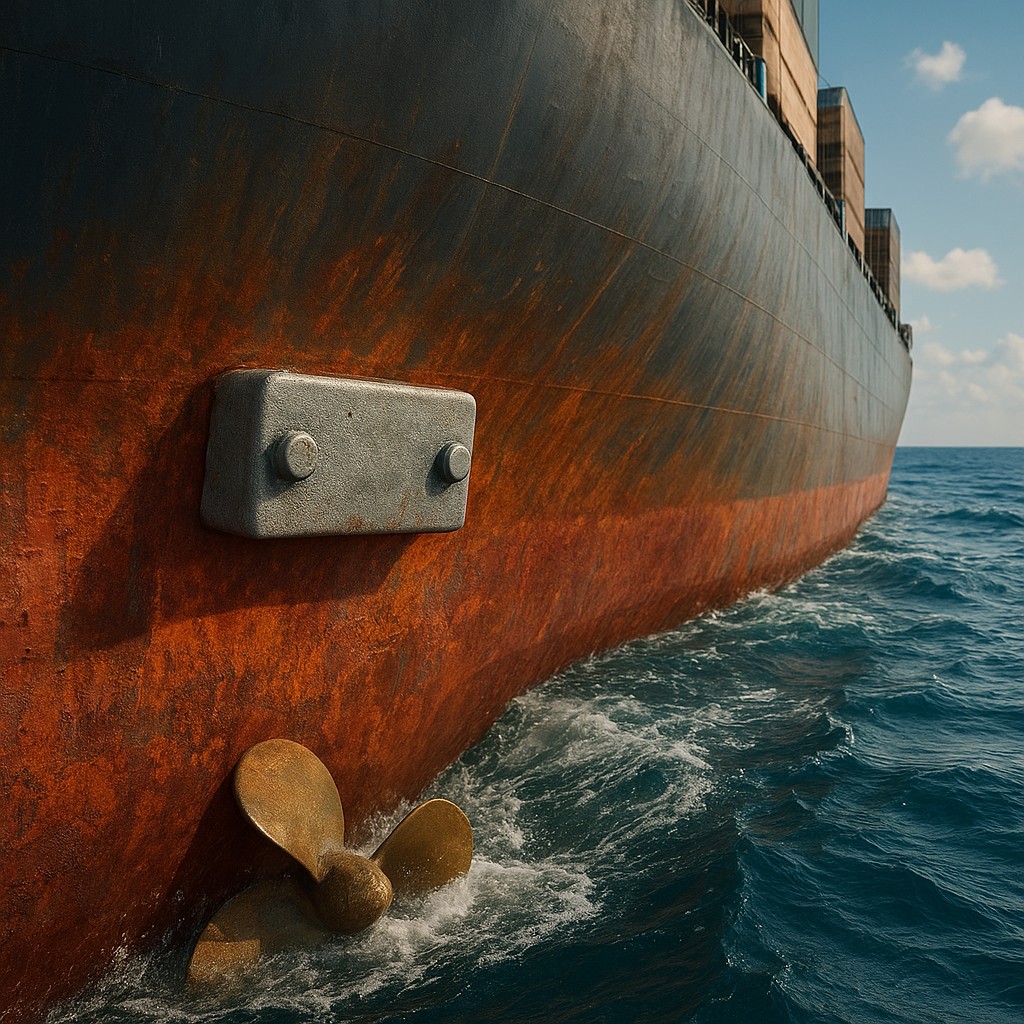
Imagine standing on the deck of a massive cargo ship, a titan made of hundreds of thousands of tons of steel, cutting through the deep blue of the Atlantic. Saltwater is one of the most destructive substances on Earth. It is a liquid environment that treats iron and steel like an all-you-can-eat buffet. Without protection, a vessel this size would surrender to the ocean’s chemical hunger, turning into a crumbling orange skeleton of rust in just a few years. Yet, these steel giants endure for decades. Their hulls stay smooth and strong despite being submerged in a corrosive chemical soup.
The secret to this long life is not some high-tech, invisible force field. Instead, it is a simple philosophy of sacrifice. Scattered along the hull and near the propeller are plain blocks of metal, usually zinc or aluminum, that look like nothing more than gray bricks bolted to the side. These are sacrificial anodes, the hidden heroes of marine engineering. By understanding how electrons move and how metals behave in water, we can see how these "bodyguard" metals willingly dissolve so the ship can live. It is a brilliant example of using the laws of chemistry to turn a destructive force into a predictable, manageable process.
The Chemistry of a Slow-Motion Explosion
To understand why a ship's hull needs a sacrifice, we first have to understand what rust actually is. Rusting, or corrosion, is essentially a slow-motion electrical fire. When steel is exposed to water and oxygen, a chemical reaction occurs where the iron atoms lose electrons. These electrons act like the mortar holding the metal together. Once they are gone, the iron turns into iron oxide, a brittle, flaky substance with no structural strength. In freshwater, this process is relatively slow because water is a poor conductor of electricity. However, the salt in seawater turns the entire ocean into a highly efficient electrolyte, a highway that allows electrons to zip around easily, speeding up the destruction of the ship.
This process creates what is known as an electrochemical cell. In this scenario, the steel hull acts as an anode, the place where electrons are lost, while other parts of the ship or the water itself act as the cathode, the place that receives them. Seawater completes the electrical circuit. Because the ocean is always moving and bringing in fresh oxygen, the steel never gets a break. It is constantly "pushed" to give up its electrons and dissolve into the waves. To save the ship, we must stop the steel from losing those electrons or, better yet, give the ocean something even more tempting to eat.
The Galvanic Series and the Hierarchy of Hunger
Every metal has a different level of "hunger" for its own electrons, a property known as electrode potential. Some metals, like gold and platinum, are extremely possessive. They hold onto their electrons with fierce intensity, which is why they do not tarnish or rust. Other metals, like magnesium and zinc, are much more relaxed and almost eager to shed electrons and react with their environment. When you put two different metals in contact with each other in an electrolyte like saltwater, they enter a chemical tug-of-war.
Engineers organize this hierarchy into the Galvanic Series. In any pairing of two metals, the one that is "more active" (less stable) will become the anode and corrode. The "less active" (more noble) metal will become the cathode and remain protected. By bolting a block of a very active metal, like zinc, directly to the steel, we create a deliberate imbalance. The zinc essentially tells the saltwater, "Don't bother with that tough steel; I am much easier to break down." Because zinc is lower on the Galvanic Series than steel, the electrical current from the saltwater focuses entirely on the zinc. As the zinc dissolves, it actually pumps electrons back into the steel, keeping the hull in a state where it cannot rust.
| Metal Type |
Galvanic Activity |
Role in Marine Protection |
| Magnesium |
High Activity |
Used in freshwater or soil with very high electrical resistance. |
| Zinc |
Medium-High Activity |
The standard choice for protecting saltwater ship hulls. |
| Aluminum |
Medium-High Activity |
Effective in brackish (mixed salt and fresh) water; lighter than zinc. |
| Mild Steel |
Moderate Activity |
The primary material we are trying to protect. |
| Stainless Steel |
Low Activity (Noble) |
Often used for fittings; can cause rust in nearby mild steel. |
| Gold/Platinum |
Very Low (Noble) |
These will never rust, but they will cause everything else to dissolve. |
Designing the Perfect Chemical Bodyguard
Choosing the right sacrificial anode is not as simple as grabbing a piece of scrap metal. Engineers must carefully calculate the surface area of the hull, how salty the water is, and the expected water temperature. For example, if you use a magnesium anode in very salty seawater, it reacts so violently that it disappears in weeks, leaving the ship vulnerable. On the other hand, if the anode is too small or made of a metal too similar to steel, the protective current won't be strong enough to shield the entire ship.
Placement is just as important. Anodes are often clustered around "high-energy" areas like the propeller and the rudder. These spots face high turbulence and high oxygen levels, making them prime targets for corrosion. Furthermore, propellers are often made of bronze or stainless steel, which are more "noble" than the hull's steel. Without a zinc anode nearby, the propeller would actually trigger a reaction that turns the hull into an anode, causing the ship to dissolve specifically around the engine mounts. By placing the zinc right next to these parts, the engineer ensures the "battle" for electrons happens between the zinc and the saltwater, rather than between different parts of the ship.
Maintaining a Willing Victim
The most important thing to remember about a sacrificial anode is that its protection is temporary by design. It is a consumable resource. As the anode works, it physically shrinks, pitting and turning into a white, crusty shadow of what it used to be. If a ship owner ignores these blocks, the protection eventually vanishes. Once the zinc is entirely gone, the "electrical shield" drops, and the saltwater immediately turns its attention back to the steel hull. This is why dry-docking, or pulling a ship out of the water for repairs, is a vital part of seafaring. Every few years, workers grind away the remains of the old anodes and bolt on fresh, shiny new blocks.
There is a subtle art to inspecting these anodes. If an anode looks brand new after a year at sea, that is actually a bad sign. It means the anode has become "passivated," perhaps because it was accidentally covered in paint or grease, and is not doing its job. A healthy anode should look "eaten." Engineers typically replace them once they have lost about 50 to 70 percent of their mass. This proactive replacement ensures there is always enough reactive material to maintain the protective voltage across the submerged metal.
From the Hull to the Heart of the Machine
While we usually think of sacrificial anodes on large ship hulls, this concept of "cathodic protection" is used in many hidden places. Inside the massive engines of a ship, or even in the water heater in your home, sacrificial anodes are quietly standing guard. In a boat's engine, seawater is often used as a coolant. This water flows through copper and steel heat exchangers, creating a perfect environment for internal rust. Small "pencil anodes," which are little sticks of zinc threaded into the engine block, protect these vital parts from being eaten from the inside out.
This principle even saves infrastructure on dry land. Pipelines buried in moist, salty soil are often connected to large beds of sacrificial anodes buried nearby. Instead of the expensive steel pipe rusting and leaking oil or gas, the remote anode bed corrodes over several decades. It is much cheaper and safer to dig up and replace a pile of scrap magnesium every twenty years than it is to replace a thousand miles of high-pressure pipeline. We have essentially learned to outsource the decay of our most important structures to materials we do not mind losing.
The Wisdom of Intentional Vulnerability
The story of the sacrificial anode is more than a lesson in engineering or chemistry; it is a profound metaphor for how we manage complex systems. In nature and in industry, we often try to make things "invincible" by making them harder or thicker. But the sea teaches us that total resistance is often impossible. Instead of trying to be indestructible, the ship survives by accepting a certain amount of vulnerability. It designates a specific, replaceable part of itself to take the damage so the core can remain intact.
This approach invites us to look at our own lives and systems through a different lens. Whether it is a business strategy that sets aside a "sacrifice" budget for risky experiments or a social system that builds in backups to handle failure, there is strength in knowing where you are willing to lose. By choosing our "anodes" carefully, we gain control over decay. We stop being victims of our environment and start becoming the architects of our own longevity, proving that sometimes the best way to stand strong is to let a small part of yourself go.