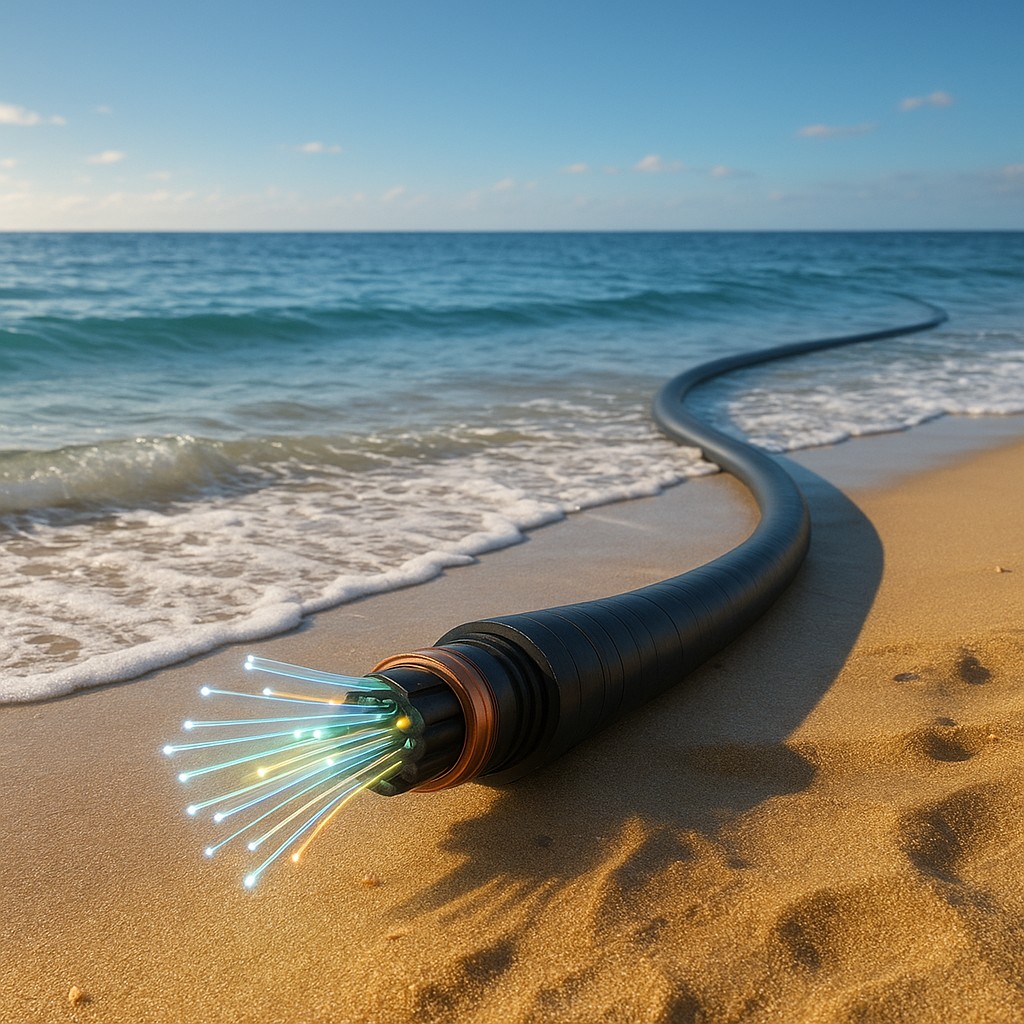
Imagine for a moment that you are standing on a beach, looking out over the vast, shimmering expanse of the Atlantic or Pacific. It looks like a pristine wilderness - perhaps a bit empty and quiet - but beneath those waves lies the most important infrastructure of the modern age. Thousands of miles of fiber-optic cables, some no thicker than a garden hose, snake across the deep-sea plains and through jagged underwater canyons. These lines act as the nervous system of our planet. They carry over 97 percent of all international data, from your latest bank transaction to the video call you had with a friend this morning. Without them, the global economy would essentially vanish in seconds.
Despite their vital role, these cables are surprisingly fragile. They are essentially long strands of glass wrapped in protective layers of copper and plastic. They sit in a dark, high-pressure environment where they are at the mercy of shifting tectonic plates, hungry sharks, and heavy ship anchors. In recent years, a new threat has emerged: intentional sabotage. Nations now realize that cutting a few well-placed lines could cripple an enemy more effectively than a traditional military strike. For a long time, the only way to know a cable was in trouble was to wait until it stopped working, by which point the damage was already done. However, a revolutionary shift in maritime security is turning these silent data highways into the world's largest, most sensitive microphones.
The Invisible Web Keeping the World Online
To understand why we need better security, we first have to appreciate what these cables actually are. Most people assume the internet is beamed through the sky via satellites, but the truth is much more grounded - or rather, submerged. Satellites are great for reaching remote areas, but they lack the bandwidth (data capacity) and low latency (speed of connection) required for the massive data loads of the 21st century. Submarine cables are the undisputed heavy lifters of the digital world. Each cable contains several pairs of hair-thin optical fibers that use light pulses to transmit information at blistering speeds across the sea floor.
The challenge with maintaining this network is its sheer isolation. Once a cable is laid on the ocean floor, it is largely out of sight and out of mind. Maintenance is incredibly expensive and difficult to organize, requiring specialized ships that can take days or weeks to reach a break. Most damage is accidental, caused by fishing boats dragging nets or ships dropping anchors in restricted zones. Yet, as global tensions rise, the vulnerability of these "choke points" has become a major national security concern. If an unauthorized vessel hovers over a sensitive cable, authorities historically had no way to know if they were just fishing or preparing to send down a mini-submarine to cut the line. This lack of awareness is exactly what new "sensing" technology seeks to fix.
Turning Light Into a Listening Device
The breakthrough in this field is a technique called Distributed Acoustic Sensing, or DAS. To understand how it works, think about how light travels through a fiber-optic cable. Normally, engineers want the light to travel from point A to point B with as little interference as possible. However, the glass fibers are not perfect; they contain tiny, microscopic flaws along their entire length. When a laser pulse is sent down the fiber, a tiny fraction of that light hits these flaws and "scatters" back toward the source. This is a phenomenon known as Rayleigh scattering. For decades, it was mostly seen as a nuisance that caused signal loss.
Now, engineers have realized that these reflected light signals are actually a goldmine of information. If something vibrates the cable - like a nearby ship engine or an anchor scraping the seabed - it slightly bends or stretches the glass fiber. These tiny physical changes alter the pattern of the reflected light. By using an extremely precise instrument called an "interrogator" at the shore end of the cable, operators can analyze these changes in real-time. Essentially, the entire cable becomes a continuous string of thousands of virtual microphones. By measuring the "time of flight" of the light pulses, the system can pinpoint exactly where a vibration is happening with incredible accuracy, often within a few meters, even if the event is occurring hundreds of miles offshore.
| Feature |
Standard Fiber Communication |
Distributed Acoustic Sensing (DAS) |
| Primary Purpose |
High-speed data transmission |
Vibration and sound monitoring |
| Active Component |
Laser light pulses carrying data |
Reflected light pulses |
| Detection Method |
Sensors at the receiving end |
Interrogator analyzing light at the source |
| Range |
Across whole oceans |
Up to 100 kilometers per interrogator |
| Interaction |
Passive (light stays inside fiber) |
Active (vibrations change fiber shape) |
Distinguishing the Signal From the Noise
One of the most common questions people ask when they hear about the ocean floor becoming a giant microphone is: "How do you tell the difference between a whale and a spy ship?" The ocean is a noisy place. It is filled with the clicks of dolphins, the low-frequency songs of whales, the cracking of ice, and the constant roar of waves. If the DAS system alerted authorities every time it heard a sound, the coast guard would spend all day chasing shadows. This is where high-level data processing and artificial intelligence come into play.
Every underwater activity has a unique "acoustic signature." A ship's propeller creates a rhythmic bubbling sound that is very different from the slow, grinding noise of a shifting tectonic plate. A heavy anchor being dragged across the sand has a distinct, high-intensity hiss and clatter. AI algorithms are trained to recognize these patterns and filter out the ambient noise of the ocean. The system can even estimate the size, speed, and direction of a vessel just by "listening" to the vibrations it sends through the water and the seafloor. This allows security teams to ignore the natural "music" of the sea and focus specifically on suspicious patterns that suggest a threat to the cable.
Privacy in the Age of Sensing
Whenever we talk about turning communication infrastructure into a "sensor," privacy concerns naturally surface. Is the government listening to our phone calls through the cable itself? It is crucial to explain how DAS actually functions to understand why this is not a concern for personal data. In a fiber-optic cable, the data you send - your emails, videos, and texts - travels as specific coded pulses of light. This data moves inside the core of the fiber at nearly the speed of light. The DAS system, on the other hand, is looking at the physical state of the glass itself.
Think of it like a high-tech hallway. Your data is a person running down the hallway carrying a message. DAS is a sensor that detects the vibration of footsteps on the floor. The sensor knows someone is in the hallway, how heavy they are, and how fast they are running, but it has no way of reading the message the person is carrying. Because DAS monitors physical vibrations rather than the digital stream of information, it is a tool for physical security, not for electronic spying. This distinction is vital for maintaining public trust, as it ensures the "microphone" is listening to the environment around the cable, not the private conversations happening inside it.
The Future of Seafloor Awareness
The implications of this technology go far beyond just stopping saboteurs. By turning the global cable network into a giant sensing array, we are effectively wiring the planet for ocean research on a scale that was previously impossible. Scientists are already looking at using these cables to detect underwater earthquakes and tsunamis much faster than current buoy systems. Because light travels so much faster than seismic waves, a cable-based sensor could provide critical extra minutes of warning for coastal cities before a disaster strikes.
Furthermore, these cables can help us monitor the health of our oceans. They can track the migration patterns of whales, measure changes in water temperature, and even monitor the melting of polar ice caps by listening to the sound of icebergs breaking off. We are moving from a world where the ocean floor was a dark, silent mystery to one where it is a transparent, monitored environment. This "dual-use" nature of fiber sensing, combining national security with environmental protection, makes it one of the most exciting frontiers in modern engineering.
The next time you send a simple text message across the ocean, remember the scale of the system behind it. That tiny pulse of light is not just connecting you to a friend; it is part of a grand, glowing web that is now keeping watch over the deep. The transition from passive cables to active sensors represents a massive leap in human ingenuity, turning a vulnerability into a strength. As we continue to refine our ability to "hear" the world through light, we aren't just protecting our internet; we are gaining a deeper understanding of the silent world that covers most of our planet. The future of the ocean is no longer silent; it is a symphony of data, and we are finally learning how to listen.