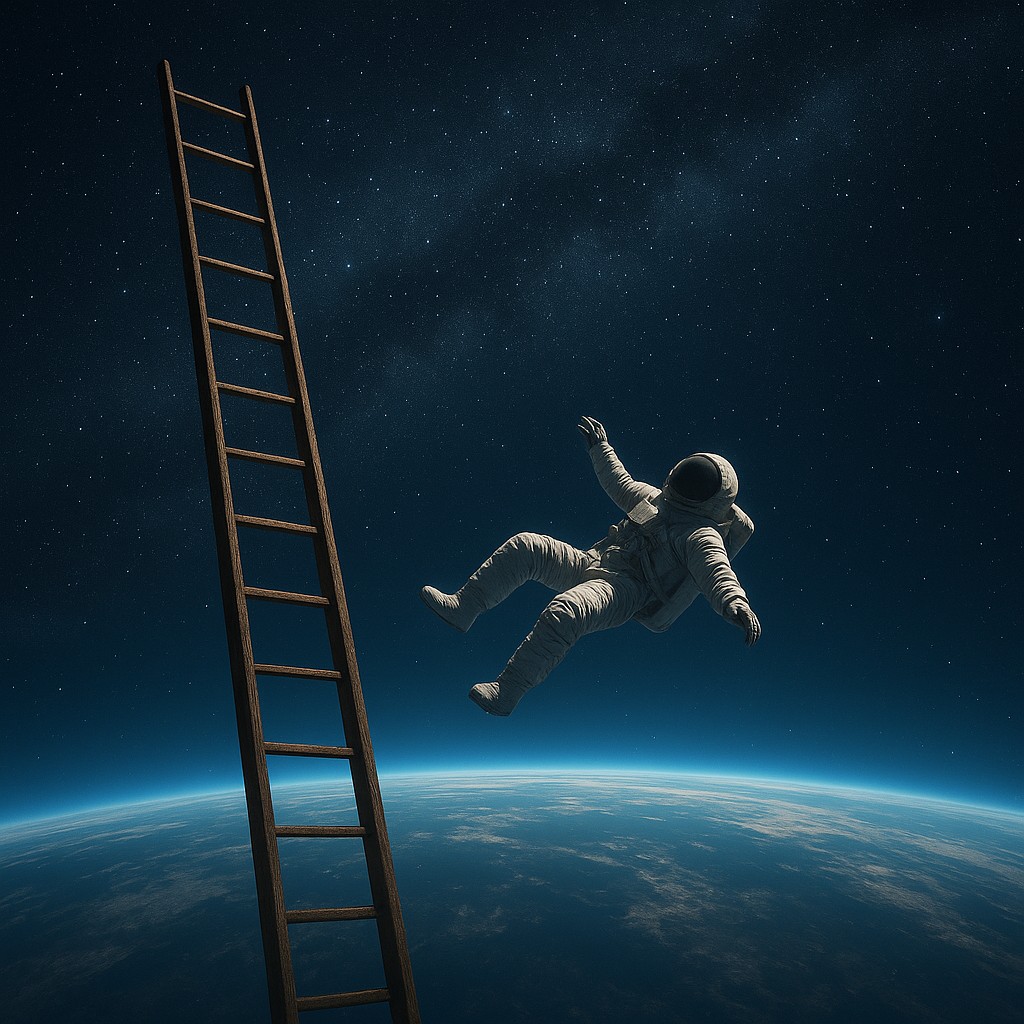
Imagine standing on a ladder that reaches 250 miles into the sky. From this height, the atmosphere looks like a thin, glowing blue ribbon, and the stars shine like steady diamonds in a dark velvet void. Most people assume that at this altitude, the invisible pull of Earth's gravity has snapped, leaving you to drift away into deep space like a balloon released at a party. However, if you stepped off that ladder, you wouldn't float. Instead, you would plummet toward the ground at a terrifying speed, eventually streaking through the air like a human meteorite. Gravity at the height of the International Space Station (ISS) is actually about 90 percent as strong as it is on your living room floor.
This creates a puzzling contradiction. We have all seen videos of astronauts gracefully somersaulting through the air, chasing floating drops of orange juice, or sleeping on the walls. If gravity is still pulling on them with nearly all its strength, why aren't they pinned to the floor like lead weights? The answer is one of the most surprising and beautiful secrets of our universe. They aren't floating because they escaped gravity; they feel "weightless" because they are falling toward Earth at over 17,000 miles per hour, but they keep missing.
The Myth of the Gravity-Free Zone
The most common misunderstanding in science is the idea that space is a vacuum where gravity simply stops. We often use the term "zero gravity," but this is a misleading phrase. Gravity is an ever-present force that controls the movement of every moon, planet, and galaxy. If the sun’s gravity only reached out a few million miles, Earth would have drifted off into the darkness long ago. Similarly, Earth’s gravitational field reaches far past the moon. To truly escape Earth’s pull, you would have to travel millions of miles away, and even then, the sun or another star would immediately take over the tug-of-war.
When we see astronauts on the ISS, they are only about 250 miles up. For perspective, if Earth were the size of a standard classroom globe, the ISS would be orbiting just half an inch from the surface. Gravity at that distance is relentless. It pulls on the station, the astronauts, and their floating spoons with almost the same intensity it exerts on a person walking in New York City. This "weightless" environment, technically called microgravity, has nothing to do with a lack of force; it is entirely about a lack of resistance.
The Great Cosmic Misunderstanding of Weight
To understand an orbit, we first have to rethink what it means to "feel" weight. When you stand on a bathroom scale, the number you see isn't actually measuring gravity pulling you down. Instead, the scale measures how hard the floor has to push back up to stop you from falling toward the center of the planet. Scientists call this the "normal force." If you were in an elevator and the cable suddenly snapped, you and the scale would both accelerate toward the basement at the exact same rate. For those terrifying few seconds, the scale would read zero. You would feel weightless, not because gravity stopped, but because the floor is no longer pushing against your feet.
This is exactly what happens in space. The International Space Station is essentially a giant elevator in a permanent state of free fall. Because the station and everything inside it are falling at the same speed, there is no "floor" to push back against the astronauts. They are falling toward Earth, but since they never hit anything to stop their descent, they feel like they are floating. It is a constant, supervised plunge into the abyss.
The Secret Ingredient: Sideways Speed
If the ISS is constantly falling toward Earth, you might wonder why it hasn't crashed into London or the middle of the Pacific Ocean. This is where the brilliance of orbital mechanics comes in. To stay in orbit, you cannot simply go up; you must go sideways, and you must do it very fast. Imagine throwing a baseball. It travels a short distance and hits the ground because gravity pulls it down. If you throw it harder, it goes further before hitting the dirt.
Now, imagine you have a superhuman arm and can throw a ball at 17,500 miles per hour. As the ball travels forward, gravity pulls it down. However, Earth is not flat; it is a sphere. Because the ball is moving sideways so incredibly fast, the ground actually curves away beneath the ball at the same rate the ball falls toward it. The ball is falling, but the Earth’s surface is constantly "dropping" out from under it. This perfect balance between forward speed and downward pull is what we call an orbit.
| Movement Type |
Forward Speed |
Result |
| Vertical Ascent |
0 mph |
The object falls straight back down to the launch pad. |
| Suborbital Flight |
5,000 mph |
The object travels in an arc and lands elsewhere on Earth. |
| Low Earth Orbit |
17,500 mph |
The object falls toward Earth, but the surface curves away. |
| Escape Velocity |
25,000+ mph |
The object overcomes gravity and leaves Earth entirely. |
Newton's Great Mountain Experiment
Isaac Newton described this using a famous thought experiment involving a giant cannon on top of an impossibly tall mountain. If the cannon fires a ball with just a little gunpowder, the ball follows a curve and hits the Earth. If you add more powder, the ball lands further away. But if you add a massive, specific amount of powder, the ball will travel so fast that it follows the curve of the Earth perfectly, traveling all the way around the planet until it hits the back of the cannon.
This sideways speed is the only thing keeping satellites in the sky. If the International Space Station were to hit the brakes and stop moving forward, it wouldn't drift away into space. It would immediately drop like a stone. Within minutes, it would hit the atmosphere, heat up due to friction, and burn up. Orbit is not a place you go to; it is a speed you maintain. You are essentially "falling around" the planet, caught in a high-tech dance between the urge to fly into the stars and the urge to crash back home.
Life in a Falling Laboratory
Living in a state of constant free fall does strange things to the human body and the laws of physics. In our everyday lives, we rely on gravity to move fluids. Heat rises because hot air is less dense than cold air, and gravity pulls the heavier cold air down, pushing the hot air up. This process is called convection. In the free fall of orbit, there are no "up" or "down" differences in density. A candle flame on Earth is teardrop-shaped because the hot gases rise. In orbit, a flame is a perfect, ghostly blue sphere because the hot gases expand in all directions equally.
The human body also reacts to the lack of a "pushing back" force. Without the ground to provide resistance, our bones lose calcium and our muscles begin to shrink. On Earth, every step you take is a fight against gravity. In orbit, your heart doesn't have to pump blood "up" to your brain, which sounds like a luxury until the body realizes it doesn't need as much blood. Astronauts have to exercise for hours every day on special treadmills with bungee cords just to trick their bodies into thinking they still have weight.
The Fragile Balance of Atmospheric Drag
While it seems like space is a vacuum, the Low Earth Orbit (LEO) environment where most satellites live is actually a bit crowded. There are still thin wisps of the upper atmosphere reaching out hundreds of miles. These tiny air molecules act like a microscopic headwind, hitting the ISS and slightly slowing it down. This is known as atmospheric drag. As the station slows down by even a tiny amount, gravity begins to win the tug-of-war, and the station's altitude starts to drop.
To prevent the station from eventually spiraling into the atmosphere, it must be "re-boosted" every so often. Spacecraft docked at the station fire their engines to give the ISS a little push, increasing its sideways speed back to that vital 17,500 mph mark. This restores the balance, pushing the station back into its proper falling path. It is a reminder that being in orbit is an active process, not a static state. You are never truly "parked" in space; you are always maintaining a delicate, high-speed balance.
Why We Don't Float Away
A common question is: "If someone let go of the space station during a spacewalk, would they float away into deep space?" The answer is no. Because the astronaut is already moving at 17,500 mph sideways just like the station, they would simply stay right next to it. They are both falling at the same rate and moving forward at the same speed. Without a rocket pack to change their velocity, they would continue to fall around the planet together, like two skydivers holding hands in mid-air.
This reality makes space travel both predictable and intense. Navigating in orbit isn't like driving a car where you turn a steering wheel to go left or right. It is more like a cosmic game of pool. To go to a higher orbit, you have to speed up, which pushes your "falling path" further out. To return to Earth, you don't steer "down"; you simply slow your sideways speed until gravity can pull you deep enough into the atmosphere for the air to grab hold and help you land.
Seeing the Universe in Free Fall
Realizing that an orbit is a state of constant falling changes how we look at the night sky. When you see a satellite streaking overhead, it isn't defying gravity; it is following it perfectly. It is a testament to the fact that we have learned to use the laws of physics as a playground, turning a downward plunge into a circular journey of discovery. This "falling around the world" is what allows us to monitor our climate, connect the globe, and look back into the deepest history of the universe through space telescopes.
Understanding this reveals the true nature of our world. We are not stuck on a static rock; we are all moving at incredible speeds through a landscape of invisible forces. The next time you see an astronaut "floating," remember they are actually experiencing one of the most intense physical events possible. They are falling toward a planet at thousands of miles per hour, held in place only by their incredible speed. It is a reminder that sometimes, the only way to fly is to stop fighting the fall and simply embrace the curve of the horizon.