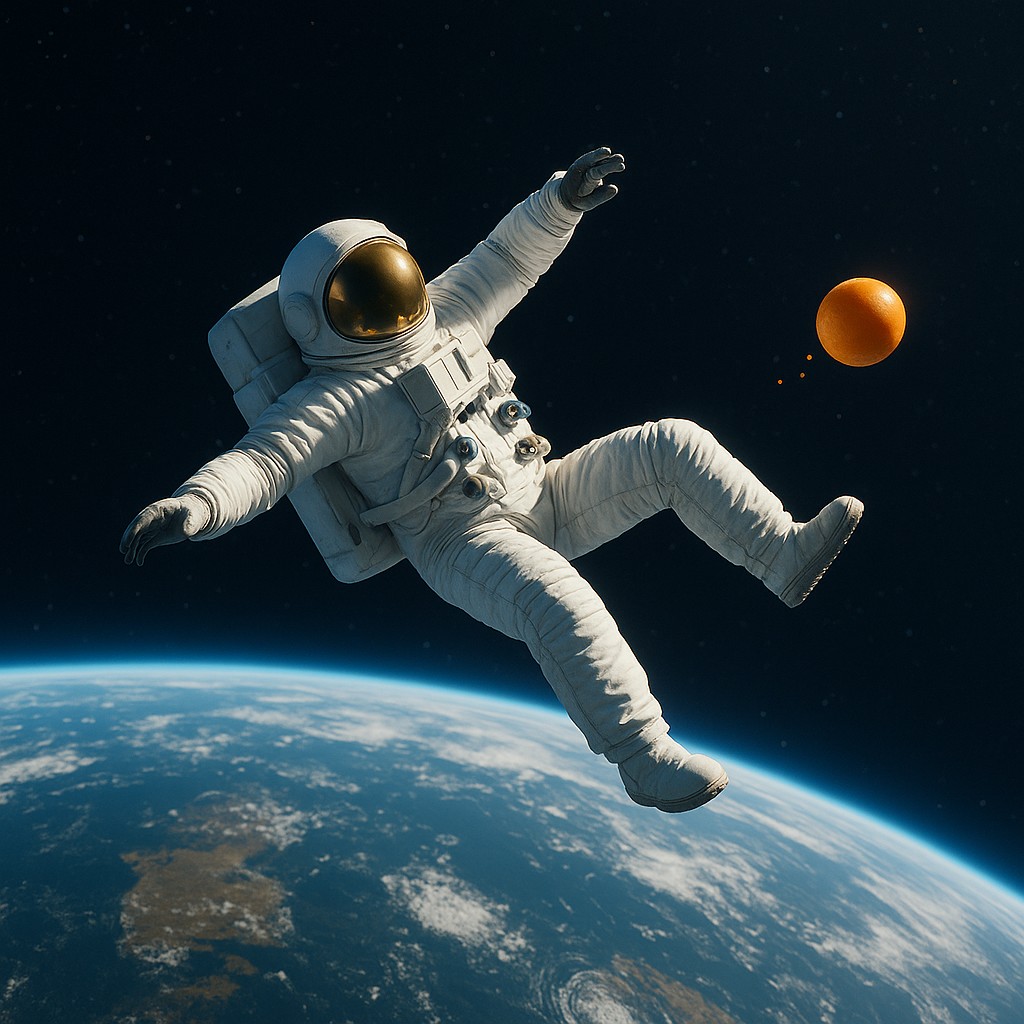
If you have ever watched a video of astronauts aboard the International Space Station, you have likely seen them gracefully somersaulting through the air or chasing floating blobs of orange juice. It is one of the most iconic images of the space age, and it almost always leads us to the same conclusion: gravity must not exist up there. Movies and casual conversation have conditioned us to call this "zero gravity," as if crossing some invisible line 250 miles above the Earth flips a switch that turns off a fundamental force of the universe. It is a beautiful, serene image, but it is also a complete myth.
In reality, Earth’s gravitational pull at the station's altitude is about 90 percent as strong as it is here on the ground. If you could build a ladder that tall and stand on the top rung, you would not float away into the abyss. You would weigh slightly less, but you would still be very much stuck to the ladder. If you stepped off, you would plummet toward the ground like a stone, eventually meeting a messy end. The mystery, then, is not why gravity has disappeared, but why the astronauts are not hitting the ground even though they are firmly within Earth’s grasp. The answer lies in a high-speed dance across the sky that redefines what it means to fall.
The Great Scale Delusion
To understand why astronauts float, we first have to understand what weight actually feels like. When you stand on a bathroom scale, the number you see is not a direct measurement of gravity’s pull on your body. Instead, it measures the scale pushing back against your feet. Because the floor is solid, it prevents you from falling toward the center of the Earth. This resistance produces what physicists call a "normal force," and that is what you feel as your weight. If the floor suddenly vanished, the scale would drop at the same rate as your feet. The reading would hit zero and you would feel instantly weightless, even though gravity would still be pulling on you with all its strength.
This state is called "free fall," and it is the secret to everything an astronaut experiences. Imagine you are in an elevator at the top of a skyscraper and the cable snaps. As the car plummets, you and the floor are falling at the exact same speed. If you let go of your keys, they will appear to hover in front of your face. You could do a backflip and stay suspended in the middle of the car. You haven’t escaped gravity; you have simply removed the object that was pushing back against you. Because everything in the system is falling together, there is no movement between you and your surroundings.
This is exactly what happens in orbit. The International Space Station is essentially a giant elevator with a snapped cable, perpetually dropping toward the center of the Earth. The reason it never actually hits the ground is not because of a lack of gravity, but because of a massive amount of sideways momentum. The passengers are not floating because they are outside of Earth's influence, but because they are trapped in a room that is falling just as fast as they are.
Newton’s Cannon and the Geometry of the Curve
In the 1680s, Isaac Newton came up with a thought experiment that remains the best way to visualize how an object stays in space. Imagine a massive cannon perched on top of a mountain so tall it pokes out of the atmosphere. If you fire a cannonball horizontally, gravity pulls it down, and it hits the ground some distance away. If you add more gunpowder and fire it faster, it travels further before landing. But there is a catch: the Earth is not flat. It is a sphere. As the cannonball travels further, the surface of the Earth begins to curve away from it.
Now, imagine you fire that cannonball with such incredible speed that the rate at which it falls exactly matches the rate at which the Earth curves. As the ball drops one foot toward the ground, the ground curves one foot away from it. The ball is "falling" the entire time, but it can never get any closer to the surface. It is now in a closed loop. It is falling around the Earth. This is precisely what an orbit is. It is not being "beyond" the Earth, but a state of moving sideways so fast that you constantly miss the planet.
To pull off this trick at the altitude of the space station, you need to move at a staggering 17,500 miles per hour. At that speed, you can circle the entire planet in about 90 minutes. If the International Space Station were to slow down even slightly, its path would become a sharper curve that eventually hits the atmosphere. If it goes too fast, the curve flattens out and it flies off into deep space. Living in orbit is less like floating in a pool and more like driving a car at 25 times the speed of sound along the edge of a cliff that never ends.
Weight Versus Mass in a Weightless World
Because we use the words "weight" and "mass" interchangeably in daily life, weightlessness creates some confusing physics puzzles. Mass is the amount of "stuff" you are made of, and it never changes. Weight is the force gravity exerts on that mass. In orbit, your mass stays the same, but your "apparent weight" is zero. This leads to strange mechanical issues that engineers must plan for when building things for space.
For example, if you tried to weigh a bag of coffee on a spring scale in the space station, it would read zero. However, if you tried to push that bag of coffee, you would still feel it resist you. It still has inertia - the tendency of an object to stay still or keep moving. If you tried to push a massive satellite, you would find it just as difficult to move as it would be on Earth, even though it appears to be weightless. The table below clarifies the differences between physics on the ground and in a perpetual fall.
| Concept |
On Earth's Surface |
In Earth's Orbit (Free Fall) |
| Gravity's Pull |
100% Strength |
~90% Strength |
| Ground Resistance |
Provided by the floor |
None (Everything falls together) |
| Apparent Weight |
Measured by a scale |
Zero (The scale falls with you) |
| Inertia |
Objects resist change in motion |
Objects still resist change in motion |
| Motion |
Requires constant force to fight friction |
Requires force only to change direction or speed |
| Fluid Behavior |
Settles at the bottom of a container |
Forms spheres due to surface tension |
The Biological Toll of Falling Forever
While falling forever sounds like a fun ride, the human body is not a fan. Our biology evolved in a consistent "one-G" environment where the heart knows it has to pump blood "up" against gravity to reach the brain. Once you enter a state of continuous free fall, that internal map of up and down vanishes. Without gravity pulling fluids toward your legs, your blood and other fluids move toward your head. This results in what astronauts call "puffy face bird leg syndrome," where their faces look swollen and their legs look skinny.
More importantly, our bodies are incredibly efficient at getting rid of resources they think they no longer need. On Earth, every time you walk, stand, or even sit up, your bones and muscles work against gravity to support your weight. In orbit, that physical stress disappears. The body interprets this as a signal that it no longer needs to maintain heavy bones or powerful muscles. Without a rigorous two-hour daily exercise routine using specialized vacuum machines for resistance, an astronaut’s bones would become brittle and their muscles would wither away.
Interestingly, this environment also messes with the inner ear's balance mechanism. On Earth, tiny crystals in your ear settle in response to gravity, telling your brain which way is down. In free fall, those crystals just float around. This usually leads to "Space Adaptation Syndrome," a polite term for being incredibly nauseous for the first few days of a mission. Your brain receives signals that you are falling, but your eyes see a stable room, and your inner ear screams in confusion. Eventually, the brain learns to ignore the ear and rely entirely on sight, proving just how well humans can adapt to a state of constant plummeting.
Microgravity and the Science of the Small
Scientists often prefer the term "microgravity" over "zero gravity." This is because a real-world spacecraft is never perfectly weightless. Small factors like the drag of the thin upper atmosphere, the movements of the crew, and the firing of tiny thrusters create minuscule amounts of acceleration. However, even this "almost zero" environment allows for experiments that are impossible on the ground. When you remove the overwhelming force of gravity, subtle forces like surface tension and the way molecules spread out suddenly become the stars of the show.
On Earth, if you heat a pot of water, the hot water rises and the cool water sinks because of their weight differences. This is called convection. In orbit, there is no "up" for the hot water to go. This makes fire behave very strangely; instead of a flickering, teardrop-shaped flame, a candle in space burns as a perfect, dim blue sphere. Because the hot gases don't rise, the flame can only get oxygen slowly, resulting in a much cooler and more controlled fire. This allows researchers to study the chemistry of fire in ways that could lead to cleaner engines and better fire safety here on the ground.
Similarly, microgravity allows for the growth of large, high-quality protein crystals. On Earth, gravity causes crystals to settle and warp as they grow. In the free fall of the space station, they can grow perfectly in all directions. These perfect crystals are invaluable for drug companies trying to map the structure of diseases and design new medicines. We aren't just going into orbit to play with floating water; we are going there to escape the "noise" of gravity so we can see how the universe works at its most basic level.
The Mental Shift of Orbital Mechanics
Understanding that orbit is a fall rather than a float changes how we view our place in the universe. It replaces a magical view of space with a logical, physical one. We are not leaving Earth’s influence when we go into orbit; we are simply entering a very fast, very specific relationship with its mass. It is a testament to human ingenuity that we have figured out how to throw ourselves at the horizon so accurately that we never hit the dirt.
This realization also brings a sense of fragility to space travel. Every satellite, every telescope, and every human being in orbit is balanced on a knife's edge between speed and gravity. They are staying aloft through sheer velocity. If you ever see a steady point of light racing across the stars at night, remember that it isn't "up there" in some void where Earth's rules don't apply. It is falling, just like a ball tossed in a park, but it is moving with such purpose and power that the Earth simply cannot catch it.