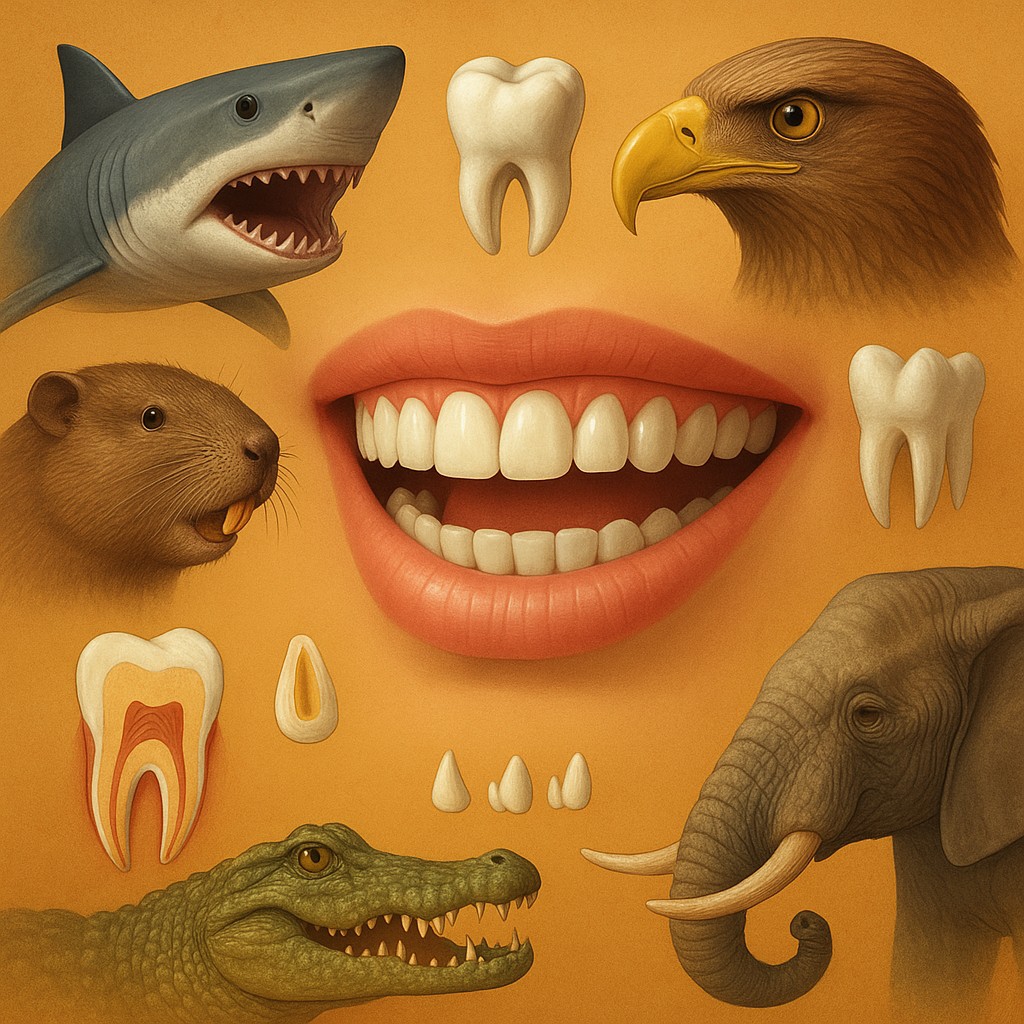
You probably already know two of the strangest dental facts in nature: sharks constantly replace their teeth, and humans get exactly two sets, as if we were issued a single spare. That contrast hints at a bigger truth: teeth are less a single invention and more a toolbox of solutions for the same problem - how to grab, slice, crush, grind, or filter food without turning your mouth into a full-time repair shop.
Across the animal kingdom, teeth are not just little white rectangles. They can be replaced, reshaped, pushed forward like a factory line, or even appear where you would not expect. Some animals have no teeth at all but solve the same problem with beaks, plates, or muscular stomachs. If you see teeth as tools, evolution looks like a workshop where each species got a custom set and a warranty that ranges from "lifetime replacements" to "good luck."
Teeth, but make it evolutionary: what counts as a tooth?
When people say "teeth," they usually mean the enamel-covered structures inside a mammal's mouth. Biologists use the term more broadly: any hard structure used for feeding, often built from enamel, dentin, and other mineralized tissues. The materials and shapes vary, but the goal is the same: handle food efficiently, because chewing badly is a fast track to not getting enough energy.
Here is a twist: teeth evolved more than once, and tooth-like structures can pop up in surprising places. True teeth typically have a dentin core and anchor into the jaw. Spikes on a tongue or in a throat may look like teeth but are often made of keratin, the same stuff as fingernails, so they act more like built-in sandpaper than real teeth.
A common mistake is to think teeth are only for chewing. Many animals use teeth for gripping prey, fighting rivals, carrying young, digging, opening shells, or just looking threatening. Nature likes multitasking, and teeth are the original multiuse tool.
The grand menu of tooth replacement strategies
Humans are "diphyodont," meaning we get two sets of teeth: baby teeth and adult teeth. That is not the norm across animals, and it is not because evolution forgot to give most species more sets. Tooth replacement balances energy cost, durability, feeding style, and risk.
Some animals replace teeth continuously, some in waves, some never, and some replace only certain teeth. The technical term for frequent replacement is "polyphyodont," and sharks are the classic example. Many other species use similar approaches, just with different timing and mechanics.
Think of teeth like shoes. If you live on sharp rocks you either buy extremely durable shoes, which are expensive, or you buy cheap shoes and replace them all the time, which is expensive in another way. Evolution settles on what keeps you alive, not what would impress a dentist.
Humans and other mammals: two sets, high quality, high commitment
Most mammals get two sets of teeth and often have different shapes for different jobs: incisors for cutting, canines for piercing, premolars and molars for crushing and grinding. This "heterodont" dentition supports varied diets. Because mammals chew precisely and need a stable bite, teeth that stay put and fit together are valuable.
That precision costs energy. You do not want molars falling out and being replaced every few weeks, because your bite would never line up. Mammals invest in thick enamel, deep roots, and complex tooth shapes, then make them last.
There are exceptions. Rodents and rabbits have incisors that grow continuously, because gnawing wears them down like pencils. Their teeth are "open-rooted," which means they keep growing from the base. Without constant chewing, those teeth overgrow and cause serious problems, which is why a rabbit's chew toys are dental health tools, not decorations.
Reptiles and many fish: replacements are normal
Many reptiles replace teeth throughout life. Crocodilians can swap out each tooth many times, handy when your job involves grabbing thrashing animals or occasionally chewing on a log. Their teeth are simple cones made for gripping and puncturing, and regular replacement keeps them sharp.
Many bony fish also replace teeth, sometimes in different parts of the mouth or even in the throat. Yes, in the throat. Some species have pharyngeal teeth deeper in the throat to grind and crush food after swallowing. They do not have hands, so this is how they compensate.
Sharks and rays: the tooth conveyor belt, explained clearly
Shark teeth are not deeply rooted like ours. They sit in tissue and come in rows. As front teeth break or wear down, new teeth roll forward from behind, like a moving walkway at an airport, except this walkway is designed for slicing and tearing.
Different sharks have different tooth shapes depending on diet. Great whites have serrated blades for slicing, while some sharks have flatter teeth for crushing shells. Continuous tooth replacement is not identical across species, but the main idea is consistent: sharks treat teeth as replaceable blades, not family heirlooms.
Teeth that never stop growing, teeth that move forward, and teeth that migrate
Replacement is not the only way to handle wear. Some animals keep growing teeth to match constant grinding or gnawing. Others have teeth that slowly migrate through the jaw as they wear, like a slow-motion escalator.
Elephants are famous for molar progression. They do not replace all their teeth repeatedly, but their huge molars move forward in the jaw over time. New grinding surfaces emerge as old ones wear away. An elephant usually cycles through a limited number of these molars in a lifetime, and when the last set wears out, feeding becomes hard. In the wild that can be a natural limit on lifespan.
Manatees use a similar strategy, with molars that continuously replace and move forward, which helps when your diet is full of abrasive plants. Think of it as a slow, steady dental treadmill.
Some animals have teeth that grow without stopping but need wear to keep them properly shaped. Rodents are the classic case. Tusks are another form of continually growing teeth. Elephant tusks are enlarged incisors, and walrus tusks are enlarged canines. Animals use them for digging, fighting, hauling onto ice, or showing off.
When "teeth" are not in the mouth where you expect
Nature sometimes puts tooth-like structures in places that make you ask, "Is that allowed?"
Tongue teeth and throat teeth: the hidden grinders
Many animals have structures that act like teeth but are not true teeth. Cats have backward-facing, keratin spines on their tongues that help scrape meat from bones and groom fur. That is why a cat's lick can feel rough, like tiny, affectionate Velcro.
Some fish have pharyngeal teeth in the throat. Cichlids, carp, and others use them to crush snails, grind plants, or process tough food. It is a second set of jaws in spirit, if not in structure, and means swallowing is not the last step of food processing.
Sea urchins: the mouth that carves rock
Sea urchins are not vertebrates, so their teeth do not follow the shark-to-human pattern. They have a complex chewing device called "Aristotle's lantern," made of five tooth-like parts. Urchins use it to scrape algae and even carve into rock. If you needed proof that "teeth" can be a complete mechanical system, sea urchins provide it while quietly reshaping the seafloor.
Birds: no teeth, no problem
Birds do not have teeth, but they do not need them. They use beaks to grab and handle food, then a gizzard, a muscular stomach, to grind it—often with swallowed stones. It is an internal mill. You could call it outsourcing chewing, except the contractor is a living organ.
Birds are toothless not because teeth are better or worse, but because beaks plus gizzards can be lighter and still effective, which helps with flight. Evolution picks what works well enough to leave descendants.
A quick tour of dental extremes, from cute to terrifying
Teeth get especially interesting when you look at how diets shape them. Predators need gripping and slicing tools, plant-eaters need grinding surfaces, and shell-eaters need crushing plates. Here are a few striking examples.
Big cats have sharp carnassials that act like shears for slicing meat. They do not chew like humans; they cut, swallow, and let digestion finish the job. That is why their molars look more like blades than grinders.
Herbivores like horses have high-crowned teeth built to survive constant grinding of tough, gritty plants. Grass contains silica and often carries soil, so grazing is like eating sandpaper salads. Many grazers have teeth that erupt gradually as they wear, offering fresh grinding surfaces over time.
Snakes use teeth for holding prey, not chewing. Many have backward-curving teeth that stop prey from slipping away. Venomous snakes have specialized fangs to deliver venom, which can be fixed or hinged. Here "tooth" often means "delivery system," not a chewing tool.
The narwhal's "horn" is actually a tooth, usually a single elongated canine that grows through the upper lip. It has sensory abilities and may play a role in social behavior. It shows how a tooth can evolve into something that looks like a completely different body part.
Comparing tooth strategies across animals (table of highlights)
| Animal group |
How teeth are replaced or maintained |
What the teeth are mainly for |
Cool fact you can repeat at dinner |
| Humans and many mammals |
Two sets, then done |
Chewing with a precise tooth-to-tooth fit |
Adult teeth are built to last decades, not weeks |
| Sharks |
Continuous replacement in rows |
Gripping, cutting, tearing |
A shark can go through thousands of teeth in a lifetime |
| Crocodilians |
Frequent replacement per tooth |
Holding prey, puncturing |
New teeth develop under old ones like backups in storage |
| Rodents and rabbits |
Continuous growth of incisors |
Gnawing |
No gnawing means dangerous overgrowth |
| Elephants |
Molars move forward in sequence |
Grinding tough plants |
Tooth wear can limit lifespan in the wild |
| Birds |
No teeth, gizzard grinding |
Processing food without chewing |
Some birds swallow stones to help "chew" internally |
The secret materials: enamel, dentin, and why tooth design is such a big deal
A tooth is not a single block. In many vertebrates the outer layer is enamel, the hardest substance the body makes. Under that is dentin, which is less hard but tougher and more flexible, like a shock absorber. Inside is the pulp, living tissue with nerves and blood vessels, which is why cavities are not just holes but invasions into a sensitive area.
Different animals adjust these materials and shapes to match their lifestyle. Enamel thickness, tooth height, root structure, and bite force all interact. If you ever wondered why you cannot combine a shark's replacement system with a human's precise bite, this is why: engineering involves trade-offs. A conveyor belt of teeth is great for replacing broken blades, but it is not ideal for delicate, interlocking chewing surfaces.
Another misconception is that tougher teeth are always better. Very hard teeth can be brittle. Teeth need to resist wear but also avoid shattering. Many designs strike a balance between hardness and toughness, like choosing between a ceramic plate that resists scratches but cracks if dropped, and a plastic plate that survives falls but gets scuffed.
Teeth as tools for living, not just eating
Teeth do more than get food into bodies; they shape social life and survival.
Tusks in elephants and walruses serve for fights, dominance displays, digging, and moving objects. In some species, larger tusks signal health or age, which matters for mating and rank. Tooth growth can therefore affect social dynamics as much as diet.
In many primates, big canines link to display and competition. In some animals biting is a weapon, but often the point is to signal, not necessarily to injure. Teeth can be a warning that says, "We can skip the fight and you will back down."
Even outside vertebrates, tooth-like structures serve defense and feeding. If you can grow a hard, pointy thing, nature will probably find a use for it.
How to spot tooth logic in the wild (and in documentaries)
If you want to read an animal by its teeth, ask a few simple questions. Teeth become detective clues and nature documentaries get more fun.
- Does the animal slice, grind, or crush? Slicers have blades, grinders have broad surfaces, crushers have thick rounded teeth.
- Does it need precision or replaceability? Precise chewing usually means fewer replacements. High-risk biting usually means frequent replacement or continuous growth.
- Is its food abrasive? Grass, gritty plants, and hard shells demand special wear management.
- Does it use teeth for fighting or tools? Tusks and oversized canines often tell a social story, not just a dietary one.
Once you notice these patterns, teeth stop seeming random and start looking like readable design choices. From a skull you can make good guesses about diet and lifestyle.
The delightful takeaway: your teeth are a compromise, and that is kind of impressive
It is easy to envy sharks for their endless tooth supply, rodents for self-renewing incisors, or elephants for giant grinders. But the human dental setup is a specific solution: a durable, precisely aligned set of tools that handles an omnivorous diet, supports speech, and fits into a face that also needs to breathe, smile, and not scare people at the grocery store.
The animal kingdom shows there is no single best tooth system, only systems that match a life. Teeth are evolutionary stories, mineralized biographies about what an animal eats, how it survives, and what it faces every day. Keep that in mind and every jaw becomes a puzzle you can solve.
So the next time you see a shark tooth necklace, a beaver gnawing a tree, or a bird swallowing something that looks like gravel, pause and admire the cleverness. Nature built a whole world of dental strategies, and now you can read smiles, grimaces, and terrifying open mouths with a smarter eye.