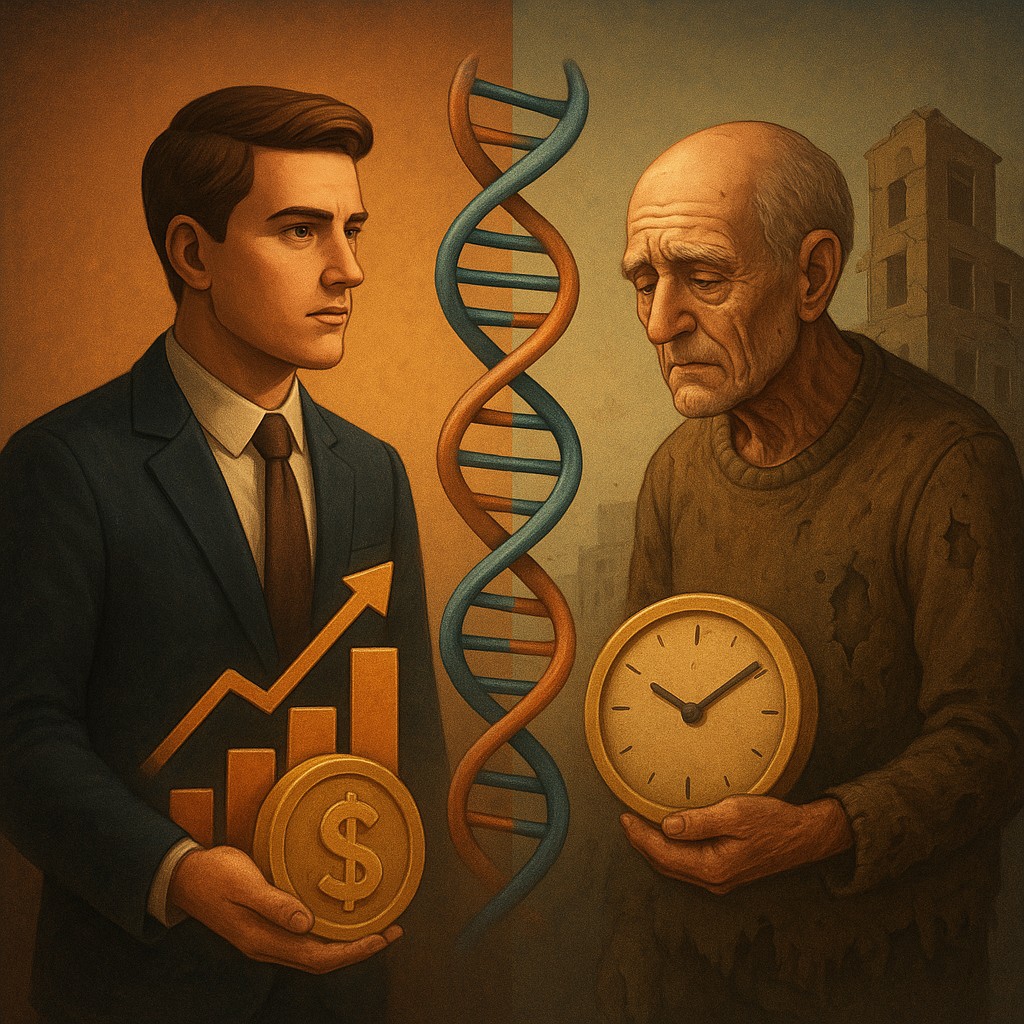
Imagine for a moment that you are the CEO of a fast-growing startup with a tight budget. You face a tough choice: you can spend your remaining cash on a brilliant marketing campaign that guarantees your product goes viral tomorrow, or you can invest that money in a high-end retirement fund for your employees that pays out in fifty years.
If you choose the retirement fund, your company might go bankrupt next month because nobody knows your product exists. If you choose the marketing campaign, you survive, thrive, and become an industry leader - even if your office building starts crumbling decades later because you skipped the long-term maintenance. Natural selection, the engine of evolution, makes this exact executive decision every single day within our DNA.
This biological strategy isn't a mistake or a glitch; it is a calculated gamble that has allowed life to persist for billions of years. We often think of aging as simple wear and tear, like a car getting rusty or a pair of jeans fraying at the knees. However, modern biology tells a more complex story. Our bodies aren't just wearing out; in many ways, they are being sabotaged by the very genes that made us strong and vibrant when we were young. This concept, known as Antagonistic Pleiotropy, suggests that the high price we pay in our later years is the bill coming due for the incredible advantages we enjoyed in our youth.
The Evolutionary Blind Spot
To understand why our bodies seem to have an expiration date, we first have to understand the priorities of natural selection. Evolution is not a master engineer trying to build a machine that lasts forever. Instead, it is a ruthless competition focused entirely on one thing: reproductive success. If a gene helps an organism live long enough to have children and protect them until they can survive on their own, that gene is a winner. It gets passed down to the next generation. However, once an organism moves past its reproductive prime, the pressure of natural selection begins to fade.
Imagine a tribe of early humans. A gene that gives a twenty-year-old superhuman speed to outrun a lion is incredibly valuable. Even if that same gene causes severe arthritis at age seventy, it doesn't matter much to evolution. By the time that person is seventy, they have already passed that "speedy" gene to their children and grandchildren. The lion didn't catch them when they were young, so the gene successfully moved forward in time. This is the evolutionary blind spot: natural selection is blind to the problems of old age because those problems don't prevent the gene from being inherited.
Because of this, our genome is littered with traits that are helpful early in life but harmful later on. If a mutation offers a 10 percent increase in fertility at age twenty but causes a 50 percent increase in heart disease at age eighty, evolution will choose that mutation every single time. Survival in the "now" is infinitely more important to the species than comfort in the "later." This creates a biological trade-off where the immediate benefit outweighs the long-term cost.
One Gene with Many Faces
The term "pleiotropy" comes from the Greek words pleion, meaning "more," and tropos, meaning "way." In genetics, it refers to a single gene that influences several unrelated physical traits. When we add the word "antagonistic," we are describing a situation where a gene has a positive effect on one trait and a negative effect on another. In the context of aging, this means one gene provides a benefit in youth while simultaneously laying the groundwork for damage later.
This isn't just a theory; we can see it in action throughout the body. For instance, consider how our bodies manage calcium. When we are young, we need to build a strong skeleton quickly to support our weight and protect our organs. Genes that promote fast, efficient bone calcification (the hardening of bone) are vital for surviving childhood. However, those genetic pathways don't just turn off once our bones stop growing. As we age, these same mechanisms can lead to the calcification of our arteries, making them stiff and increasing the risk of heart disease. The very process that gave you a sturdy frame at eighteen is the same one that might harden your heart at eighty.
Another example involves our immune system. In our youth, we need a hyper-responsive immune system to fight off infections. A gene that causes a powerful inflammatory response is a lifesaver when you step on a rusty nail or encounter a virus. But inflammation is a double-edged sword. In old age, that same tendency toward high inflammation becomes "inflammaging." This chronic, low-grade inflammation contributes to everything from Alzheimer's disease to diabetes. The protective fire of your youth becomes the slow burn that damages your tissues in your senior years.
The High Cost of Cancer Prevention
Perhaps the most famous example of this trade-off involves a protein called p53, often called the "Guardian of the Genome." This protein is a hero in our younger years. Its primary job is to monitor our cells for DNA damage. If a cell starts to become cancerous, p53 steps in and either pauses the cell's growth so it can be repaired or triggers a cellular suicide, called apoptosis, to prevent the cancer from spreading. Without p53, most of us would develop terminal cancer before our teens. It is an essential safeguard.
However, the Guardian has a dark side that emerges as we age. Because p53 is so good at stopping cells from dividing to prevent cancer, it also eventually stops our healthy stem cells from dividing. As we get older, our tissues need to be repaired and replaced. But if p53 is too active, it prevents those repair cells from doing their job. It perceives minor, age-related DNA damage as a potential cancer risk and shuts the process down. The result is that our skin thins, our muscles waste away, and our organs lose their ability to heal.
In this scenario, we see a perfect biological trade-off. We have a gene that prevents us from dying of cancer when we are young, which is a massive evolutionary win. But the cost is a gradual loss of the ability to maintain our bodies as we get older. We are essentially trading the risk of a quick death from a childhood tumor for the certainty of a slow decline in old age. It is a grim bargain, but from the perspective of a species trying to survive, it is an incredibly effective one.
| Biological Function |
Early-Life Benefit (The Pros) |
Late-Life Cost (The Cons) |
| Bone Calcification |
Rapid growth and strong bones for mobility. |
Hardened arteries, leading to heart disease. |
| Immune Response |
Fast healing and protection against infections. |
Chronic inflammation ("Inflammaging") damaging tissues. |
| Cell Cycle Control (p53) |
Prevents early cancer by stopping damaged cells. |
Exhausted stem cells, leading to poor repair and frailty. |
| Sex Hormone Production |
Boosts fertility and physical strength. |
Increases risk of certain cancers later in life. |
| Iron Metabolism |
Essential for energy and blood oxygen. |
Iron buildup in organs, causing cell damage. |
Why Evolution Never Fixed the Glitch
It is tempting to wonder why evolution hasn't found a way around this problem. In a world of infinite resources, you might imagine a gene that acts perfectly when you are twenty and then switches to a sustainable mode when you are sixty. But evolution doesn't work toward perfection; it works toward "good enough." Because very few animals in the wild actually survive to old age due to predators, famine, and accidents, genes that protect the young have a much bigger impact than genes that protect the elderly.
If you are a wild rabbit, your chances of being caught by a fox are very high. If you have a gene that makes you 5 percent more fertile but kills you of "rabbit Alzheimer's" at age ten, that gene will spread through the population quickly. Why? Because almost no rabbit lives to be ten years old anyway. The cost of the gene is never paid in the wild, but the benefit is harvested immediately. When we humans moved into our modern, safe world, we started living long enough to actually pay the bills our ancestors signed for us.
This realization changes how we view "bad" genes. Many of the genes linked to late-life diseases aren't accidents or errors. They are highly optimized tools designed for a world where living to age eighty was an impossible dream. We aren't dying because our bodies are breaking down randomly; we are dying because our bodies are following a plan that was never designed for the long haul. We are living in the "extended warranty" period of the human experience, and our genes are simply following the original, short-term contract.
Rethinking Medicine Through Trade-offs
Understanding these trade-offs has profound implications for modern medicine. Currently, our medical system treats age-related diseases - like heart disease, arthritis, and dementia - as isolated problems that can be cured individually. However, if these diseases are the direct result of biological trade-offs, curing them might be much more complicated than we thought.
If we try to turn off the genes that cause artery hardening, will we accidentally weaken the bones of young people? If we dampen the inflammation that causes "inflammaging," will we leave ourselves vulnerable to new pandemics? This framework teaches us that in the body, you can rarely change one thing without affecting something else. We must look for low-cost interventions that can reduce late-life damage without sacrificing the early-life benefits that keep us healthy and resilient.
One exciting path is the study of "senolytics" - drugs that target and remove old, "senescent" cells that have stopped dividing but refuse to die. These cells often pump out inflammatory signals. By clearing these cells out once they've already done their job, we might be able to enjoy the benefits of strong early-life growth without suffering the full consequences later. We are, in effect, trying to negotiate a better deal with our own biology, looking for ways to keep the marketing budget of our youth while still saving for retirement.
The Poetry of the Biological Bargain
There is a bittersweet beauty in this reality. It suggests that our vitality, our strength, and our ability to bring new life into the world are linked to our eventual decline. We are not broken beings; we are optimized beings. The same genetic instructions that allowed you to run through the grass as a child, to heal a scraped knee, and to grow into an adult are the ones that eventually lead to the quiet fading of your later years. It is one continuous story of life, rather than a story of health followed by a story of failure.
This perspective should inspire gratitude for the biological loans we've been granted. Every day of health and energy you enjoy is powered by a genetic system that prioritized your survival above all else. While science continues to look for ways to soften the blow of aging, we can find peace in knowing that our bodies have been remarkably well-designed for the most important task of all: the continuation of life. You are a masterpiece of engineering, built to burn brightly while the sun is high, even if the stars eventually call for a rest.