Why the idea of manifesting everything you want feels both thrilling and vague
Imagine waking up and finding that your career, relationships, health, and bank balance all fit together like a perfectly designed puzzle. The word manifest makes that possibility sound effortless, as if you can think a thought and the universe will rearrange itself for you. That image is thrilling because it promises control, meaning, and less struggle. It is also vague because minds and worlds are complicated, and "manifesting" has been sold as everything from gratitude journals to overnight riches.
The good news is that you can learn to reliably produce outcomes you care about, and that the best way to do it borrows from psychology, planning, habit design, and meaningful action. This practice is not mystical puppetry. It is more like learning to be a skilled gardener - you choose seeds, prepare the soil, create the right microclimate, and tend patiently. In the following pages you will discover a practical, evidence-informed system for turning desires into reality, while keeping the wonder that makes manifesting fun.
We will move from clear definitions to practical tools, from myths to science, and from small wins to systems that scale. Along the way you will get exercises, reflection questions, and an easy-to-follow action plan you can apply today. Think of this as a learning nib for manifesting: compact, sharp, and designed so you remember what matters.
What "manifesting" really means, and why clarity matters
Manifesting often gets used as a catchall for "getting what I want," but the word covers several distinct processes. At its simplest, manifesting is the orchestration of thought, feeling, behavior, and environment toward a desired outcome. That orchestration has four moving parts: clarity about the goal, mental framing and motivation, concrete actions and systems, and feedback so you can adapt. If any of those parts is missing, manifestation becomes wishful thinking.
Clarity is the foundation because a vague goal splits your attention. If your aim is "be happier," the mind has nothing to steer toward. If you specify "write 30 minutes a day, five days a week for three months," your brain, calendar, and habits become useful tools. Science supports this: goal-setting research by Locke and Latham shows that specific, challenging goals reliably produce better performance than vague intentions. Clear goals allow for measurable progress and keep motivation aligned with effort.
Another essential distinction is between outcome goals and identity goals. Outcome goals describe an end state, such as "earn $100,000 this year." Identity goals answer the question, "What kind of person do I want to be?" such as "be someone who manages finances responsibly." Identity-level changes are stickier, because behavior that fits a new identity is more likely to persist. When you shift your story about who you are, actions follow more naturally.
The science-friendly toolkit: mental strategies that actually work
There are evidence-backed mental techniques that improve your chances of achieving goals. These are not magic; they are cognitive tools that shape attention and behavior.
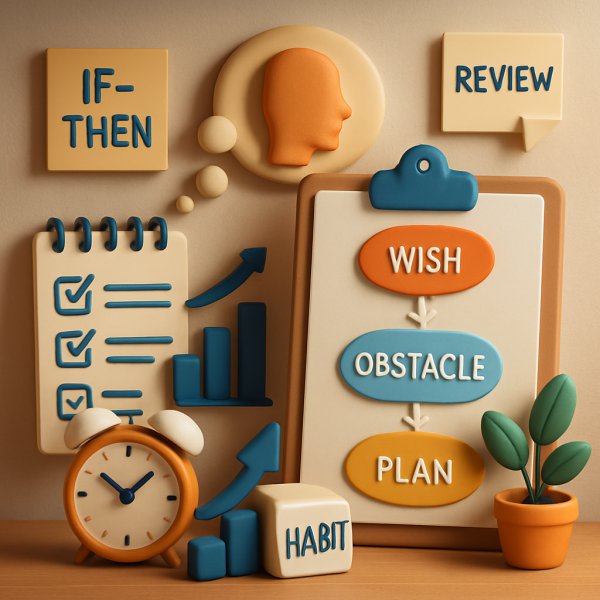
First, mental contrasting, popularized by Gabriele Oettingen as WOOP - Wish, Outcome, Obstacle, Plan - is powerful. You imagine your wish and the best outcome vividly, then contrast that with the main personal obstacle you will face, and finally form an if-then plan to overcome it. The act of naming obstacles increases realism and triggers concrete planning, which boosts follow-through.
Second, implementation intentions, also called if-then plans, were studied by Peter Gollwitzer. These are precise links between a cue and an action, such as "If it is 8:00 a.m., then I will write for 20 minutes." Implementation intentions automate decisions, reducing reliance on fleeting willpower.
Third, visualization and imagery have mixed results but can help when combined with planning and practice. Athletes who visualize not only the outcome, but also the process steps and how they handle obstacles, tend to get real gains. The key is process-focused visualization, not only fantasizing about trophies.
Finally, self-efficacy - believing you can do a specific behavior - is crucial. Albert Bandura showed that higher self-efficacy predicts greater effort and persistence. You can build it through mastery experiences (small wins), social modeling (seeing similar people succeed), persuasive coaching, and managing physical and emotional states.
How habits, environment, and systems do the heavy lifting
Manifesting long-term outcomes is less about one-time inspiration and more about creating systems that consistently produce desired behavior. Tiny habits add up. BJ Fogg’s model - behavior = motivation x ability x prompt - makes clear that the easiest lever is the prompt or environment. If you remove friction and add triggers, behavior becomes much more likely.
Design your environment to make the desired behavior the path of least resistance. Want to read more? Put a book on your pillow and remove the phone from your bedroom. Want to save money? Automate transfers to savings the day you get paid. Tiny, structural changes accumulate into large results because they reduce the cognitive cost of repeating a behavior.
Feedback loops matter. Set measurable indicators and check them regularly. Systems without feedback are guesswork. Use weekly reviews, habit trackers, or simple metrics that tell you whether your system is working. If it is not, iterate. Systems thinking turns the romantic language of "manifesting" into practical operations.
How identity and storytelling change what you attract
You do not merely pursue goals; you become a person who pursues them. If your inner story is "I am someone who procrastinates," that narrative shapes attention, memory, and behavior. Shifting identity is one of the most effective ways to reshape outcomes. Start with small, consistent actions that produce evidence for the new story.
For example, rather than declaring "I am a writer," you might set an identity-shifted behavior: "I am someone who writes for 15 minutes every day." After a few weeks, those sessions create a memory bank of wins that your brain uses as proof. This evidence rewires your self-concept, which in turn changes expectations and choices. The trick is to pick identity claims that are specific enough to be testable, and gentle enough to avoid creating pressure.
Stories also direct attention. If you tell a dramatic story about scarcity, your brain scouts for threats and closes options. If you tell a story about growth and learning, you are likely to notice opportunities and take small, constructive risks. Choose stories deliberately, crafting language that points toward action, curiosity, and resilience.
What manifesting is not: common myths and the truth behind them
Magical thinking is the easiest trap. Manifestation is not the belief that thinking alone, without action, causes change. There is no scientific evidence that thought replaces effort. Another mistake is mistaking gratitude or positive affirmations for a full strategy. Gratitude can change mood, but mood alone rarely builds a business or heals a relationship.
A related myth is that you must always feel confident and inspired. Real work often happens under discomfort. Expect discomfort, and plan for it. Also beware of blaming yourself when outcomes fail. External forces and randomness matter. Skillful manifesting accepts uncertainty and focuses on improving controllable inputs.
Finally, avoid the "one big visualization" fallacy. Visualization works best when paired with implementation intentions and deliberate practice. If you want to play piano, imagining the applause will not replace hours of scales and lessons. Effective manifesting blends imagination with preparation and repeated action.
A step-by-step practice you can start today
This routine synthesizes science, storytelling, and habit design into a compact method that you can repeat for multiple goals. Try it for 21 days on one specific desire.
- Clarify the wish. Write a clear, concrete outcome. Be specific about metrics and timeline. For example: "Secure a full-time UX designer role by January 1, with salary between X and Y."
- Envision the outcome and the process. Spend five minutes visualizing the experience of achieving the goal, and five minutes visualizing the steps you will take each week to get there.
- WOOP the goal. Write your Wish, the Outcome, the Obstacle (internal), and an If-Then Plan for the biggest obstacle. Example: If I start procrastinating on job applications, then I will block two 45-minute slots on my calendar and work with a friend.
- Set identity micro-commitments. Define one identity sentence and a tiny action that proves it. Example: "I am someone who practices design problems weekly" and "I will do one 30-minute UX case study every Monday."
- Design the environment. Remove friction and create cues. Put job application templates where you will see them, or schedule automatic calendar triggers.
- Automate and track. Use a habit tracker, a calendar, or a simple spreadsheet to record actions. Measure progress weekly.
- Reflect and iterate. Weekly, ask what worked, what failed, and what small change will improve the system. Be ready to adapt.
- Celebrate tiny wins and recalibrate identity. Acknowledge evidence that supports your new identity and behavior.
- Keep social sources aligned. Share goals with supportive people and seek models who have done what you want.
Try the WOOP exercise now. Spend five minutes: wish - outcome - obstacle - plan. Write it down. This short ritual alone has boosted success rates in multiple studies. Reflection question: Which obstacle do you avoid admitting is real? Name it.
Real stories that show the system in action
Consider Mira, a mid-career copywriter who wanted to transition to product marketing. She could have "manifested" the role by visualizing titles on LinkedIn, but instead she clarified her outcome, set a weekly learning schedule, created a portfolio project with clear deliverables, and used informational interviews as both practice and networking. When she hit rejections, she used her if-then plans to keep applying and asked interviewers for feedback. Over a year, her consistent system produced interviews and offers. The tiny habit of two hours every Sunday practicing case studies created identity evidence: she became someone who knows product marketing.
Another story: Jamal, training for a marathon, used visualization only for motivation. He combined it with implementation intentions and environment tweaks - he laid out running clothes the night before, scheduled runs as calendar events, and ran with a buddy. When injuries threatened his schedule, he applied WOOP to plan cross-training. The result was a stronger, sustainable routine and a successful race day.
These stories are not exotic. They show that imagination plus deliberate practice plus systems equals outcomes.
A quick table: Contrasting Magical Manifesting and Evidence-Based Manifesting
| Feature |
Magical Manifesting |
Evidence-Based Manifesting |
| Primary tool |
Thought and feeling |
Clarity, planning, behavior, environment |
| Role of action |
Optional |
Essential and measurable |
| Handling obstacles |
Deny or blame |
Anticipate and plan (WOOP, if-then) |
| Time horizon |
Instant expectation |
Iterative, weeks to months |
| Evidence basis |
Anecdotes |
Psychology, habit research, goal-setting |
| Best outcome |
Short-lived motivation |
Sustainable change and skill growth |
Simple scripts and phrases you can use tonight
- For implementation intentions: "If it is 8:00 p.m. on a weekday, then I will spend 20 minutes writing my cover letter." Repeat this in your planner so it becomes automatic.
- For identity framing: "I am the kind of person who learns one new skill every month." Pair this with a tiny, consistent action to prove it.
- For obstacle planning (WOOP): Write one sentence for each step: Wish, Outcome, Obstacle, Plan. Keep it short and specific.
Practice these scripts out loud. Saying plans in a clear voice increases commitment and helps memory encoding.
Reflection prompts to deepen your practice
- What is one specific outcome you want in the next 90 days? Write it in precise terms with numbers or dates.
- What internal obstacle most often stops you from starting? Name it without judgment.
- Which small daily or weekly action, if repeated, would make that outcome inevitable?
- Who in your life models the behavior you want, and how could you learn from them this month?
Spend 10 minutes writing answers to these prompts. This small investment increases clarity and accountability.
Common stumbling blocks and how to get past them
Many people fail not from lack of desire, but from flawed strategies. The first stumbling block is all-or-nothing thinking. If you miss one action, you might abandon the whole plan. Replace this with a recovery script: when you slip, do a pre-planned small action that restores momentum.
The second stumbling block is poor measurement. If you cannot tell whether you are closer to the goal, you will be unable to improve. Pick one or two simple metrics and track them weekly. The third stumbling block is isolation. Social accountability accelerates progress. Use buddies, coaches, or communities.
Finally, do not confuse persistence with stubbornness. Be persistent on principles, flexible on tactics. If something does not work after a fair trial, change the method rather than double down blindly.
A short checklist you can use right now
- Define one clear goal with a timeline.
- Write a WOOP for that goal.
- Create one if-then plan for your biggest obstacle.
- Design one environmental change that makes action easier.
- Commit to a tiny daily habit that proves your identity claim.
- Schedule a weekly 20-minute review to measure and adapt.
Doing these six things in the next 48 hours sets a robust beginning.
Why ethical and joyful manifesting matters
Manifesting everything you want should coexist with empathy and realistic constraints. Pursuing goals that harm others or ignore systems of privilege is neither ethical nor sustainable. Aim for outcomes that increase your flourishing and that of those around you. Joy and curiosity are legitimate metrics: if chasing a goal drains you of joy, reassess the purpose and process.
The best manifestations are those that align inner values and external actions, so your achievements feel earned and meaningful.
Parting push: small actions, compound results, and the patience of precision
Manifesting is not magic, and that is why it is miraculous. The miracle lies in understanding cause and effect: clear goals change attention, attention shapes decisions, decisions accumulate into habits, habits reshape identity, and identity changes outcomes. When you design this chain deliberately, you can create a life that feels like you attracted it - because you did, with skill, strategy, and heart.
Start with one clear desire, and treat the process like a craft. Tend your goals the way a gardener tends plants: choose seeds, prepare the soil, water consistently, prune what is failing, and celebrate each new shoot. In twenty years the garden you build will look nothing like a random wish. It will look like your work, your choices, and your care. So pick one seed tonight, set up one tiny routine tomorrow, and let the compounding begin. You will be surprised how much you can manifest when you combine imagination with real-world tools and a little stubborn kindness to yourself.