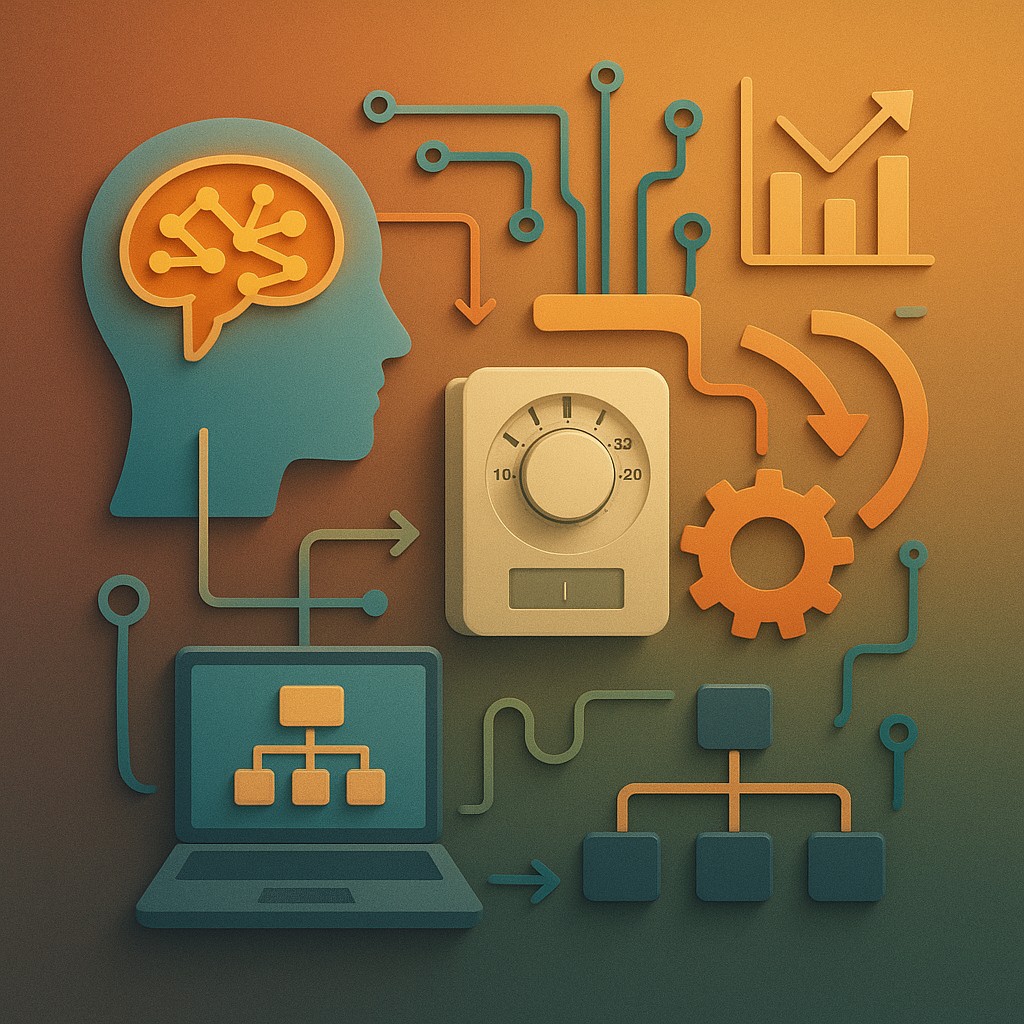
You probably encounter cybernetics every day without knowing its name. That thermostat that nudges the heater on a chilly morning, your body dialing sweat up or down to cool itself, and an app quietly reshuffling which posts you see - these are all variations on the same set of ideas. Cybernetics is the study of how systems regulate themselves through information, feedback, and control. Once you start looking for it, you will see it everywhere.
This field feels both ancient and forward-looking because it sits where machines, minds, and society overlap. It explains why a flock of birds avoids collisions and why organizations reorganize after a crisis. Learning cybernetics gives you a framework to design systems that adapt, to detect hidden dynamics, and to question who controls the feedback loops that shape our lives. Keep reading and you will come away with clear concepts, practical steps, and a healthier skepticism about the word "automation."
What cybernetics really studies in plain language
At its heart, cybernetics is about feedback, information, and control. Picture driving a car: you steer, watch the road, sense if you are drifting, correct, and then repeat. That loop - sense, compare to a goal, adjust - is what cybernetics analyzes. It does not care whether the parts are neurons, gears, code, or people; it cares how information moves and how behavior is regulated.
A few core ideas hold the field together. Feedback is the process where a system uses its output as input to influence future behavior. Negative feedback stabilizes a system by correcting deviations, like a thermostat holding a room near a set temperature. Positive feedback amplifies change, like viral fame or a microphone placed too close to a speaker creating a howl. Another central idea is information - cybernetics treats information as meaningful differences that can change actions. Together, these concepts let us describe and design self-regulating systems.
A short, friendly history you can remember
The name "cybernetics" appeared in the 1940s and 1950s, when engineers, biologists, and mathematicians noticed the same patterns in animals and machines. Norbert Wiener popularized the term and showed how feedback and communication could bridge disciplines. Early cybernetics inspired control theory, robotics, early AI, and even some work in the social sciences.
Later waves broadened the perspective. First-order cybernetics studied systems from the outside, focusing on regulation and control in machines and organisms. Second-order cybernetics brought the observer into the picture - the idea that people studying a system influence it and must be part of the description. That shift matters when you design systems that affect humans, because ignoring the observer creates blind spots and unintended consequences.
How cybernetics shows up in everyday technology and institutions
You see cybernetic design whenever someone sets up a loop to measure and correct behavior. Thermostats, cruise control, and automatic braking are classic engineering examples. In healthcare, closed-loop insulin pumps measure glucose and administer insulin automatically, using feedback to keep a patient within a healthy range.
In the social world, cybernetic thinking appears in management, education, and public policy. Companies use key performance indicators and dashboards to steer behavior. Social media platforms tune recommendations based on engagement feedback, which changes what people click and therefore what content spreads. Even climate policy uses cybernetic models: scientists monitor atmospheric data and adjust interventions to steer toward sustainability targets.
Table: Quick comparison of familiar cybernetic systems
| System |
Main goal |
Feedback type |
Key sensors/actuators |
Typical risks |
| Thermostat |
Keep temperature near a setpoint |
Negative feedback |
Thermometer sensor, heater/AC actuator |
Overshoot, incorrect calibration |
| Human body (homeostasis) |
Maintain internal balance |
Negative and positive feedback |
Hormones, nerves, organs |
Disease when signals fail |
| Insulin pump (closed-loop) |
Regulate blood glucose |
Negative feedback with control algorithm |
CGM sensor, insulin pump actuator |
Sensor failure, algorithm mismatch |
| Social media recommender |
Increase engagement |
Positive and negative feedback mixture |
User actions, ranking algorithms |
Filter bubbles, manipulation |
| Organization (company) |
Meet goals, adapt to market |
Feedback via metrics and governance |
Reports, meetings, incentives |
Misaligned incentives, blind spots |
This table is a compact reminder that, despite different appearances, these systems share a common structure - a purpose, sensors, a way to compare the current state to goals, and actions that change the environment.
Core concepts that make cybernetics powerful
Feedback loops are the engine. Cybernetics also relies on models - internal representations a controller uses to predict outcomes. If you steer a boat, your brain models currents and wind to predict where the boat will go after you turn the rudder. Models let systems act proactively rather than purely reactively.
Another powerful idea is requisite variety, formulated by W. Ross Ashby. He showed that to control a system effectively, the controller must have at least as much variety in responses as the disturbances it faces. In short, complexity requires matching complexity. That principle explains why simple fixes fail in complex situations, and why increasing the diversity of responses in an organization improves resilience.
Information flow and communication are also crucial. Cybernetics studies how information is encoded, transmitted, and interpreted within and between systems. Miscommunication can break feedback loops, just as poor sensor calibration can ruin a closed-loop controller.
Common misconceptions and the corrections you should remember
Many people think cybernetics is just science-fiction robotics, or worse, a scheme for total control. While cybernetics offers tools for control, it is neutral - a description of how systems regulate themselves, not a recipe for domination. The ethics and use of cybernetic tools depend on human choices and governance.
Another myth is that cybernetics equals artificial intelligence. They overlap, but AI focuses on algorithms that learn or make decisions, while cybernetics focuses on relationships between parts of a system and how they achieve stability or change. AI can be one component in a cybernetic loop, providing the controller or model, but cybernetics covers a broader set of questions.
Finally, people often assume automation removes humans. In practice, many effective cybernetic designs keep humans in the loop. Second-order cybernetics especially insists that human observers and values must be included. Removing people can break the feedback that preserves ethics, context, and adaptability.
How to use cybernetic thinking to design better systems
Start by naming clearly the goal you want the system to achieve and what counts as success. A goal could be as concrete as keeping a greenhouse at a target humidity or as abstract as increasing trust in neighborhood governance. Be explicit about the variables you can measure, because you can only control what you can observe.
Next, design simple feedback loops before adding complexity. Simplicity helps you see where errors arise and prevents cascading failures. Choose sensors that are reliable and actuators with predictable effects. Build models that explain causal relationships rather than just correlations, and test them with small experiments.
Finally, anticipate failure modes by asking how feedback can be gamed, delayed, or misread. Design transparency into your system so stakeholders can understand and correct it. Include mechanisms for adaptation, such as learning rates or manual override, and ensure the people affected have a say in how the loop operates.
Practical examples that teach the idea quickly
The thermostat is the classic learning example: it measures temperature, compares it to the setpoint, turns heating on or off, and repeats. Change the setpoint and the thermostat adapts proportionally. If the sensor is broken, the loop fails - you end up too cold or too hot.
A more human example is classroom learning. Students receive instruction, attempt tasks, get feedback from teachers, and adjust their strategies. A well-designed classroom is a cybernetic system where feedback is timely, informative, and actionable. Poor feedback - vague grades or delayed comments - causes learning to stall.
Consider a city transit system using real-time data to reroute buses when delays occur. Sensors (vehicle GPS) feed into a controller (routing algorithm) that changes bus assignments (actuators) to minimize delays. Success depends on accurate data, flexible operations, and incentives for staff to follow the changes.
Societal implications and ethical considerations you should not ignore
Cybernetic systems shape behavior, and that power creates responsibility. Algorithmic feedback loops can amplify biases when historical data reflect unfair treatment. For example, predictive policing algorithms trained on biased arrest records can create a loop where certain neighborhoods are over-policed, producing more recorded incidents and further biasing the model.
Surveillance is another concern. Systems that monitor everything can optimize efficiency but at the cost of privacy and autonomy. The trade-off is not purely technical; it requires democratic deliberation. Cybernetic design should include transparency, accountability, and routes for remediation when things go wrong.
Power dynamics also matter. Whoever controls the sensors and interprets feedback holds influence. Decentralized and participatory cybernetic designs, inspired by second-order cybernetics, invite multiple observers into the loop so different perspectives shape the model and control rules. This approach can reduce single points of failure and improve fairness.
Practical checklist to apply cybernetic ideas in real projects
- Define the purpose and measurable success criteria clearly.
- Identify the minimal set of sensors and actuators needed to form a feedback loop.
- Build simple models that capture cause and effect, and test them experimentally.
- Start with minimal automation and keep humans in the loop for oversight and learning.
- Monitor for unintended consequences, biases, and gaming of the system.
- Design transparency and control options for affected stakeholders.
- Iterate: collect data, update models, refine feedback, and repeat.
These steps help you avoid common pitfalls, such as over-automation, opaque decision-making, and fragile designs.
Where cybernetics meets the future: why this matters for you
As AI, robotics, and ubiquitous sensing spread, cybernetic thinking becomes more essential. It gives you a mental toolkit for understanding how those technologies actually change behavior. It helps citizens, designers, and policymakers ask better questions: Who sets the goal? What are we measuring? Who benefits from the feedback loop?
Learning cybernetics makes you a better critic and creator. You will spot when systems lack requisite variety, when feedback is delayed, or when incentives are misaligned. You will be able to propose fixes that are practical and humane rather than technocratic or punitive.
Final nudge to get you started experimenting
Now that cybernetics feels less mystical, try a tiny experiment: pick one routine you want to improve - getting more sleep, decluttering a home, or managing email. Define a simple measurement, set a realistic goal, and create a feedback action you can take daily. Watch how your behavior responds, adjust your model, and keep human judgment in the loop. You will learn faster from real-world tests than from reading alone.
Cybernetics is a toolkit for noticing patterns, designing feedback, and shaping systems so they behave as intended - while keeping an eye on ethical seams. With curiosity and a little care, you can use these ideas to build systems that are robust, fair, and a bit wiser than the last idea you borrowed from the internet. Try one feedback loop this week, then tell someone what you learned.