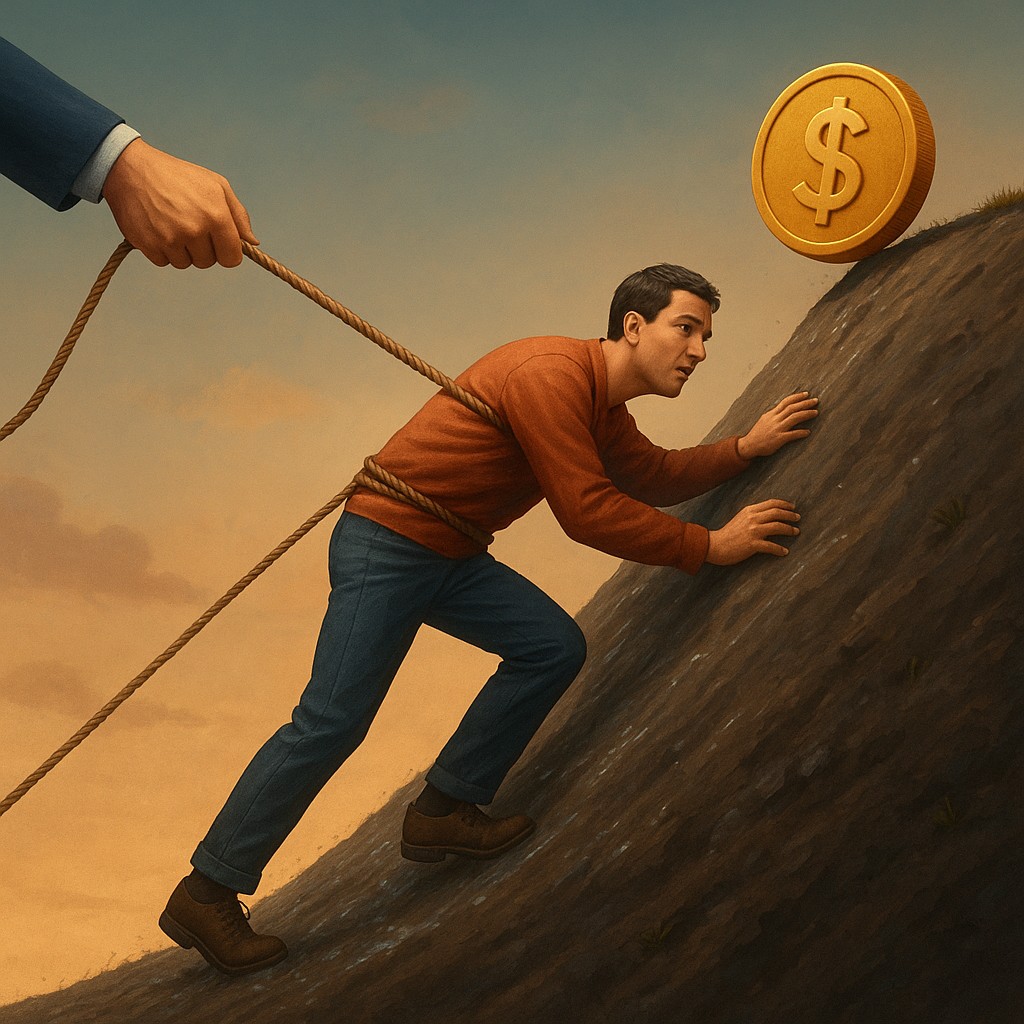
Imagine you are standing at the bottom of a steep, slippery hill. You have been told a comfortable life waits for you at the top, but there is a catch. Every time you climb a few inches, someone pulls a rope tied to your waist, dragging you back down. In the world of social policy, this isn’t just a metaphor; it is the daily reality for millions of people stuck in a "poverty trap." This happens when the very systems meant to help people escape financial hardship actually make it a bad mathematical move to take a new job or a pay raise. It is one of the toughest puzzles in modern government, and solving it requires us to rethink how we value hard work and human dignity.
The conversation about money, work, and survival is moving away from old models of temporary relief toward something much more steady. Universal Basic Income, or UBI, is no longer just a far-off dream discussed in academic journals. It is being tested right now, from the foggy streets of Stockton, California, to rural villages in Kenya and cities in Wales. These pilot programs aren’t just handing out cash for no reason; they are testing a basic theory of psychology and economics: if we stop punishing people for succeeding, will they actually work more? By looking at how the "benefit cliff" works and the potential of a guaranteed income floor, we can see a future where people pick a career based on passion and growth rather than a desperate struggle to survive.
The Invisible Wall of the Benefit Cliff
To understand why UBI has become such a popular topic, we first have to look at the flaws in traditional welfare. Most government aid programs are "means-tested," which is a technical way of saying they are only for people who stay below a certain income level. This sounds fair in theory, but it creates a major system failure called the "benefit cliff." Imagine a single parent who gets $1,000 a month in food and housing assistance. If they find a part-time job that pays $200 a month, the government might decide they no longer need as much help and cut their benefits by $300. In this case, the person has worked hard for several hours a week only to end up with $100 less than they had when they were doing nothing.
This creates a backward incentive where staying unemployed is actually the smartest financial choice. It isn't about laziness; it is about basic math. If taking a job means your children lose their health insurance or you can no longer afford rent because your subsidy vanished, the logical choice is to stay put. This is the heart of the poverty trap. It keeps the human spirit stuck in a cycle of just getting by rather than moving forward. Traditional systems often act like a ceiling that holds people down, while supporters of UBI argue that we should instead build a floor that everyone can stand on while they reach for something higher.
Building a Floor Instead of a Ceiling
Universal Basic Income flips the script by providing a guaranteed, unconditional payment to every citizen, regardless of whether they have a job. The magic of this approach is its simplicity: the payment does not disappear when you get hired. Because the "floor" is permanent, every extra dollar you earn at work is added on top of that base. This removes the "marginal tax rate," a hidden penalty that hits low-earners the hardest. Under a UBI system, if you earn $100 at a grocery store, you actually have $100 more in your pocket than you did the day before. This shift changes the psychological landscape of the workforce from a place of fear to one of opportunity.
Researchers running pilot programs, such as the SEED project in Stockton, found that people who received a guaranteed income actually looked for full-time work at higher rates than those in the traditional system. When people have their basic needs met - food, heat, and basic shelter - they have the mental "bandwidth" to look for better jobs. Poverty is incredibly expensive and time-consuming; when you are constantly worried about being $50 short, you don't have time to polish a resume or practice for an interview. By providing a stable base, UBI acts as a launchpad rather than a hammock. It allows people to take risks, like going back to school or starting a small business, without fearing total ruin if things don't go perfectly on day one.
Comparing Traditional Welfare and Basic Income
To better see how these two systems affect a person's life and choices, we can look at the differences in how they are designed. The following table shows how the incentives change depending on which system is used.
| Feature |
Traditional Welfare (Means-Tested) |
Universal Basic Income (Guaranteed Floor) |
| Eligibility |
Highly specific (based on income, family size) |
Universal (everyone receives it) |
| The "Work Penalty" |
High; benefits drop as income goes up |
None; payments stay the same |
| Admin Costs |
High; requires many caseworkers and audits |
Low; simple automated payments |
| Psychological Impact |
Increases stress and the stigma of "dependency" |
Increases a sense of security and control |
| Moving Up |
Often blocked by the "benefit cliff" |
Encouraged since every earned dollar adds up |
The Great Inflation Debate and Economic Anxiety
While the social benefits of UBI are becoming clearer through global trials, the economic effects are still being debated. The most common concern is the "inflation ghost." Critics argue that if everyone suddenly has an extra $1,000 a month, landlords will simply raise rents by $1,000, and the price of milk will skyrocket, canceling out the extra cash. This is a classic supply and demand argument: if there is more money chasing the same amount of goods, prices go up. However, the outcomes in smaller trials, such as those studied by the nonprofit GiveDirectly in Kenya, suggest that the "multiplier effect" often does more good than inflation does harm.
In many cases, the extra cash in a community increases the demand for local services, which encourages people to start new businesses. This creates more supply, which can keep prices stable while growing the local economy. Furthermore, UBI is usually funded through taxes rather than printing new currency, meaning it moves existing money around rather than increasing the total money supply. Still, researchers remain careful. A pilot program for a few thousand people in one city is very different from a national policy for 300 million people. The long-term effects on the "labor supply" - the total number of people willing to work - and the resulting impact on wages are variables we are only just beginning to map out.
From Survival Mode to Career Planning
Beyond the spreadsheets and economic models, there is a deeply human side to this change. When a person is stuck in "survival mode," the part of the brain responsible for long-term planning is essentially hijacked by the stress of the present moment. This is often called a "scarcity mindset." When you don't know where your next meal is coming from, you cannot think about where you want to be in five years. UBI pilots have shown that when this immediate pressure is lifted, people begin to make choices that help their future and their community.
- Investing in Education: Participants in various trials often use the extra money to pay for certifications or trade schools that lead to higher-paying careers.
- Improved Health: With better food and lower stress, participants visit the emergency room less often, which saves taxpayers money in the long run.
- Starting Small Businesses: Many people use the "floor" as a safety net to start side projects that eventually grow into full-time companies.
- Family Stability: Parents can spend more time with their children instead of working three low-wage jobs, leading to better lives for the next generation.
This shift from surviving to thriving is perhaps the most important way to break the poverty trap. By treating citizens as leaders of their own lives rather than people to be managed, the guaranteed income model builds a sense of dignity that traditional systems often take away. It acknowledges that people generally want to contribute to their communities and improve their lives, but they need a stable platform to jump from.
As we look toward the future, the lessons from these ongoing trials will likely shape the social rules of the 21st century. Whether or not Universal Basic Income becomes the global standard, the data being collected today is exposing the cracks in our current systems. It forces us to ask hard questions about what it means to support one another in a world of increasing automation. The poverty trap is a complex knot, but by focusing on stability and human potential, we are finally starting to find the loose ends. There is a quiet power in the idea that a person's worth is not defined by their lowest moment, and that a little bit of certainty can go a long way in unlocking the greatness hidden within everyone.