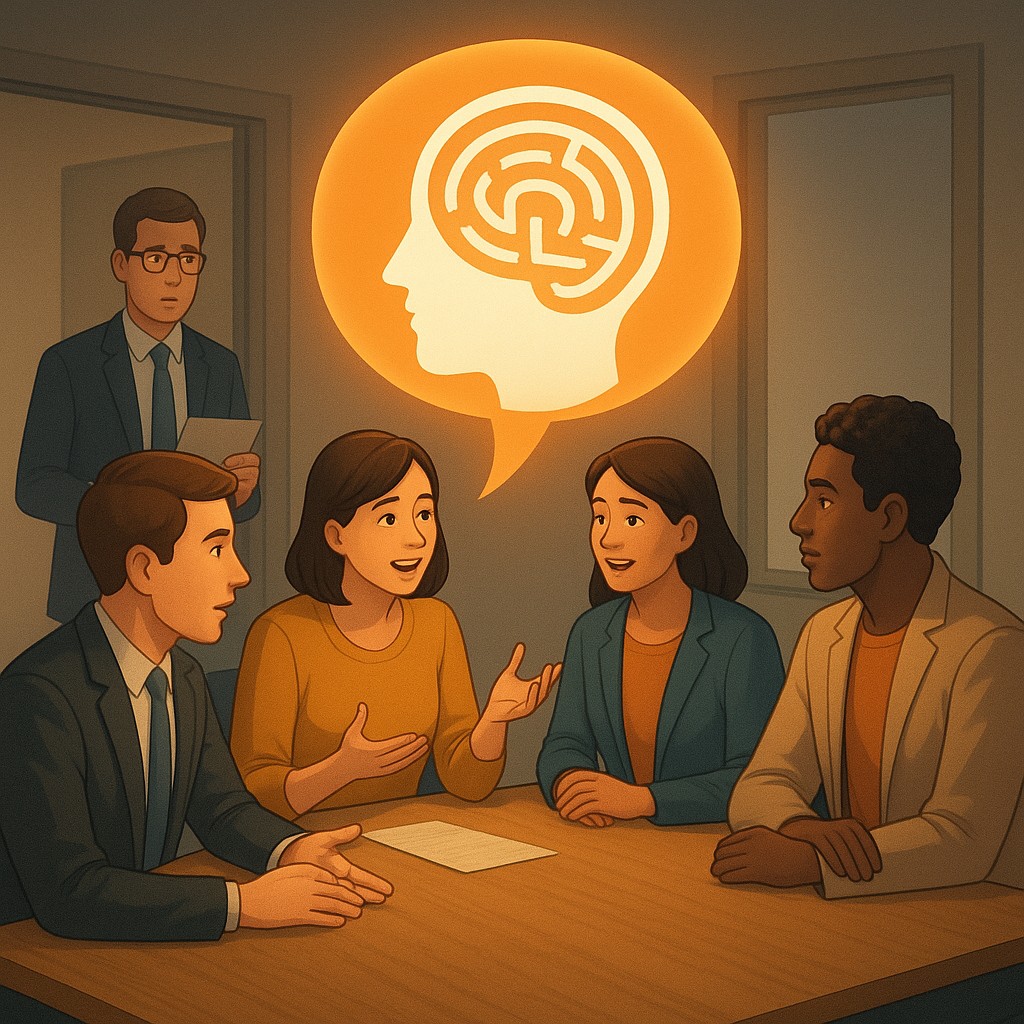
Imagine sitting in a high-stakes meeting to decide which of three marketing campaigns to launch. You happen to have a secret piece of data from a focus group suggesting that Option B is a total disaster, even though it looks great on paper. You walk into the room ready to save the day. However, within five minutes, the CEO mentions how much she loves the "vibe" of Option B, and two colleagues quickly chime in to agree.
Suddenly, that crucial piece of data feels like a weight in your pocket. Instead of speaking up, you find yourself nodding along and mentioning how the colors in Option B really "pop." Before you know it, the meeting is over, the wrong decision is made, and your vital insight remains a secret.
This scenario isn't just a personal failure of courage. It is a fundamental glitch in human social behavior known as Common Knowledge Bias. While we like to think of groups as "think tanks" where different perspectives merge to create a better outcome, the reality is often the opposite. Groups frequently act as "echo chambers" that filter out unique insights in favor of information everyone already knows. We are biologically and socially programmed to seek agreement. Unfortunately, this means that the most important information in the room-the facts only one person knows-is the least likely to be discussed.
The Comfort of the Echo Chamber
At its heart, Common Knowledge Bias is a byproduct of our desire for social approval. When you share a fact that everyone else already knows, you get immediate positive reinforcement. People nod and smile, perceiving you as knowledgeable and a "team player." This creates a rewarding feedback loop. We feel more confident in our own judgment when others back it up, and we like people more when they agree with us. As a result, group discussions tend to settle on the "lowest common denominator" of information. This is the material that feels safe, familiar, and comfortable for everyone involved.
The social cost of introducing "unshared information" can be surprisingly high. When you bring up a fact that no one else has heard, you are effectively challenging the group's current direction. You might be seen as a contrarian, a "Negative Nancy," or simply as someone who isn't keeping up. Because humans are social animals whose survival once depended on staying in the tribe's good graces, we have developed a subconscious radar that detects social risk. Often, our brains decide that being liked is more important than being right, leading us to bury the very data that would lead to a better decision.
The Hidden Profile and the Mathematical Trap
Researchers often study this phenomenon using a setup called the "Hidden Profile" task. In these experiments, a group is asked to choose the best candidate for a job. The researchers distribute information so that no single person has all the facts. For example, if Candidate A is the best choice, the researchers might give every group member two positive facts about Candidate B, but give each individual only one unique positive fact about Candidate A. On the surface, everyone enters the room thinking Candidate B is the front-runner because that is the "common knowledge" they all share.
Mathematically, the group has everything they need to realize Candidate A is the superior choice. However, because Candidate B's strengths are common knowledge, they dominate the conversation. Statistically, common information is much more likely to be mentioned because anyone in the room could bring it up. If someone does mention a unique fact about Candidate A, it often gets ignored or dismissed because the rest of the group cannot verify it. The "profile" of the best candidate remains hidden because the group prefers to focus on the shared profile of the mediocre candidate.
| Feature of Discussion |
Common Information |
Unique (Unshared) Information |
| Chance of being mentioned |
Extremely High (Multiple sources) |
Low (Only one source) |
| Social reaction |
Validation, nodding, agreement |
Skepticism, confusion, or silence |
| Perceived credibility |
Seen as highly reliable |
Often viewed as a fluke or flawed |
| Impact on confidence |
Boosts group confidence |
Creates doubt and slows momentum |
| Strategic value |
Low (Everyone already knows it) |
High (Crucial for getting it right) |
Why Expertise Does Not Save the Day
You might assume that a group of experts would be immune to this bias, but the data suggests otherwise. In fact, high-status experts are sometimes the worst offenders. When an expert enters a room, they often feel a "burden of competence." They want to appear as though they have a firm grasp on the situation, which leads them to focus on the broad, structural facts that ground the discussion. Junior members, on the other hand, might hold specialized, specific data that contradicts the expert's broad view. However, the junior member is often too intimidated to speak, and the expert is too focused on maintaining the "narrative" to look for exceptions.
This produces a paradox: the more "expert" a group is, the more they might rely on a narrow set of professional jargon and established norms. This is why multi-disciplinary teams often struggle. A heart surgeon, a nurse, and a hospital administrator all have different unique information, but they might spend their entire meeting talking about "patient throughput" (the rate at which patients move through the system) because it is the only language they all share. The nurse’s specific observation about a patient’s unusual reaction to a medication might never surface because it does not fit the common framework of the administrative meeting.
Re-Engineering Meetings for the Truth
To combat Common Knowledge Bias, we have to stop treating meetings as places where we "get on the same page" and start treating them as "information harvests." If the goal is merely to align everyone, a memo is more efficient. The only reason to have a meeting is to surface the information that is not on the page. Leaders can help by separating the information-gathering phase from the decision-making phase. If you ask for a decision too early, the group will instinctively grab the nearest piece of common knowledge and run with it to reach a consensus as fast as possible.
One effective strategy is the "Anonymous Brain-Dump." Before a discussion starts, every member writes down three pieces of information they have that they suspect others might not know. These are then read aloud or posted on a board without names attached. This removes the social risk of being the "odd one out." When information is separated from the person who holds it, the group can evaluate the data on its own merits rather than judging the person for bringing it up. It turns unique data into "common knowledge" before the debate even begins, leveling the playing field.
The Power of the Designated Dissenter
Another powerful tool is the formal assignment of roles. In many groups, there is a natural push toward harmony. By assigning someone the role of "Information Scout" or "Devil’s Advocate," you give them social permission to be difficult. If it is someone’s literal job to find the data point that everyone is ignoring, they no longer feel like they are risking their reputation by bringing it up. They are simply doing their duty. This shifts the social reward system: instead of being praised for agreeing, they are praised for uncovering the "hidden profile."
It is also helpful to change how we ask questions. Instead of asking, "Does everyone agree with this plan?" which is a trap that triggers the bias, a leader should ask, "What is one thing you know about this project that we haven't talked about yet?" or "Who has a piece of data that makes them nervous?" These questions signal that the group’s value lies in its differences, not its similarities. By framing unshared information as a treasure to be hunted rather than a nuisance to be avoided, you can transform the group dynamic from a social club into a high-functioning intelligence unit.
Redefining Group Intelligence
The ultimate goal is to move from "Groupthink" to "Group Intelligence." Real intelligence in a group setting is the ability to combine different, often conflicting pieces of data into a clear and accurate picture. It requires intellectual humility and a willingness to be wrong. We must recognize that our instinct to agree is a biological relic from a time when disagreeing with the tribe meant being left out in the cold. In the modern world, the "cold" is actually the failure of a company, the crashing of a plane, or the failed launch of a product because no one wanted to mention a unique flaw they noticed.
As you move forward in your career and life, try to be the person who values quiet information. Train yourself to listen for the "but" and the "actually" that someone starts to say before trailing off. When you lead a group, do not look for the fastest path to a "yes." Look for the most difficult path to the "truth." When we stop rewarding people for telling us what we already know, we unlock the true potential of human cooperation, turning a room full of individuals into a powerful, collective brain.