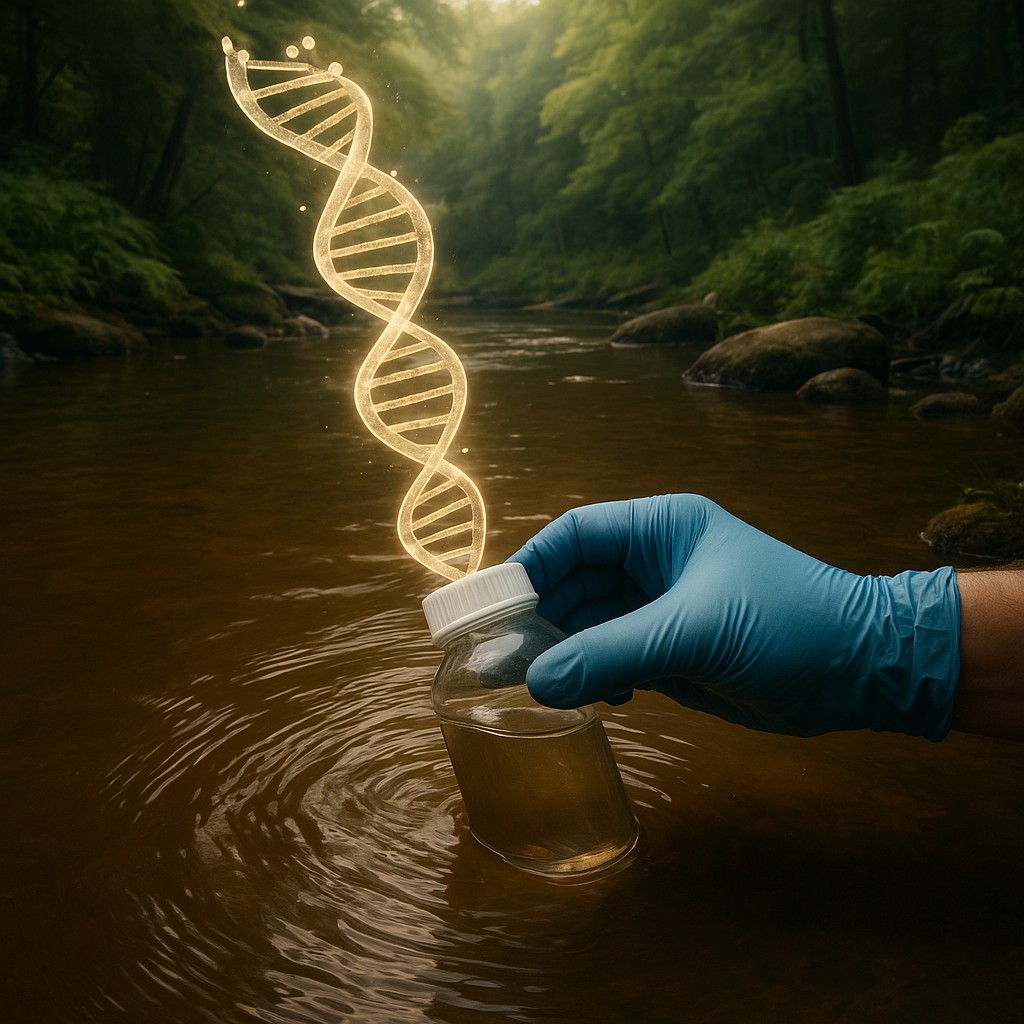
Imagine standing on the banks of a river so deep and murky it looks like a vat of cold coffee. Somewhere beneath those swirling currents lives a creature so rare that no human has seen it in a decade. Traditionally, to prove this animal still exists, you would have to spend months setting steel traps, hauling heavy nets, or sitting perfectly still in a humid blind, hoping for a fleeting glimpse that might never come. Even then, the stress of being caught could harm the very animal you are trying to save. Given the sheer size of the water, finding one individual is like looking for a specific grain of sand on a beach.
But today, you do not need a net or a powerful camera. Instead, you dip a sterile plastic bottle into the water, pull out a single liter, and screw the cap tight. Inside that bottle is a microscopic soup of information, a biological "roll call" of every creature that has swam, bathed, or even just had a drink in that river over the last forty-eight hours. This is the world of environmental DNA, or eDNA. It is a technological breakthrough that effectively turns our waterways and forests into massive, natural crime scenes where every inhabitant leaves behind a trail of genetic evidence.
The Genetic Breadcrumbs of the Natural World
Every living thing is a bit messy. As an animal moves through its environment, it constantly sheds material. Skin cells flake off, scales rub away against rocks, and mucus is left behind as a protective coating. Animals also release waste, and even their breath contains tiny droplets of moisture packed with biological data. All of this material contains DNA, the unique instruction manual found inside the cells of every organism. In the past, scientists thought this "extra-organismal" DNA was just background noise, but we have recently realized it is a high-definition broadcast of an entire ecosystem's health.
Once this genetic material is released into the water or soil, it does not vanish instantly. It drifts like a microscopic cloud of digital ink. In cold, still water, these strands of DNA can last for weeks. In turbulent, warm rivers, they might break down in just a few days. By collecting a sample and running it through a laboratory process called sequencing, researchers can match these drifting fragments against a global library of known genetic codes. It is essentially the biological equivalent of running a fingerprint through a police database. If the code in your water bottle matches the code for a Pink River Dolphin, you know that dolphin was right there, even if you never saw a single fin.
From Samples to Sequences: The Laboratory Pipeline
Turning a cup of pond water into a list of species is a feat of modern molecular biology. The process relies on a technique known as Polymerase Chain Reaction, or PCR. When a scientist brings a water sample back to the lab, the first step is filtration. They push the water through a membrane with holes so tiny they can catch individual cells and even free-floating strands of DNA. Once the genetic material is concentrated on this filter, chemicals are added to "lyse" the cells, which means breaking them open to release the DNA into a liquid solution.
This is where the magic happens. Because the amount of DNA in a single liter of water is incredibly small, scientists use PCR to "amplify" it, or make copies. They add specific chemical primers that seek out and latch onto the DNA of a target group, such as fish or amphibians. The PCR machine then cycles through different temperatures, causing the DNA to unzip and replicate itself millions of times. Within a few hours, a trace that was once invisible becomes a loud, clear signal. This amplified DNA is then put through a "Next-Generation Sequencer," which reads the order of the chemical bases (the A, C, G, and T of the genetic code) and produces a digital file to be compared against international databases.
Comparing Traditional Surveying to eDNA Monitoring
The shift from physical sightings to genetic sampling is a massive change in how we handle conservation. While both methods have their place, the efficiency of eDNA is hard to ignore, especially in environments that are difficult for humans to reach.
| Feature |
Traditional Field Surveys |
eDNA Sampling |
| Intrusiveness |
High (Trapping, handling, stress) |
Low (No contact with animals) |
| Cost |
High (Labor, equipment, travel) |
Moderate (Lab fees, but fast) |
| Detection Success |
Lower (Requires a visual sighting) |
Higher (Detects hidden traces) |
| Data Detail |
High (Age, health, sex, weight) |
Low (Only shows if they are present) |
| Speed |
Slow (Weeks or months of work) |
Fast (A snapshot of one moment) |
| Expertise Needed |
High (Identifying species in the field) |
Moderate (Standardized collection) |
Navigating the Limitations of the Microscopic Lens
While it sounds like a superpower, eDNA is not a magic wand. One of the biggest challenges is that eDNA is "blurred" across space and time. Because water flows, a DNA match for a rare trout does not necessarily mean the fish is exactly where you dipped your bottle. It might be several miles upstream, its genetic trail carried down by the current. Furthermore, because DNA breaks down over time, a positive result only tells you the animal was there recently. It cannot tell you if the animal is still there now or if it has moved on to another part of the watershed.
There is also the "dead or alive" dilemma. DNA does not come with a pulse. In some cases, researchers have detected the DNA of invasive species in a lake, only to realize the genetic material came from the droppings of a bird that had eaten the fish in a completely different body of water. Similarly, eDNA cannot tell you if you are looking at one massive whale or a hundred small fish of the same species. It provides a list of who is in the room, but it does not tell you how many individuals are there, how old they are, or if they are healthy. For these reasons, conservationists view eDNA as a "triage" tool, a way to quickly find out where they should focus their traditional, more intensive research.
The Future of Bio-Surveillance and Citizen Science
The beauty of eDNA is how simple it is to collect. You do not need a PhD in fish science to fill a bottle with water and pump it through a filter. This has opened the door for "citizen science," where hikers, fishers, and students can contribute to global biodiversity databases. Large-scale projects are already underway where thousands of volunteers collect samples from local streams on the same day. This provides a "biomolecular map" of entire countries in a way that would have been impossible twenty years ago.
As the technology continues to shrink, we are moving toward a future with "autonomous samplers" permanently installed in rivers and oceans. These devices would act like smoke detectors for nature, constantly sipping the water and sequencing DNA on the fly. If they detect a dangerous invasive species or the return of a long-lost endangered one, they could send an instant alert to a scientist's smartphone. This real-time monitoring would allow us to react to environmental changes as they happen, rather than discovering a problem years too late.
The shift toward genetic monitoring reminds us that every drop of water is a library. Every forest is a living archive of the creatures that call it home. We are finally learning how to read the stories written in the environment itself. In doing so, we are discovering that the world is far more crowded and full of life than we ever imagined. The next time you walk past a stream, remember that you aren't just looking at water. You are looking at a vast, swirling database of life, waiting for someone to pick up a cup and read the code.