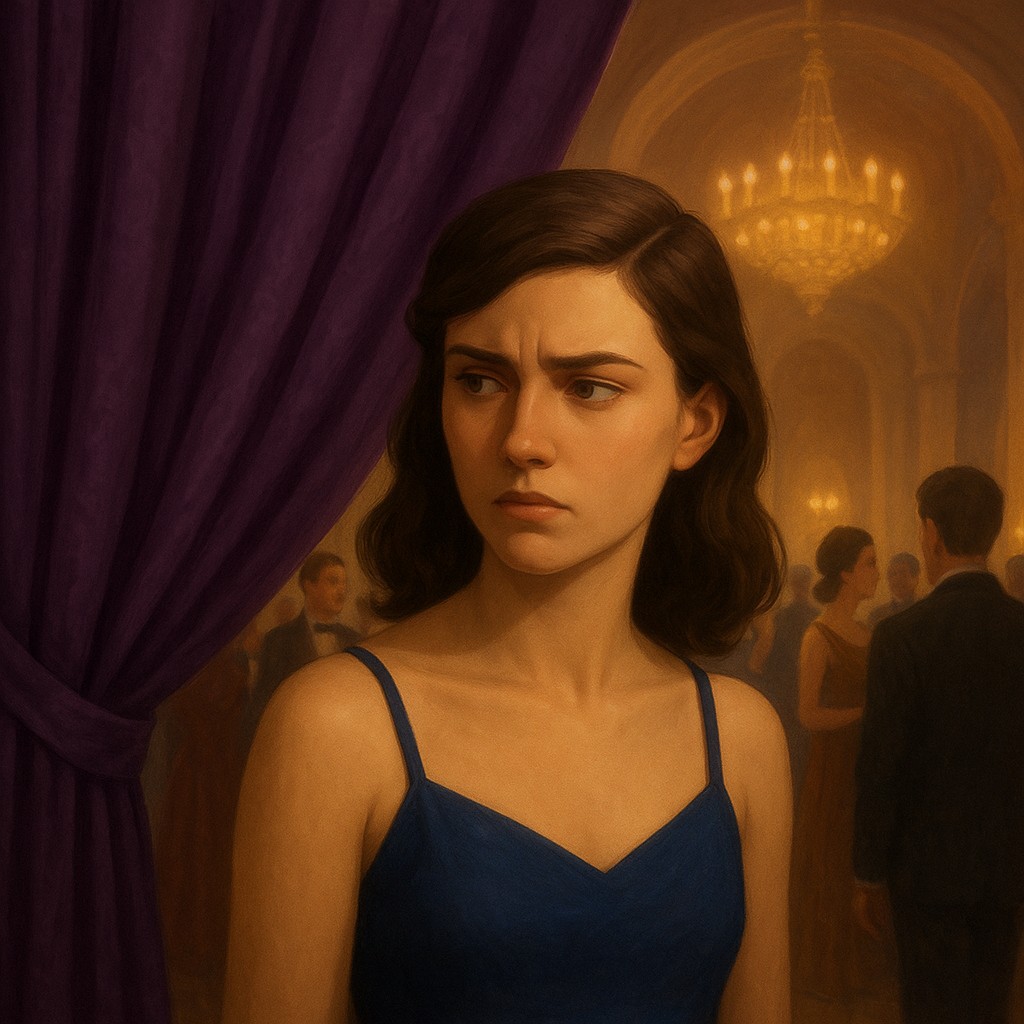
Imagine you are reading a novel about Clara, a young woman attending a high-society gala she is dying to escape. A typical narrator might say, "Clara looked at the velvet curtains and thought they were tacky, wishing she were back home in bed." This is clear and functional, but it keeps you at a distance. It reminds you that a middleman, the narrator, is standing between you and Clara’s inner life. You are being told about her distaste rather than feeling it yourself.
Now, imagine the narrator says, "Clara scanned the room. Those velvet curtains were simply hideous, a tragic shade of bruised purple that made the whole evening feel like a funeral. Why on earth had she agreed to come?" Suddenly, the "she thought" and "she felt" labels have vanished. You are seeing the world through her judgmental eyes, even though the story is still written in the third person.
This clever perspective trick is known as free indirect discourse. It is the literary version of a "mind meld," where the narrator’s objective voice and a character's subjective feelings bleed together until you can't tell where one ends and the other begins. It allows a writer to keep the broad, "bird's-eye view" of third-person storytelling while capturing the intense intimacy of a first-person diary. By removing the clunky scaffolding of "he realized" or "she wondered," the author invites you to step directly into the character's mind. You aren't just watching a puppet on a stage; you are experiencing the puppet’s private anxiety about the stage lighting.
The Architecture of a Narrative Ghost
To understand how this works, we first have to look at how stories usually handle thoughts. Direct discourse is the most basic style, using quotation marks or italics to show exactly what a character thinks: "I hate this party," he thought. Indirect discourse is a more formal version where the narrator reports the thought: He thought that he hated the party.
Free indirect discourse is the rebellious child of the two. It uses third-person pronouns like "he" or "she," but keeps the internal flavor, slang, and emotional bias of the character. It is "free" because it has been liberated from introductory verbs like "said" or "believed."
When a writer uses this technique, the narrator adopts the character’s vocabulary. If the character is a cynical detective, the city isn't just "raining"; it is "weeping like a witness who knows too much." The narrator isn't just describing a setting; they are performing an impression of the character’s mood. This creates a fascinating layer of irony. Because the narrator is still technically a third party, they can show us a character’s thoughts while simultaneously winking at the reader. We see the character’s self-delusions reflected in the very language used to describe the world. It is a powerful tool for building empathy because it forces the reader to inhabit a specific, often flawed, human perspective.
Detecting the Shift Without a Map
How do you know when you have slipped into free indirect discourse? Look for words that signal a shift in attitude or "judgmental" language. In a purely objective sentence, the narrator stays neutral. But the moment the prose starts using exclamation points, rhetorical questions, or biased adjectives, you have likely crossed the border into a character’s mind.
If the text says, "The coffee was cold. How typical of this miserable cafe!" the second sentence is free indirect discourse. The narrator isn't objectively proving the cafe is miserable; they are channeling the character’s irritation.
Another key sign is the use of "deictics," which are words that point to a specific time or place, like "now," "here," or "tomorrow." In standard narration, these are usually tied to when the narrator is telling the story. In free indirect discourse, they anchor to the "now" of the character. If the book says, "He looked at his watch. Only two hours until the meeting," the word "only" betrays the character’s internal pressure. The narrator has left their neutral post at the edge of the universe to stand right next to the protagonist, checking the time over their shoulder.
| Feature |
Direct Discourse |
Indirect Discourse |
Free Indirect Discourse |
| Example |
"Am I late?" he wondered. |
He wondered if he was late. |
Was he late? He surged forward. |
| Tags Used |
He thought, she said, etc. |
He felt that, she saw that. |
None (the tag is removed). |
| Pronouns |
First person ("I," "Me"). |
Third person ("He," "She"). |
Third person ("He," "She"). |
| Tone |
The character's unique voice. |
The narrator's neutral voice. |
Character's voice in 3rd person. |
| Immersion |
Medium (feels like a quote). |
Low (feels like a report). |
High (feels like a shared mind). |
The Master of the Invisible Bridge
While many writers use this technique today, we owe a huge debt to Jane Austen, who perfected it in the early 1800s. Before Austen, novels often felt rigid. You were either stuck in a character’s head through a series of letters or you were listening to a narrator who sounded like a preachy history professor. Austen changed the game by letting her narrator’s voice dance with her characters’ voices.
In Emma, when the main character tries to convince herself she doesn't care about a suitor, the narrator doesn't just say "Emma was lying to herself." Instead, the prose mirrors Emma’s frantic, self-justifying logic. It uses the third person to gently mock her lack of self-awareness.
This creates a brilliant effect where the reader and the narrator share a secret joke at the character’s expense. We are inside Emma’s head, feeling her confidence, but because it is written in the third person, we can see the gaps in her logic that she cannot. It allows for a level of psychological depth that was revolutionary at the time. Modern masters like Virginia Woolf and James Joyce took this even further, pushing it toward "stream of consciousness," where the barrier between the world and the mind evaporates entirely. In Woolf’s work, the narrative might glide from one person’s internal thoughts to another’s in a single paragraph, using free indirect discourse as the bridge that connects their separate souls.
The Danger of the Unreliable Lens
One of the most exciting aspects of free indirect discourse is that it effectively turns every character into an "unreliable" narrator, even if the book is written in the third person. In a standard story, if the narrator says "The mountain was steep," you believe them. It is an objective fact of the story. But in free indirect discourse, "The mountain was an insurmountable, jagged wall of spite" might just be how the character feels because they are tired and their boots hurt. The "facts" of the world are colored by the character's emotional baggage.
This requires a more active, alert reader. You have to ask yourself: "Is the narrator telling me the truth, or am I seeing a filtered version of reality?" This ambiguity is where great literature thrives. It forces us to recognize that no two people experience the same room in the same way. By using this style, a writer can show how prejudice, love, or grief can physically change how a person sees their surroundings. It moves the story from a sequence of events to a sequence of experiences. You aren't just reading about a character’s life; you are inhabiting their biased and often beautifully flawed version of the world.
Designing Intimacy in Your Work
If you are a writer, experimenting with free indirect discourse can be a powerful exercise. Start with a simple scene of a character doing something boring, like grocery shopping. Write it first in pure, objective third person: "He walked down the aisle and picked up a jar of pickles."
Then, try to rewrite it using free indirect discourse by pouring the character’s current mood into the description. If he is feeling overwhelmed, the aisle might become "an endless fluorescent tunnel of choices he wasn't prepared to make." Notice how the "he thought" disappears, and the world itself begins to take on the character’s personality.
The goal is to find your character's natural "diction," or word choice. A professor would use different words than a teenager to describe the same sunset. By letting the narrator adopt the character's vocabulary, you create a seamless experience for the reader. They don't have to pause to process a dialogue tag; they just flow through the character’s mind. It is a subtle art that requires a deep understanding of your character's psychology, but once you master it, you create a bond between the reader and the protagonist that is almost impossible to break. It turns a story into a shared secret.
The beauty of free indirect discourse lies in its quiet power. It is like a camera lens that doesn't just record the scene, but shifts its focus and color based on the heartbeat of the person it is pointed at. By blurring the lines between what is told and what is felt, it reminds us that "objectivity" is often a myth. Every story we hear is filtered through the messy lens of human perception. When you read or write, look for those moments where the narrator steps aside and lets a character’s soul take the wheel. That is where the true magic of storytelling happens.