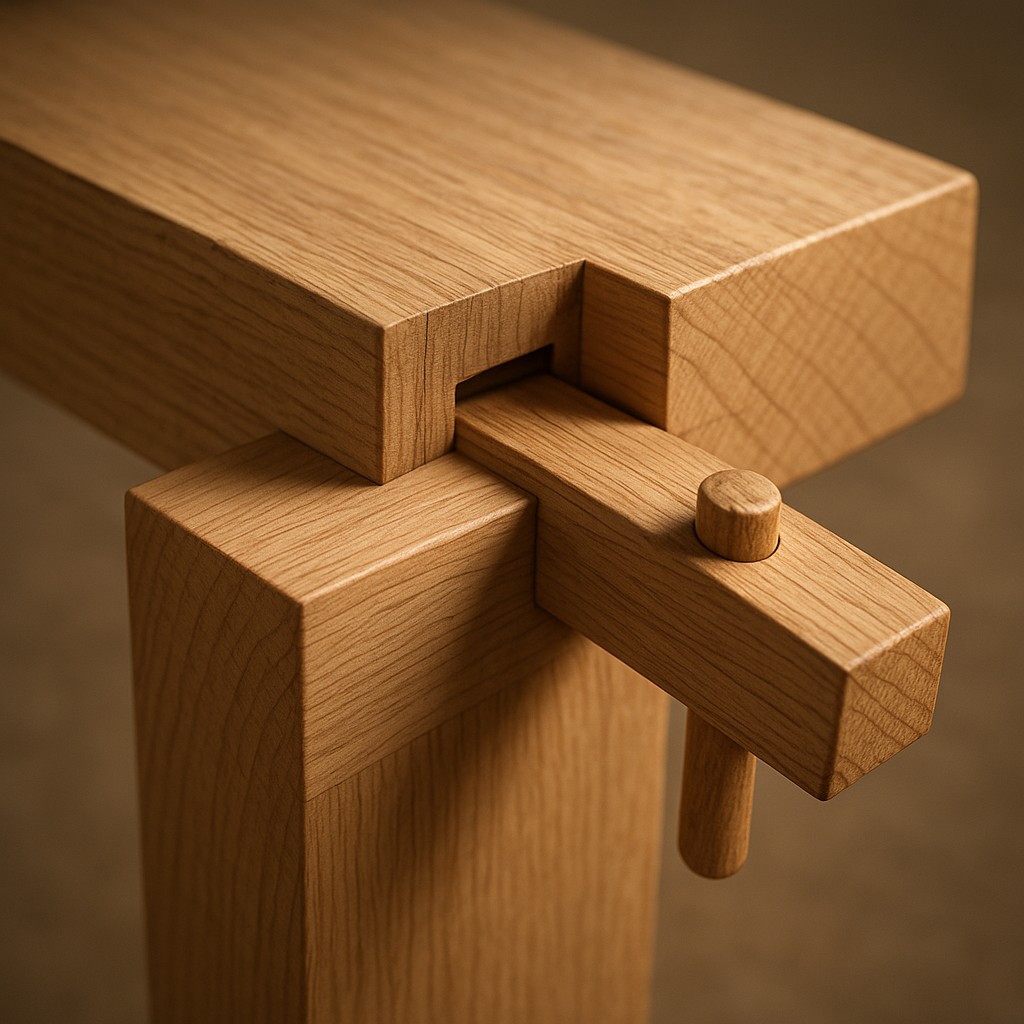
In modern construction, we are used to the smell of harsh chemical glues and the piercing whine of impact drivers forcing screws into soft pine. While these fasteners are effective for a while, they work against the natural behavior of the wood. Metal is stiff and prone to rust, while glue eventually becomes brittle and snaps as the wood swells and shrinks with the changing seasons. To build something that lasts for centuries, you cannot simply fight the wood; you have to harness its physical properties to work in your favor.
This is where the ancient, clever technique of drawboring comes in. This joinery method uses nothing but a wooden peg and smart geometry to create a joint that pulls itself tight and stays that way forever. By slightly offsetting the holes before driving the peg through, a woodworker creates a mechanical engine of tension. This force pulls the joint shut much tighter than any hand clamp could. It is a perfect example of using "elastic deformation" (the way a material bends and then snaps back) to ensure structural longevity. Even as the timber dries and shrinks over the next hundred years, the joint only grips tighter.
The Geometry of Intentional Imperfection
At the heart of a drawbored joint is the mortise and tenon, the foundation of traditional woodworking. Normally, you would slide the tenon (the tongue) into the mortise (the slot), drill a hole straight through both, and hammer in a pin to keep them from sliding apart. This is a standard pinned joint. It works fine until the wood moves. Over time, as humidity drops, the tenon might shrink. This creates a tiny gap, leading to the annoying wobble often found in old chairs or fence posts. The pin is still there, but it is no longer holding the joint’s shoulder tight against the wood's face.
Drawboring solves this by introducing a deliberate "error." The woodworker first drills a hole through the walls of the mortise. They then insert the tenon and use a sharp tool to mark the center of that hole onto the tenon's surface. After pulling the joint apart, they do not drill the second hole on that mark. Instead, they shift the hole slightly closer to the shoulder of the tenon, usually by about 1/16th to 1/8th of an inch. When the joint is put back together, the holes no longer line up. If you look through the mortise hole, the tenon hole is offset, partially blocking the path.
This misalignment is the secret. When a tapered wooden peg is hammered into the hole, it acts as a powerful wedge. As the peg is forced through the offset, it must bend or "draw" the tenon deeper into the mortise to find the exit hole on the other side. This creates immense internal tension. The shoulders of the tenon are crushed against the mortise, creating a seal so tight it can often hold water without any glue at all.
Physics of the Wooden Spring
To understand why a drawbored joint stays tight for three centuries while a glued joint might fail in thirty, look at the physics of the peg. When you drive a straight peg through misaligned holes, the peg is forced to follow a curved path. It essentially becomes a very stiff, strong wooden spring. This spring is constantly pushing back, exerting a continuous pull that keeps the joint under pressure.
In a standard glued joint, the bond is rigid. If the wood shrinks enough to break that chemical bond, the joint is dead. However, because a drawbored peg is held under mechanical tension, it can absorb the seasonal movement of the wood. If the wood expands, the peg bends a little more. If the wood shrinks, the "spring" in the peg takes up the slack. It is a living system rather than a static one. This is why medieval barns held together by oak pegs (often called "treenails") are still standing today, while the steel-reinforced concrete buildings of the 1950s are often crumbling.
The choice of material for the peg is vital. Woodworkers typically use straight-grained hardwoods like oak, locust, or hickory. These woods have high "elastic memory," meaning they always want to return to their original shape. When you force an oak peg through a 1/8th-inch offset, the peg fights to straighten out. That internal struggle is what keeps your dining table from wobbling when you lean on it. It is a beautiful way to use a material's natural resistance to create stability.
| Feature |
Standard Pinned Joint |
Drawbored Joint |
Metal Fasteners (Screws) |
| Primary force |
Resistance to sliding |
Continuous squeezing |
Tension and friction |
| Fastener material |
Matching wood |
Selected hardwood |
Steel or zinc |
| Aging process |
Loosens as wood shrinks |
Tightens or stays stable |
Rusts or strips the wood |
| Tools required |
Drill and hammer |
Drill, offset marking tool |
Impact driver or drill |
| Can it be undone? |
Easy to drill out |
Very difficult and permanent |
Easy until rusted |
The Delicate Dance of the Offset
While the concept of drawboring is simple, the execution requires a careful touch and a deep understanding of wood grain. If the offset is too small, you have just made a standard pinned joint; there will not be enough tension to pull the shoulders tight. However, if you are too aggressive, the wooden peg will act like a log splitter. Instead of bending through the hole, the peg will simply shear the end of the tenon off, or worse, split the entire piece of wood down the middle.
The "sweet spot" for an offset depends on the wood species and the thickness of the joint. In a soft wood like white pine, you can get away with a larger offset because the wood fibers are more forgiving. In a dense, brittle wood like kiln-dried white oak, an offset of a full 1/8th inch could be a recipe for disaster. Most craftsmen aim for a gap about the thickness of a penny or a nickel.
To help the peg navigate this offset without snapping, woodworkers often "point" the pegs. By carving a long, gradual taper on the end of the peg, they create a guide that slowly coaxes the tenon into position as the peg is driven home. Many also use a tool called a "drawbore pin," which is a steel rod shaped like the final wooden peg. By driving the steel pin in first, the woodworker can pre-stretch the fibers and ensure the joint will close properly before committing to the final, permanent wooden peg. It is the woodworking version of a "dry run" for a high-stakes performance.
Beyond the Glue Bottle
One of the most liberating parts of drawboring is that it frees the builder from the stress of "open time," the window before glue dries. If you have ever tried to assemble a complex piece of furniture with eight different joints that all need to be clamped at once, you know the pressure. Glue turns assembly into a race against the clock. If a clamp slips or a joint does not seat properly in the first ten minutes, the project can be ruined.
Drawboring removes this pressure. Because the mechanical force of the peg provides all the clamping pressure you need, you can assemble a project one joint at a time, at your own pace. In fact, many traditional woodworkers will drawbore a project "dry" to ensure everything fits perfectly. Once the pegs are in, they are nearly impossible to remove, making the assembly a series of deliberate wins.
Furthermore, this technique is better for the environment and the life of the piece. Modern glues are often stronger than the wood itself. This sounds like a benefit until you realize that if the wood ever breaks, it will shatter in a way that is impossible to repair. A drawbored joint is robust but natural. It allows for the wood's movement. If a repair is needed a century from now, a future craftsman can simply drill out the old wooden pegs, take the furniture apart, and replace a damaged part without fighting a chemical bond that has turned to stone.
The Ritual of the Final Blow
There is a specific sound for a successful drawbore: a solid, deep "thwack" that changes pitch as the peg seats and the joint closes the final hair’s breadth of space. It is one of the most satisfying moments in the craft. As the peg emerges from the far side, often slightly curved from its journey through the offset, you can watch the gap between the two pieces of wood simply vanish.
This technique represents a philosophy of building that looks toward the distant future. It assumes that the object is meant to outlive the person who made it. In a world of "flat-pack" furniture designed to be thrown away after two moves, drawboring is a quiet rebellion. It stands for the idea that we can create things that get better with age, things that tighten their own grip as the years pass, and things that rely on the beauty of geometry rather than the convenience of chemicals.
When you master the drawbore, you aren't just joining two pieces of wood. You are creating a living system of tension. You are acknowledging that the wood is still "alive" in a sense, moving and breathing with the air around it, and you are giving it a way to stay strong despite that movement. It is a reminder that sometimes, the best way to make something last is to build in a little bit of flexibility and a healthy dose of intentional friction. Now, go find a scrap of oak and a drill; the satisfaction of that self-tightening "thwack" is waiting for you.